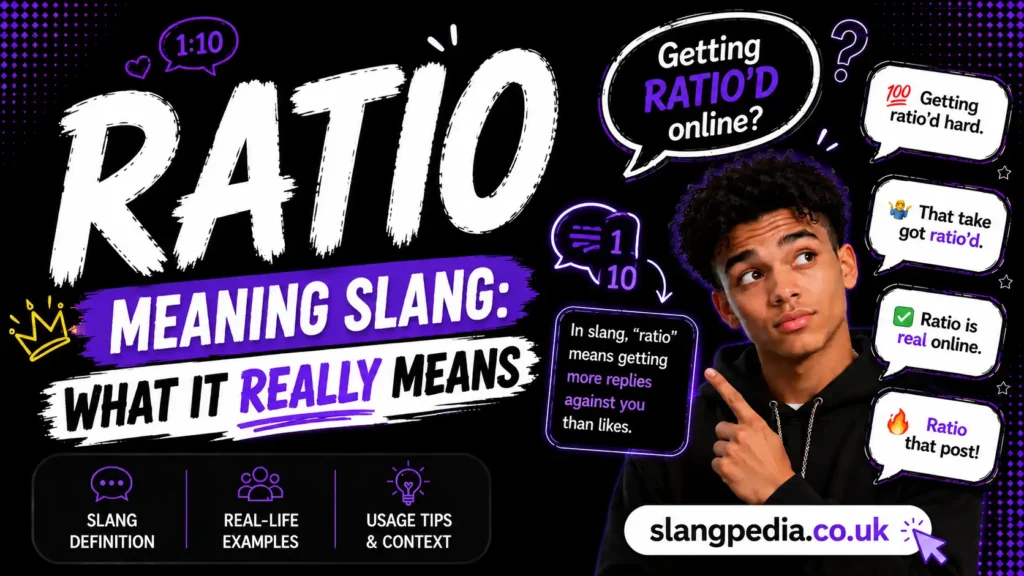
“Ratio” means to publicly embarrass or disagree with someone online by posting a reply that gets way more engagement—you’ll see it most on TikTok and Twitter when someone calls out another user’s bad take or claps back harder.
TL;DR
- Ratio = replying to someone with a more popular post that makes them look bad or wrong
- Tone: confrontational, humorous, sometimes harsh
- Origin: Twitter circa 2019–2020, became TikTok standard by 2024
- Who uses it: Gen Z, online creators, Twitter/TikTok natives
- ⚠️ Warning: Can feel like public humiliation; use sparingly with people you actually know
What Does Ratio Mean in Slang?
You’re scrolling through TikTok and see someone’s comment that’s absolutely unhinged. Someone replies with a single video: them nodding, completely unfazed. That video gets 50K likes. The original comment gets 200. That’s a ratio.
Ratio is when your reply to someone gets exponentially more engagement than their original post. It signals that the internet collectively disagreed with them, embarrassed them, or found your comeback funnier. The math doesn’t lie—more likes, more retweets, more laughs. You just got ratio’d.
But it’s deeper than just engagement metrics. When someone says “you got ratio’d,” they mean you got publicly called out in a way everyone saw. It’s not a private clap-back. It’s a public L, broadcast to thousands. The tone ranges from playful (friends joking in a group chat) to genuinely vicious (quote-tweeting someone’s controversial take). Context matters hard here.
The word also functions as a verb: “ratio them” means intentionally post a reply designed to outperform the original. Some people do this for clout. Others do it to pile on. Either way, once you say someone got ratioed, the damage is done—at least in the eyes of the internet.
Similar slang like tweaking describes a different kind of public behavior, but both involve some form of social exposure.
Ratio = A reply that gets way more engagement than the original post, making the original poster look bad.
Where Did the Slang “Ratio” Come From?
Ratio exploded on Twitter around 2019–2020 during the peak of political ratio culture. Twitter users would quote-tweet politicians, celebrities, or just anyone with a bad take, and their reply would immediately dwarf the original engagement. The term “ratio’d” became shorthand for this public takedown.
The word itself isn’t new—”ratio” has been used in math and business for ages. But online, it took on this specific, brutal meaning: your post lost the numbers game.
Why It Spread So Fast
TikTok amplified it massively by 2023–2024. TikTok doesn’t show quote-tweets the way Twitter does, but creators use “ratio” in comments, captions, and voiceovers to mean the same thing: you got shown up. The platform’s algorithm made engagement warfare visible and addictive to watch. Every creator suddenly understood what “ratio” meant because the engagement counts were literally on screen.
Timeline:
| Year | Event |
|---|---|
| 2019 | Twitter users start using “ratio” to describe quote-tweets that outperform original posts |
| 2021 | Term spreads to TikTok; becomes slang for public embarrassment |
| 2024 | Mainstream Gen Z slang; used casually in texts and Discord |
What Does Ratio Mean in Text?

In texts and DMs, “ratio” usually shows up in group chats where someone said something controversial or just dumb. It’s shorthand for “you just got embarrassed in front of everyone.”
In private chats, it’s often softer—friends joking around. In group chats, it hits different. It signals that multiple people saw the same bad take and you’re now the target.
Common emoji pairings: 💀 (you’re dead/embarrassed), 😭 (laughing at you), or no emoji at all—just the word, cold and brutal.
Sample text exchange:
Jess: french fries are better than pizza
Marcus: ratio
Jess: WAIT NO
Marcus: too late bestie 💀
That’s a ratio—Marcus’s one-word clap-back got the cultural vote.
You might also see mo used similarly to describe someone getting shut down, though ratio has more crowd-power embedded in it.
Common Text Scenarios with Ratio:
| Situation | How It’s Used | Example |
|---|---|---|
| Friend says something dumb | Playful group roast | “did she really say that??? ratio fr fr” |
| Someone defends a bad opinion | Direct call-out | “ratio. next question.” |
| Defending yourself after getting ratio’d | Self-deprecating humor | “nah i’m taking the L, ratio me i deserve it” |
What Does Ratio Mean on TikTok?
On TikTok, ratio appears in comment sections when creators are beefing. It also shows up in captions and voiceovers during response videos.
The TikTok meaning stays basically the same as Twitter: you got out-performed. But TikTok’s format makes it feel more visual. Instead of just engagement numbers, you can literally see the creator’s face in a response video. The “ratio” becomes a whole video format—the original creator gets clipped, then someone posts their reaction, and that reaction video gets more views.
Ratio is equally popular on US and UK TikTok, though the tone shifts slightly. UK creators tend to make it more humorous and less mean. American TikTok leans harder into the pile-on energy.
The word shows up most in: comment sections under controversial posts, response video captions, and voiceovers during callout content.
Is the meaning different from texting? Not really. It’s the same public embarrassment energy. But TikTok makes it more cinematic.
Ratio in Real Conversations: 5 Examples
Example 1 — Playful friend group
Tyler: coffee tastes like burnt water change my mind
Ashley: ratio 💀
Tyler: ASHLEY NO
Tyler just got hit with the internet’s collective judgment. Ashley’s one-word response signals that everyone disagrees with him.
Example 2 — Sincere call-out
Cody: just realized i’ve been wrong about this the whole time
Jess: ratio (sorry king but yeah u were)
Jess isn’t being cruel here. She’s confirming Cody took an L, but warmly. The tone softens because Cody already admitted he was wrong.
Example 3 — Sarcastic pile-on
Marcus: pineapple belongs on pizza and if you disagree you’re a coward
Everyone: ratio ratio ratio ratio
The group chat turned into a ratio fest. Marcus said something objectively unhinged, and now he’s facing a ratio barrage.
Example 4 — Casual Discord chat
User1: anime is mid
User2: bro you just ratio’d yourself before anyone else could
User1: 😭😭😭
User2 points out that User1’s statement was so bad it pre-emptively ratio’d them. Self-aware and funny.
Example 5 — Political/serious ratio
Creator: [posts hot take about social issue]
Response creator: [makes video calmly explaining why that’s wrong]
Viewers: ratio ratio ratio under original post
This is the brutal version. It’s not friends joking. It’s a genuine ideological clash where the internet decides one person won.
Ratio vs. Similar Slang
| Word | Core Meaning | Tone | Best Used When |
|---|---|---|---|
| Ratio | Reply gets more engagement than original post | Confrontational, humorous, harsh | Someone posts a bad take publicly |
| Clown | Someone embarrasses themselves | Mocking, comedic | Someone does something obviously stupid |
| Taking an L | Losing, admitting defeat | Casual, self-aware | After you’ve been proven wrong or failed |
| Getting read | Someone critiques you harshly | Sharp, witty, personal | Someone calls you out directly for hypocrisy |
The key difference: Ratio is about public numbers and engagement winning. When you say someone “took an L,” you’re just acknowledging they lost—but a ratio is specifically when the internet shows they lost through sheer engagement. A ratio is witnessed. An L can be private.
People confuse ratio with just “roasting someone,” but a roast is the method. A ratio is the result.
The Emotional Vibe Behind “Ratio”
Why does ratio even exist? Because the internet needed a word for that moment when the crowd turns against you in real-time.
Online spaces run on engagement. Likes, retweets, video views—they’re currency. Before ratio existed, people felt humiliated online but had no name for it. Then Twitter quantified it: your post lost the numbers game. It’s brutal and funny at the same time.
Ratio spread fast because it captures something real about digital life: you’re never posting alone. There’s always an audience. And audiences have opinions. When someone gets ratioed, it means they didn’t just lose an argument—they lost the room.
The word also signals tone-deafness. Someone who gets ratioed didn’t read the room. They posted something the internet collectively rejected. It’s partially about the idea being bad, but mostly about missing the cultural moment.
When you use ratio, you’re saying: “I’m part of the crowd that saw through this.” It’s tribal. It’s proof you understand the vibe. That’s partly why it spread so fast among Gen Z—we’re always reading the room, always aware of the collective judgment. Ratio just gave us the scoreboard.
Similar dynamics show up in how people use mo to describe someone fumbling socially, but ratio is specifically about the public loss of face.
The speaker using “ratio” is implying: I’m sharp enough to see the bad take. The person being ratioed is seen as: out of touch, wrong, or not funny.
Is “Ratio” Offensive?
No, ratio is not offensive on its own. It’s not a slur. It doesn’t target protected groups.
But it can be used offensively depending on context. If you’re ratio-ing someone to genuinely pile on and humiliate them, that’s bullying energy. If you’re ratio-ing as a joke among friends, it’s playful. The word itself is neutral; the use determines the harm.
Is it safe to use in the USA and UK? Yes, in both countries. It’s Gen Z standard slang in both places. You won’t offend someone just by using the word.
Context shifts the sting: Ratio-ing a celebrity who posted a genuinely bad take? Fair game. Ratio-ing your friend for a mild joke? Still playful if you’re close. Ratio-ing someone repeatedly to make them feel excluded? That’s bullying, and the word choice doesn’t matter—the behavior does.
Who should avoid it? Anyone in a professional or formal setting. Teachers shouldn’t ratio students. Employers shouldn’t ratio employees. It signals mockery, and authority figures shouldn’t mock people they hold power over.
Formal alternative for professional writing: “Disagree publicly” or “receive more engagement in disagreement” or just say what you mean: “The post received significant backlash.”
📌 Quick note for parents and teachers: “Ratio” means your engagement on social media got beat by a reply—basically getting called out publicly and the internet saw it. It’s not inherently harmful, but it can feel like bullying if used to pile on someone repeatedly. Kids use it casually in group chats and TikTok comments; context matters for whether it’s mean-spirited.
Ratio Slang — FAQ
Q: What does ratio mean on TikTok?
A: On TikTok, ratio means a reply or response video gets way more engagement than the original post, essentially proving the original poster wrong or embarrassing them publicly. It shows up in comments and captions during callout videos.
Q: Is ratio a bad word?
A: Ratio itself isn’t a bad word—it’s not a slur or inherently offensive. But it can be used cruelly if you’re pile-on bullying someone. The word is neutral; intent matters.
Q: What’s the difference between ratio and taking an L?
A: “Ratio” specifically means your reply beat the original post’s engagement numbers publicly. “Taking an L” just means losing or being wrong—it doesn’t require the internet to witness it. A ratio is a spectator sport.
Q: Do Americans and British people use ratio the same way?
A: Mostly yes. Both use it on TikTok and Twitter identically. British creators sometimes make it more humorous and less vicious, but the core meaning stays the same.
Q: Can you accidentally ratio yourself?
A: Totally. If you post something so bad that someone’s reply immediately gets more engagement—before anyone even tries to pile on—you ratio’d yourself. It’s the worst.
The Bottom Line
Ratio is the internet’s way of quantifying public shame—or public victory, depending on whose side you’re on. It’s about engagement warfare and reading the room. When someone gets ratioed, the numbers decided who was right.
The word exists because online spaces run on visibility and metrics. A ratio makes that invisible judgment visible. It’s brutal, sometimes funny, and definitely a core part of how Gen Z communicates online.
Next time you see someone get ratioed, you know exactly what happened: the internet picked a side, and it wasn’t theirs.
Have you seen ratio used in a way that surprised you? Drop it in the comments.
Last verified: June 2026 | Based on TikTok, Twitter, and Discord usage across US and UK Gen Z communities.

Maggie Wiersma is a USA-based writer with 2 years of experience covering slang meanings, internet culture, and modern language trends. With a background in communication studies, she creates simple and engaging content that helps readers understand today’s most popular slang terms.