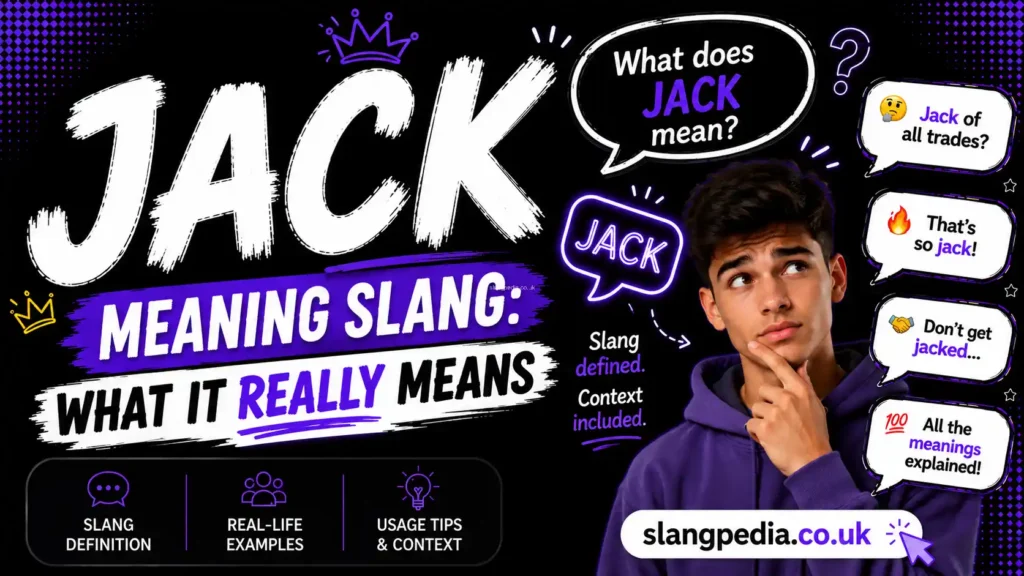
“Jack” means to take, steal, or copy something without asking — you’ll see it most on TikTok and in group chats when someone calls out a stolen outfit, joke, or idea.
TL;DR
- “Jack” means to steal, take, or copy something, often playfully.
- The tone ranges from lighthearted teasing to real accusation, depending on context.
- It comes from AAVE and hip-hop slang, later spread through gaming culture.
- Teens and young adults use it most, especially on TikTok and Discord.
- Warning: in some contexts it can still mean actual theft, not a joke.
What Does Jack Mean in Slang?
Picture a group chat after someone posts a fit pic. Ashley drops a photo in the same jacket Jess wore last week. Someone types “she jacked your whole fit” before Jess can even respond.
That’s “jack” in action. At its core, it means to take, steal, or copy something, usually without permission. The nuance matters here. It rarely means armed robbery.
Most of the time, “jack” signals a lighter kind of theft: stealing a joke, an outfit, a nickname, or someone’s exact wording in a caption. The tone can shift from playful to petty fast, depending on who says it and why.
Jack = to take, steal, or copy something, often without asking
This meaning sits close to another popular term, tuff meaning slang, which shows up in the same group-chat energy but signals approval instead of theft. Both words carry weight through tone, not just definition.
Where Did the Slang “Jack” Come From?
The exact origin is unclear, but “jack” spread mainly through African American Vernacular English (AAVE) and hip-hop culture. The term carried a “steal” or “take” meaning well before the internet existed.
Gaming culture pushed it further into the mainstream. Grand Theft Auto players used “jack a car” constantly in the 2000s, cementing the verb in everyday slang for millions of young players.
Why Is “Jack” Spelled Different Ways?
You’ll mostly see three forms: “jack,” “jacked,” and “jackin’.” “Jack” is the base verb, used for the action itself, like “don’t jack my idea.”
“Jacked” describes something already stolen, or a person who looks extremely muscular — a separate, unrelated meaning that causes confusion. “Jackin'” is the casual, dropped-g spelling used in captions and comments for a looser, more conversational tone.
Timeline:
- 1990s: “Jack” spreads through hip-hop lyrics and AAVE as slang for stealing or taking.
- 2000s: Gaming culture, especially GTA, pushes “jacking a car” into mainstream teen vocabulary.
- 2020s: TikTok and group chats revive “jack” for softer theft — outfits, jokes, and content ideas.
What Does Jack Mean in Text?
In texts and DMs, “jack” usually stays playful rather than accusatory. Between close friends, it often reads as a compliment disguised as an accusation — proof someone’s style is worth copying.
In group chats, it can turn into a running bit. Someone gets called out repeatedly for “jacking” the same joke or outfit choice.
Common emojis paired with it include 👀, 💀, and 😭, signaling the callout is teasing, not serious.
Text exchange:
Tyler: bro why does your caption sound exactly like mine 👀
Marcus: nah I didn’t jack it, great minds think alike
Tyler: sure jack 😭 word for word tho
Marcus: fine I jacked it a little
This term links closely to slime meaning slang, which also shows up constantly in the same casual texting exchanges between close friends.
| Phrase | Meaning | Common Use |
|---|---|---|
| Jack a fit | Copy someone’s outfit exactly | TikTok comments, group chats |
| Jack a joke | Steal a punchline or bit | Twitter/X replies, Discord |
| Jack the wifi | Use someone’s internet without asking | Roommate or family texts |
What Does Jack Mean on TikTok?
On TikTok, “jack” shows up mostly in comments and captions calling out copied trends, outfits, or dance moves. Creators use it to accuse someone of reposting an idea without credit.
It appears heavily on fashion, comedy, and dance-trend content, where originality gets tracked closely by followers.
The meaning stays close to texting use, just louder and more public. It’s roughly equal across US and UK TikTok, though UK users pair it more with dry sarcasm.
Jack in Real Conversations: 5 Examples
Example 1 — Copied outfit callout
Ashley: wait that’s literally my exact fit from Tuesday
Jess: I did NOT jack your outfit lol
She signals mock outrage over a playful accusation.
Example 2 — Gaming chat
Cody: yo someone jacked my car in the lobby
Marcus: skill issue tbh
He describes an actual in-game theft, no deeper meaning attached.
Example 3 — Sincere compliment in disguise
Jess: not gonna lie I jacked your study method
Tyler: honestly it works, use it
She admits copying something because it genuinely helped her.
Example 4 — Sarcastic group chat energy
Ashley: Cody jacked my joke AGAIN
Cody: I’ve never heard that joke in my life 🙄
He denies it sarcastically, knowing everyone saw the receipts.
Example 5 — Casual, low-stakes teasing
Marcus: bro jacked my whole personality this week
Tyler: I’m just built different, not my fault
He deflects a lighthearted accusation with confidence, not defensiveness.
Jack vs. Similar Slang
| Word | Core Meaning | Tone | Best Used When |
|---|---|---|---|
| Jack | Take or copy without asking | Playful to petty | Calling out a copied fit, joke, or idea |
| Snag | Grab something quickly | Neutral, casual | Getting something before it runs out |
| Yoink | Take something suddenly, often for fun | Silly, lighthearted | Grabbing food or an item mid-joke |
| Cop | Buy or obtain something desired | Neutral to excited | Talking about a purchase or pickup |
The biggest mix-up happens between “jack” and “cop.” “Cop” almost always involves buying something, while “jack” implies taking it without paying or asking. People confuse them when talking about limited sneakers or drops.
The Emotional Vibe Behind “Jack”
“Jack” exists because credit matters more than ever online. Every outfit, joke, and caption feels traceable now, so calling someone out for copying carries real social weight.
It spread fast because it’s short, sharp, and easy to type mid-argument or mid-joke. One word does the job of a whole sentence.
Using “jack” signals the speaker noticed something specific enough to call it out. It shows attention, not just annoyance.
For the person being described, it can sting a little, even as a joke. Nobody loves being told their original idea, similar to how slime meaning slang gets used for closeness, wasn’t actually theirs first.
Is “Jack” Offensive?
No, “jack” is not a slur and doesn’t target any specific group. It carries no inherent offense in everyday slang use.
Context does shift its weight slightly. Said sarcastically among friends, it’s harmless teasing. Used to accuse a stranger of real theft, it can sound genuinely hostile.
It’s safe to use casually in both the USA and UK without causing offense. Formal writing should swap it for “took,” “copied,” or “borrowed without permission.”
📌 Quick note for parents and teachers: “Jack” typically means taking or copying something, often as a joke. It isn’t harmful language on its own. It mostly appears in casual texting, gaming chats, and TikTok comments about outfits or content.
Jack Slang — FAQ
Q: What does jack mean on TikTok? A: On TikTok, “jack” means copying someone’s outfit, trend, or joke without credit. It shows up mostly in comments calling out repeated content.
Q: Is jack a bad word? A: No, it’s not offensive or a slur. It’s casual slang for taking or copying something, usually said in a teasing tone.
Q: What’s the difference between jack and cop? A: “Jack” means taking something without paying or asking. “Cop” means buying or obtaining something you actually want.
Q: Do Americans and British people use jack the same way? A: Mostly yes, though UK speakers lean more sarcastic with it. British slang also uses “jack it in” separately, meaning to quit something entirely.
Q: Why do people confuse jack with jacked? A: “Jacked” usually describes someone muscular or something already stolen, not the action itself. The base word “jack” is the verb people use to call out copying in real time.
The Bottom Line
“Jack” works as internet shorthand for credit and originality. It calls out copying fast, without needing a whole explanation.
Knowing the difference between playful and serious use helps you read the room correctly. Context, tone, and who’s talking always decide the real meaning.
Have you seen “jack” used in a way that surprised you? Drop it in the comments.
This article is reviewed periodically for accuracy and updated to reflect current slang usage across US and UK platforms.

Maggie Wiersma is a USA-based writer with 2 years of experience covering slang meanings, internet culture, and modern language trends. With a background in communication studies, she creates simple and engaging content that helps readers understand today’s most popular slang terms.