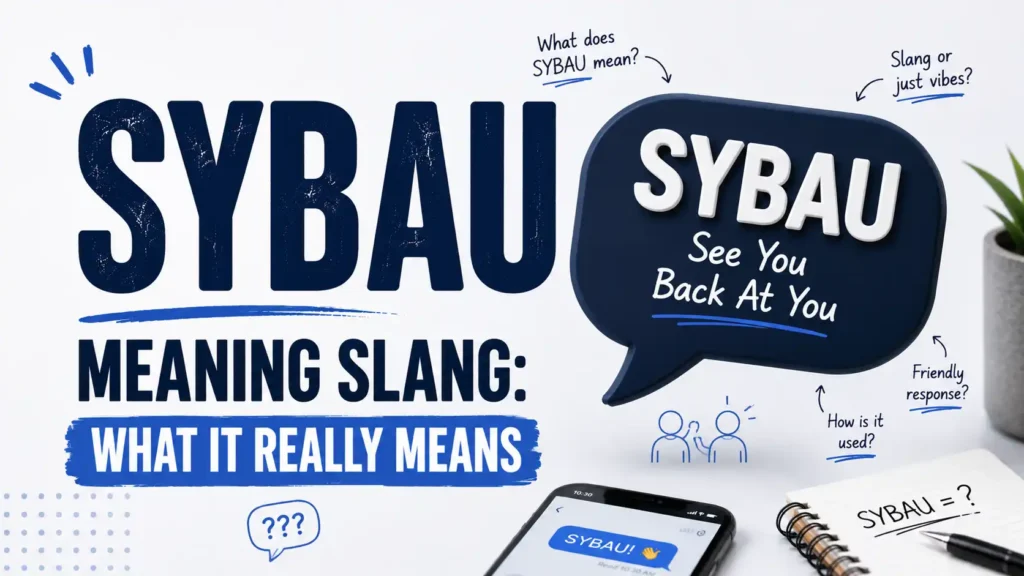
“SYBAU” means “Shut Your Bitch Ass Up” — you’ll see it most on TikTok and Discord when someone wants to dismiss a bad take, shut down an argument, or playfully roast a friend.
TL;DR
- Definition: SYBAU = “Shut Your Bitch Ass Up” — a blunt, dismissive acronym
- Tone: Can be humorous and playful between friends, or genuinely aggressive toward strangers
- Origin: First documented on Urban Dictionary in 2003; rooted in AAVE and Black internet culture
- Who uses it: Primarily Gen Z on TikTok, Discord, iMessage, and X (formerly Twitter)
- Usage warning: It’s vulgar — never use it in formal settings or with people you don’t know well
What Does SYBAU Mean in Slang?
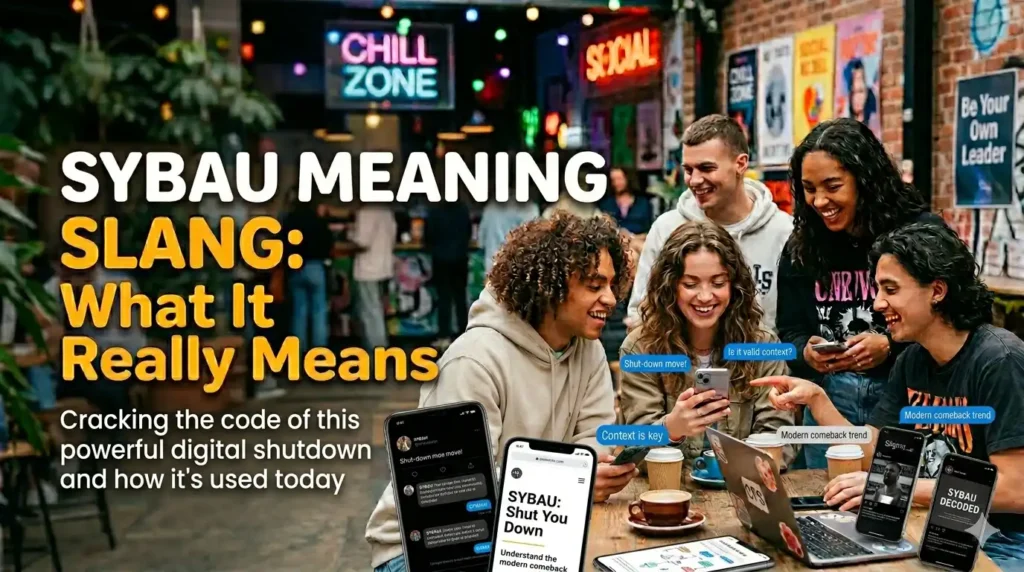
You’re scrolling TikTok at midnight. Someone drops the most unhinged take in the comments — “pineapple pizza is objectively better than pepperoni.” And right there, under 847 likes, someone just typed: SYBAU 💀.
That’s SYBAU in its natural habitat.
At its core, the SYBAU slang meaning is a sharper, more theatrical version of “shut up.” It doesn’t just tell someone to stop talking. It signals that what they said was so wrong, so embarrassing, or so annoying that a simple “be quiet” wouldn’t cut it.
SYBAU = “Shut Your Bitch Ass Up” — a dismissive acronym used to reject someone’s words or opinion entirely.
The tone is the whole point. SYBAU carries a specific energy — half frustration, half comedy. Between close friends, it reads as a roast. Between strangers, it hits harder and can feel genuinely hostile. Context is everything.
It slots naturally alongside terms like OP — both are used to shut something down quickly in a comment thread or group chat.
Where Did the Slang “SYBAU” Come From?
SYBAU has roots that go back over 20 years — long before TikTok, Instagram, or most of its current users were born.
The earliest known use of the acronym is a definition by Urban Dictionary user gh0ti a.k.a. markie, made on November 19th, 2003. From there, the term circulated through early internet forums, chat rooms, and message boards — mostly during heated online arguments.
Its roots trace back to African American Vernacular English (AAVE) and the broader Black online community. This cultural origin is crucial context that often gets lost when slang goes mainstream.
The term slipped in and out of visibility for years. Then TikTok’s algorithm changed everything. It became increasingly popularized in the 2020s on sites like TikTok as a way of telling someone to shut up, particularly seeing virality in late 2024 and early 2025.
The 2024–2025 viral spike wasn’t random. Several TikTok creators with large followings began using SYBAU in videos that received millions of views. Because TikTok’s algorithm is interest-based, these videos reached audiences far beyond existing fanbases.
In mid-2025, the SYBAU Picture / SYBAU Guy reaction image became a prominent meme, featuring rapper Lazer Dim 700, and spread across TikTok, X, and Instagram.
Why Is “SYBAU” Spelled Different Ways?
You’ll sometimes see it written as SYAU, dropping the “B.” This is usually a typo or an attempt to soften the acronym slightly. Some users drop the full phrase down to just “sybau” in lowercase to make it feel more casual and less aggressive.

The lowercase version is common in iMessage and Discord, where the all-caps version can feel like shouting. Either spelling carries the same meaning — the casing just signals tone.
Timeline:
- 2003: First defined on Urban Dictionary, used in early internet chat rooms and online arguments
- 2020–2023: Circulated in gaming Discord servers and Black Twitter/X as a quick shutdown phrase
- 2024–2025: Exploded on TikTok; the SYBAU Guy meme pushed it into mainstream Gen Z vocabulary
What Does SYBAU Mean in Text?
In private DMs, SYBAU is almost always playful. You send it to your best friend when they text you something ridiculous at 2am. Nobody’s actually mad — it’s a roast wrapped in five letters.
In group chats, the tone shifts slightly. Dropping a SYBAU in a 12-person group chat means everyone sees it, so the stakes feel higher. It’s funnier but also riskier if the target doesn’t get the joke.
Common emojis that pair with SYBAU: 💀🥀💔😭. The skull emoji softens it into comedy. The dead rose (🥀) and broken heart (💔) are tied to JuggTok aesthetics and add a dramatic flair.
Real text exchange:
Tyler: bro I lowkey think the sun is the closest star to earth Marcus: …SYBAU 💀 Tyler: wait am I wrong?? Marcus: yes you are extremely wrong please delete this
Here, SYBAU signals playful disbelief. Marcus isn’t actually angry — he’s performatively horrified, which is very on-brand for the term.
You might also see it used like rabe — a quick, punchy rejection of what someone just said.
| Phrase | Meaning | Vibe |
|---|---|---|
| SYBAU 💀 | You said something stupid, I’m done | Playful roast |
| SYBAU fr | I actually need you to stop talking | Semi-serious |
| SYBAU bestie | Affectionate shutdown between close friends | Funny, no malice |
What Does SYBAU Mean on TikTok?
On TikTok, SYBAU lives in comment sections and video captions — almost never in voiceovers. It’s a reaction tool.
Creators drop it under videos featuring opinions they find absurd. It appears in stitches and duets where someone responds to a hot take with text overlay reading “SYBAU 💀.” SYBAU is often used in TS PMO ICL videos — a TikTok subgenre built around venting frustration and relatable annoyance.
The TikTok meaning matches the texting meaning — it doesn’t shift platforms. What changes is the scale. A SYBAU in a TikTok comment can rack up thousands of likes, turning a five-letter acronym into its own mini-punchline.
It’s popular on both US and UK TikTok, though it skews slightly more American in origin and usage density. UK users have adopted it fully, often mixing it with roadman-adjacent humor.
SYBAU in Real Conversations: 5 Examples
Example 1 — Hot take disaster
Jess: unpopular opinion: Breaking Bad is mid Tyler: SYBAU Jess I will not be reading the rest of this text
SYBAU signals pure disbelief — Tyler isn’t entertaining the argument for even a second.
Example 2 — Group chat chaos
Ashley: guys I think we should skip the concert and just watch a livestream Marcus: SYBAU we bought tickets three months ago Cody: SYBAU x2
The double-down from Cody shows how SYBAU works as a group response — it compounds and gets funnier each time.
Example 3 — Sarcastic compliment fishing
Cody: I feel like I give better advice than most therapists honestly Jess: SYBAU 😭
Here SYBAU is dripping with sarcasm — Jess is calling out the ego in one word without writing a whole paragraph.
Example 4 — Sincere frustration
Marcus: did you really eat my leftovers again Tyler: they were just sitting there Marcus: SYBAU Tyler I labeled them
No emojis. No skull. When SYBAU drops without comedy signifiers, it means someone is actually annoyed. The tone is unmistakable.
Example 5 — TikTok comment energy
[Under a video of someone saying they prefer ketchup on scrambled eggs] Ashley: SYBAU 💀🥀
Classic comment-section SYBAU — short, dismissive, maximally dramatic.
SYBAU vs. Similar Slang
| Word | Core Meaning | Tone | Best Used When |
|---|---|---|---|
| SYBAU | “Shut your bitch ass up” | Aggressive-funny or genuinely hostile | Reacting to a bad take, roasting a friend |
| STFU | “Shut the f*ck up” | Direct, blunt | General frustration or shutdown |
| ISTG | “I swear to God” | Exasperated | Warning someone before escalating |
| IKYFL | “I know you f*cking lying” | Disbelieving, shocked | Calling out something unbelievable |
The biggest confusion is between SYBAU and STFU. Both mean “shut up,” but SYBAU carries more theatrical weight. STFU is quick and clean. SYBAU is a performance — it implies the person said something so embarrassing that a basic “shut up” wouldn’t cover it. If STFU is a door closing, SYBAU is a door slamming, spinning around, and refusing to open again.
The Emotional Vibe Behind “SYBAU”
SYBAU exists because sometimes “shut up” isn’t satisfying enough.
There’s a specific kind of online frustration — the feeling of reading a take so bad, so confidently wrong, that you need a word that matches the level of disbelief. STFU is blunt. SYBAU is theatrical. It performs the emotion as much as it expresses it.
That performance is why it spread so fast. TikTok rewards exaggerated reactions. A word that signals “I am DONE with what you just said” fits the platform’s energy perfectly.
When someone uses SYBAU, they’re signaling social awareness — they know what’s acceptable, and that thing you just said isn’t it. It’s a cultural gate-keeping move dressed up in comedy.
And when it’s aimed at you? It doesn’t always sting. Between friends, being hit with a SYBAU means your take landed hard enough to get a reaction. That’s internet currency.
It belongs to the same emotional family as ohio — both are ways of labeling something as categorically unacceptable, using humor as the delivery mechanism.
The word fills a gap that polite language can’t. Online culture needs fast, expressive, slightly unhinged dismissals. SYBAU delivers all three.
Is “SYBAU” Offensive?
Yes — SYBAU is a vulgar acronym, and it can be offensive depending entirely on context.
It is not a slur. It doesn’t target any specific group based on race, gender, or identity. But it does contain strong profanity (“bitch ass”), which makes it inappropriate in most professional, academic, or mixed-age settings.
Between friends who regularly use this kind of language, SYBAU reads as banter. Between strangers — especially online — it can land as genuinely hostile and aggressive.
In the USA, it’s widely understood and largely used without serious offense in informal digital spaces. In the UK, it’s equally recognized, though UK users tend to mix it with softer humor.
Who should avoid it: Anyone in a professional role, formal setting, or communicating with people who might not know it’s meant as a joke.
Formal English alternative: “I disagree strongly” / “Please stop” / “That’s not something I can engage with.”
📌 Quick note for parents and teachers: SYBAU stands for “Shut Your Bitch Ass Up.” It’s vulgar but not a slur. Teens use it mostly as a humorous reaction to things they find absurd or annoying online. It appears most on TikTok, Discord, and group chats — almost always as banter rather than genuine aggression.
SYBAU Slang — FAQ
Q: What does SYBAU mean on TikTok?
A: On TikTok, SYBAU means “Shut Your Bitch Ass Up.” It’s used in comment sections and captions to react to opinions, trends, or videos that someone finds absurd or annoying. It’s almost always humorous in tone on TikTok, often paired with 💀 or 🥀.
Q: Is SYBAU a bad word?
A: It’s vulgar, but it’s not a slur. SYBAU contains strong language (“bitch ass”), which makes it inappropriate in formal or professional settings. Among friends who use this kind of language, it’s typically playful rather than genuinely offensive.
Q: What’s the difference between SYBAU and STFU?
A: Both mean “shut up,” but the weight is different. STFU is blunt and direct. SYBAU is more dramatic and theatrical — it implies the person said something so wrong or embarrassing that a basic “shut up” wasn’t enough. SYBAU is the louder, more expressive version.
Q: Do Americans and British people use SYBAU the same way?
A: Mostly yes. Both US and UK users deploy it as a humorous shutdown on TikTok and in group chats. The origin is American (rooted in AAVE), and US usage is denser, but UK Gen Z users have fully adopted it — sometimes blending it with British slang for extra comedic effect.
The Bottom Line
SYBAU is more than a vulgar acronym. It’s a cultural shortcut — a word that communicates disbelief, dismissal, and humor all at once, in five letters. It’s been around since 2003, but TikTok gave it its biggest stage yet. Now it lives in comment sections, group chats, and meme reactions across the internet.
Understanding SYBAU means understanding the tone behind it. When you see it, someone isn’t just saying “be quiet.” They’re saying what you just did or said was categorically unacceptable — and they want everyone to know it.
Have you seen SYBAU used in a way that surprised you? Drop it in the comments.
Article reviewed for cultural accuracy. US and UK slang usage verified against native speaker examples and platform data. Last updated: 2026.

Maggie Wiersma is a USA-based writer with 2 years of experience covering slang meanings, internet culture, and modern language trends. With a background in communication studies, she creates simple and engaging content that helps readers understand today’s most popular slang terms.