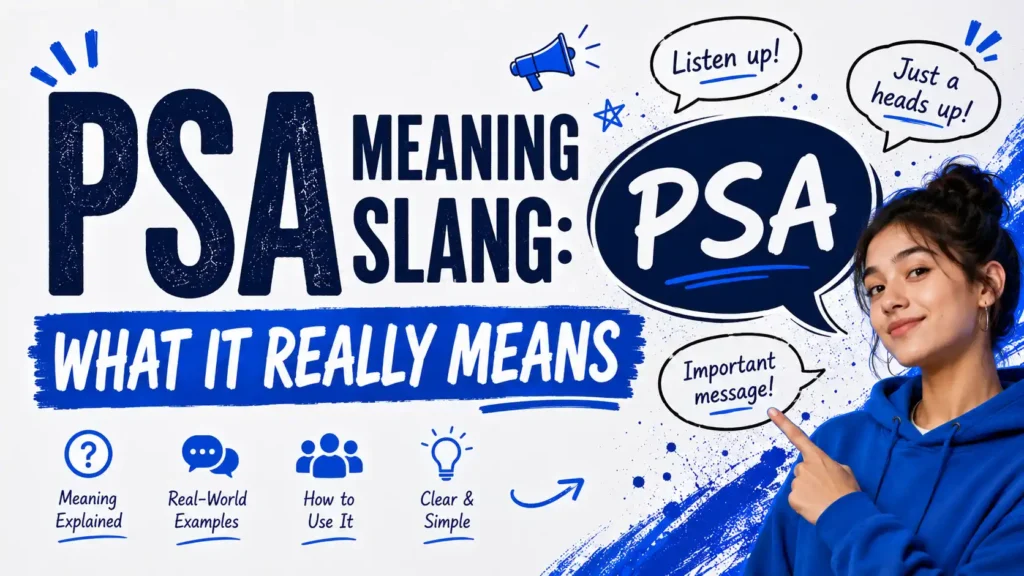
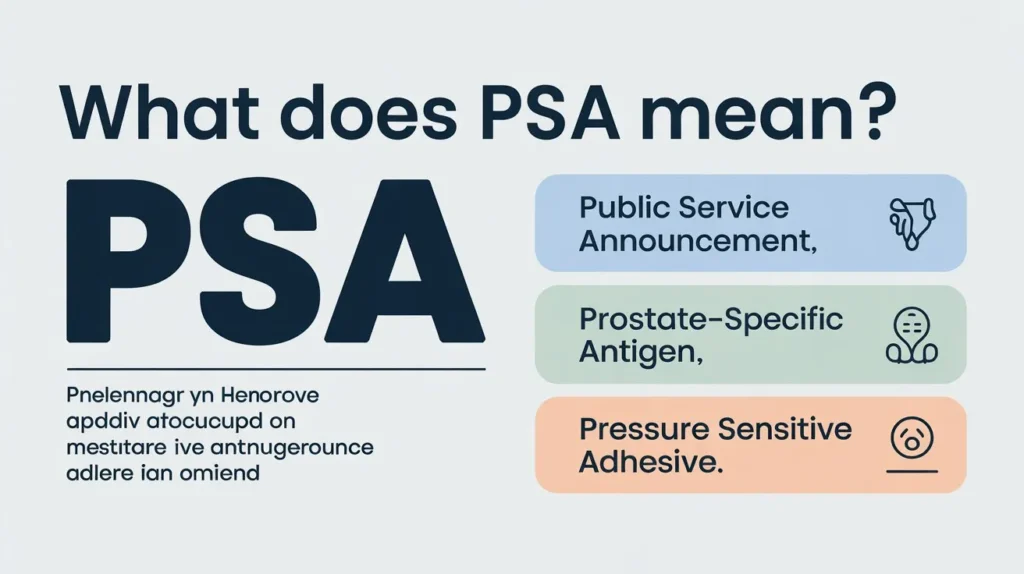
“PSA” means public service announcement — used ironically or sincerely to flag something important — you’ll see it most on TikTok and Twitter/X when someone wants to call out behavior, share a warning, or drop an opinion as if it’s official news.
TL;DR
- PSA stands for “public service announcement” — borrowed from formal broadcast language and used casually online.
- The tone can be funny, sarcastic, sincere, or genuinely urgent depending on context.
- It originated in broadcast media but spread through social platforms around 2015–2018.
- Used by teens and young adults across TikTok, Twitter/X, Instagram, and Discord.
- Warning: Using it too often for minor things can come across as dramatic or attention-seeking.
What Does PSA Mean in Slang?
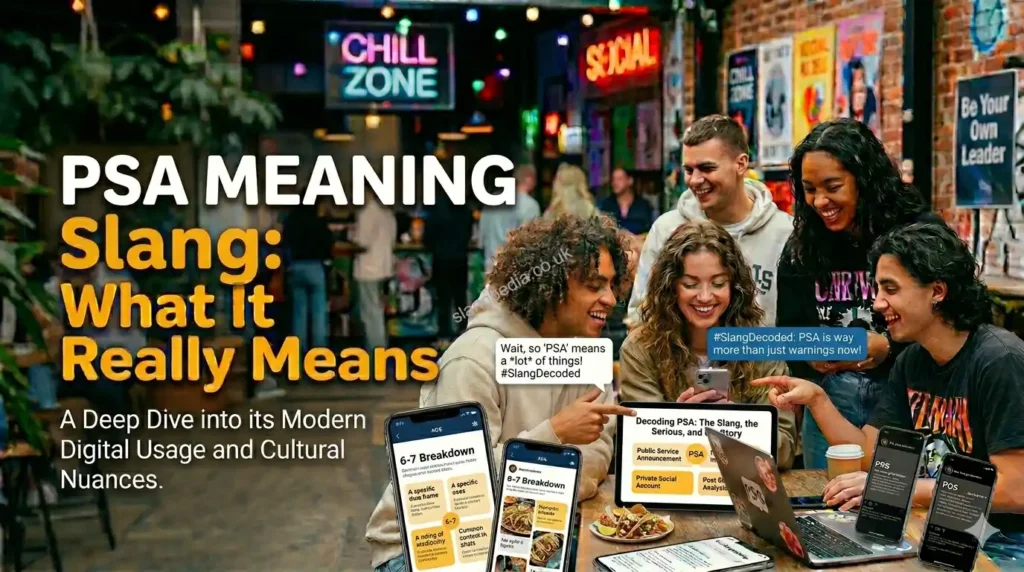
Picture this: your group chat just blew up. Someone typed “PSA: that new Chipotle on Fifth Street gives double rice if you ask nicely.” Twelve people immediately react. That’s PSA in action.
The slang version of PSA is borrowed directly from formal broadcast language. In official media, a public service announcement is a message in the public interest. Online, it works the same way — but the “public interest” could be anything from a genuine safety warning to a petty opinion delivered like it’s gospel.
PSA = “I have something important (or at least important to me) to tell you.”
The word signals that the speaker is stepping into an authoritative role — even briefly. It adds weight to whatever follows. That weight can be real, ironic, or completely performative.
Sometimes a PSA is genuinely helpful. Other times it’s someone announcing their hot take like it’s a CDC bulletin. The tone of the surrounding message tells you which one you’re dealing with.
Where Did the Slang “PSA” Come From?
PSA as an acronym has existed for decades in American broadcasting. Television networks would air public service announcements — short, non-commercial spots about health, safety, or civic issues. Everyone over 30 remembers “the more you know” spots on NBC.
The slang version crept into online culture around 2013–2015, first on Tumblr. Users would post “PSA:” before callouts, discourse posts, or community notices. It felt official without being official — which was exactly the point.
By 2017–2018, it had migrated fully to Twitter and Instagram. People started using it more playfully — not just for community callouts, but for opinions, relatable announcements, and mild complaints dressed up as civic duty.
By 2022–2026, TikTok normalized the ironic PSA format completely. Creators open videos with “PSA for everyone who…” as a hook that immediately implies authority and relevance.
Why Is “PSA” Spelled Different Ways?
PSA doesn’t have major spelling variants since it’s an acronym. You’ll sometimes see it written as “psa” (all lowercase) in casual texts and Discord, which tends to read as softer or more offhand. All-caps “PSA” carries more urgency or irony. The meaning stays the same either way.
Timeline:
- 2013: Tumblr users adopt “PSA:” prefix for community callouts and discourse posts.
- 2017: Twitter and Instagram spread the ironic, opinion-dressed-as-announcement usage.
- 2026: TikTok makes the ironic PSA video format a mainstream content hook worldwide.
What Does PSA Mean in Text?
In texts and DMs, PSA usually kicks off a message the sender wants you to take at least semi-seriously. In private texts, it often signals genuine info — a warning, a tip, or something important.
In group chats, it flips more ironic. The funnier or more trivial the announcement, the more the PSA label is playing with the format itself.
Common emojis paired with PSA: 📢 🚨 ‼️ 👀 📣
Example text exchange:
Tyler: psa: the vending machine on floor 3 takes Apple Pay now
Jess: bro why did I need to know this immediately
Tyler: public service. you’re welcome.
Jess: genuinely helpful actually
Here, Tyler uses PSA to add mock-official gravitas to something trivial. It’s a common texting pattern — like FYI but with more drama baked in.
Common PSA Text Phrases
| Phrase | Meaning | Tone |
|---|---|---|
| “PSA: nobody asked” | Self-aware disclaimer before an unsolicited opinion | Ironic / humorous |
| “PSA for the people in the back” | Emphasis that this info is important and being repeated | Slightly frustrated / sincere |
| “okay PSA real quick” | Casual opener signaling something actually useful follows | Casual / genuine |
What Does PSA Mean on TikTok?
On TikTok, PSA is a full content format, not just a word. Creators open videos with “PSA for anyone who…” or type “PSA ‼️” as a caption to signal the video contains important or surprising info.
It appears most on:
- Advice content (“PSA: you don’t have to tip on counter service”)
- Callout videos (“PSA for people who do this in public”)
- Relatable rant content (“PSA: it’s okay to leave a party early”)
The TikTok meaning is slightly more performance-driven than the texting version. On TikTok, the PSA format is a hook — it grabs attention by implying authority. The ironic version is equally popular. Both US and UK TikTok use it heavily, with no major regional difference in meaning.
PSA in Real Conversations: 5 Examples
Example 1 — Group Chat Warning
Marcus: PSA the aux cord in Jake’s car is broken bring a speaker
PSA here signals useful logistical info shared with group-chat authority.
Example 2 — Ironic Opinion Drop
Ashley: PSA: pineapple on pizza is not a controversy it’s just good
Cody: who gave you a podium
PSA is used to dress up a personal preference as a public announcement — fully intentional irony.
Example 3 — Sincere Heads Up
Jess: hey PSA the deadline for that form got moved to Friday
Tyler: oh thank god you told me
Here PSA is genuine — it flags important information clearly and efficiently.
Example 4 — Sarcastic Callout
Cody: PSA: showing up 20 minutes late to a reservation for eight people is actually insane
PSA is used sarcastically to frame a callout as if it’s obvious public knowledge.
Example 5 — Self-Deprecating Casual Chat
Marcus: PSA I just sent a voice note to the wrong person and I’m not okay
Ashley: 💀 who got it
PSA here is used loosely — more as a dramatic opener than an actual announcement format.
PSA vs. Similar Slang
| Word | Core Meaning | Tone | Best Used When |
|---|---|---|---|
| PSA | Public announcement, real or ironic | Authoritative, ironic, or sincere | Flagging info with mock or real urgency |
| FYI | For your information | Neutral, matter-of-fact | Sharing info without drama |
| Heads up | Warning or advance notice | Casual, friendly | Giving someone a low-key warning |
| NGL | Not gonna lie — honest admission | Casual, vulnerable | Sharing an opinion or confession |
The closest comparison to PSA is FYI — and people mix them up. The key difference is register. FYI is flat and informational. PSA carries performance — it implies the speaker is doing you a service. When someone says PSA instead of FYI, they’re adding a layer of drama, irony, or self-importance (sometimes all three).
The Emotional Vibe Behind “PSA”
PSA exists because people online want to be heard — but they also want plausible deniability about how much they care.
Wrapping a message in “PSA” lets the speaker act like they’re doing others a favor. The format borrows institutional authority without requiring any. It’s low-effort and high-impact.
This explains why the ironic version spread so fast. Saying “PSA: I don’t like mondays” is funnier than just saying “I don’t like Mondays.” The mismatch between the formal packaging and the trivial content is the joke.
When someone uses a sincere PSA, they’re signaling civic-mindedness. They want you to know they’re looking out for the group. When someone uses an ironic PSA, they’re self-aware enough to mock that exact impulse — while still using it.
The word also fits cleanly with the attention economy of TikTok. A PSA video hook promises the viewer something worth knowing. It’s optimized for curiosity and urgency simultaneously.
Similar to how 6/7 slang repurposes existing language into new emotional shorthand, PSA transforms a bureaucratic phrase into an expression of personality.
Is “PSA” Offensive?
No — PSA is not offensive. It’s not a slur, it doesn’t target any group, and it carries no harmful connotations.
Context does matter slightly. A PSA used to callout a specific person (“PSA: [name] is a liar”) can feel aggressive — but that’s the content of the callout, not the word itself.
It’s completely safe to use in both the USA and UK without causing offense. No specific group needs to avoid it.
In professional or academic writing, skip PSA entirely. Use “Important note,” “Please be aware,” or “This is to inform you” depending on the context.
📌 Quick note for parents and teachers: PSA stands for “public service announcement” and is borrowed from broadcast media. Online, it’s used to introduce information — sometimes serious, often humorous or ironic. It is not harmful, not a slur, and appears across all types of content from genuine advice to jokes.
PSA Slang — FAQ
Q: What does PSA mean on TikTok?
A: On TikTok, PSA is used as a content hook — creators say “PSA for anyone who…” to open videos that share advice, warnings, or opinions. The format borrows authority from official broadcast language. It works equally well played straight or used ironically.
Q: Is PSA a bad word?
A: No. PSA is not offensive, rude, or harmful in any context. It simply means “public service announcement” and is used online to flag something the speaker considers important — often with humor.
Q: What’s the difference between PSA and FYI?
A: FYI (for your information) is flat and neutral — it shares info without fanfare. PSA carries performance and weight. It implies the speaker is making an official-feeling announcement, which is why it reads as more dramatic or ironic than FYI.
Q: Do Americans and British people use PSA the same way?
A: Yes — largely. Both US and UK users deploy PSA the same way across TikTok, Twitter/X, and Discord. The ironic format is equally popular in both countries. There’s no major cultural split in meaning or usage.
The Bottom Line
PSA is a word that lets people borrow the voice of authority without earning it — and that’s exactly why it works.
It signals urgency, importance, or community-mindedness. But it also lets the speaker be ironic about all of that at the same time. That flexibility is rare in slang, and it’s why PSA has survived and spread across every major platform.
Next time you see it, check the content. The word is packaging — what matters is whether the sender is being sincere, funny, or both at once.
Have you seen PSA used in a way that surprised you? Drop it in the comments.
Last reviewed May 2026. Definitions verified against native US and UK usage across TikTok, Discord, and iMessage.

Maggie Wiersma is a USA-based writer with 2 years of experience covering slang meanings, internet culture, and modern language trends. With a background in communication studies, she creates simple and engaging content that helps readers understand today’s most popular slang terms.