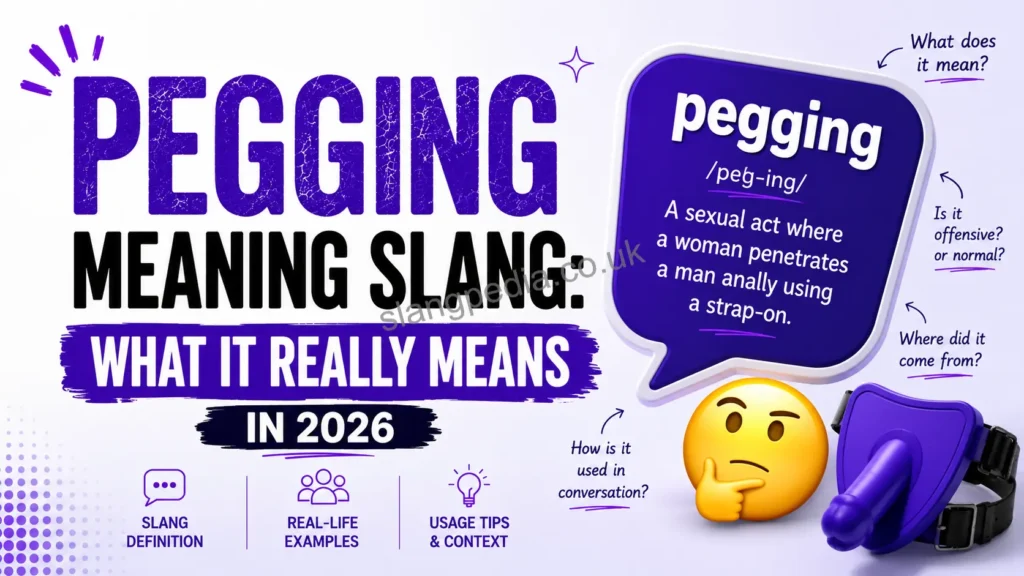
“Pegging” means a specific sexual act where a woman penetrates a male partner using a strap-on dildo — you’ll see it most on TikTok and Twitter/X when someone makes a joke, thirsts over a celebrity, or casually references kink culture without spelling it out.
TL;DR
- Pegging refers to a sexual practice involving strap-on penetration of a man by a woman.
- The tone online is almost always humorous, ironic, or thirst-coded — rarely clinical.
- It entered mainstream internet slang around 2014–2016 after a viral campaign to add the word to the dictionary.
- Used widely by Gen Z and millennials on TikTok, Twitter/X, Reddit, and Discord.
- Usage warning: It’s explicit content — avoid using it in professional, academic, or mixed-company settings without context.
What Does Pegging Mean in Slang?
You’re scrolling TikTok. A video pops up of someone listing their celebrity hall passes. The top comment reads: “She would absolutely peg him and he would say thank you.” Everyone in the replies is losing it.
That’s pegging in the wild.
In slang, pegging refers to a sexual act where a woman uses a strap-on dildo to penetrate a male partner anally. The clinical definition hasn’t changed. What has changed is the cultural weight around it.
Online, the word carries a very specific energy. It signals power-dynamic humor, confident female sexuality, and a kind of ironic reverence. When someone tweets “he looks like he gets pegged,” they’re not being graphic — they’re placing a man in a submissive role, usually affectionately or sarcastically.
Pegging = a woman penetrating a male partner with a strap-on, used online mostly as a joke or thirst statement.
The slang functions a lot like other kink-adjacent humor online — where the joke is the directness. Similar vibes to fob humor, where the shock of stating something plainly is the punchline.
The word also travels alongside LGBTQ+ and sex-positive spaces, where it’s discussed earnestly and without irony.
Where Did the Slang “Pegging” Come From?
The term “pegging” as a defined sexual act was popularized — and essentially named — by American sex columnist Dan Savage in 2001. He ran a contest in his Savage Love column asking readers to coin a term for the act. “Pegging” won.
That’s unusually well-documented for slang. Most internet slang has murky origins. This one has a paper trail.
For years it stayed in sex-positive and LGBTQ+ circles. Then in 2016, a viral internet campaign pushed to add “pegging” to the Merriam-Webster dictionary. It spread across Reddit, Twitter, and Tumblr. The joke was the campaign — absurdist humor wrapped around a genuine cultural normalization push.
By 2019–2020, TikTok carried it into Gen Z mainstream. Memes, thirst posts, and ironic “he looks like he gets pegged” comments made it a fixture of internet culture.
Why Is “Pegging” Spelled Different Ways?
“Pegging” is consistently spelled one way. Unlike slang terms with phonetic drift (like feening vs. fiending), this one is stable. Some users write “peg” as a verb — “she would peg him” — which is the conjugated form, not an alternate spelling.
Timeline:
- 2001: Dan Savage coins the term “pegging” via reader contest in Savage Love column.
- 2016: Viral Merriam-Webster campaign brings the word to mainstream internet audiences on Reddit and Twitter.
- 2020–2026: TikTok cements it as casual Gen Z slang — jokes, thirst posts, and memes.
What Does Pegging Mean in Text?
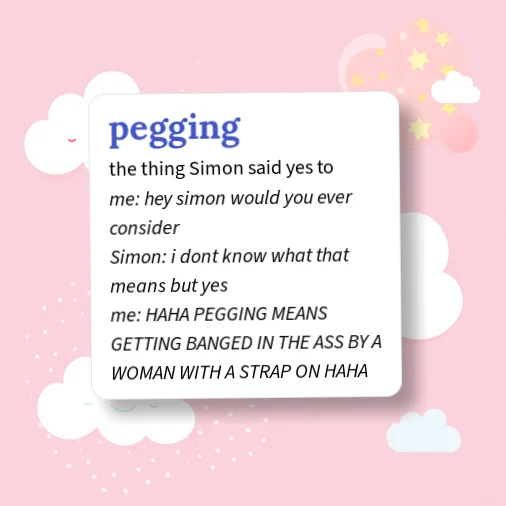
In texts and DMs, “pegging” is usually part of a joke or a low-key compliment about someone’s vibe. It rarely appears out of nowhere — there’s almost always a celebrity, a TV character, or a mutual friend being discussed.
In private chats, it can be used more candidly between close friends. In group chats, it’s almost always played for laughs.
Common emojis: 😂, 💀, 😭, 🫡, and the classic 🍑. The skull (💀) emoji almost always signals the joke landed.
Example text exchange:
Tyler: bro they cast him as the love interest??
Jess: he looks so peg-able lmaooo
Tyler: 💀💀 you’re so right actually
Jess: she could do it with her eyes closed
Similar energy shows up when people use aura as a vibe descriptor — the word does character work fast, with no full sentence needed.
Common “Pegging” Adjacent Phrases in Texting
| Phrase | Meaning | Tone |
|---|---|---|
| “He gives peg energy” | He has submissive or bottom vibes | Playful, thirst-coded |
| “She would peg him no hesitation” | She’s dominant; he’d accept it | Compliment/ironic |
| “Peg rights” | Claiming the hypothetical right to peg someone | Absurdist humor |
What Does Pegging Mean on TikTok?
On TikTok, “pegging” lives in comment sections more than captions. Creators rarely caption videos with the word directly — the algorithm is unforgiving — but the comments are unfiltered.
It shows up most on:
- Celebrity thirst edits — “she would peg him” under a slow-motion clip
- Character analysis videos — “ranking fictional men by peg-ability”
- Relationship dynamic content — discussions about power dynamics and gender roles
The TikTok meaning matches the texting meaning but skews more performative. It’s about the audience. Saying it in the comments is a bit like raising your hand in class — you get points for boldness.
It’s equally popular on US and UK TikTok. British users tend to deliver the joke more dryly. American users lean into the chaos.
Pegging in Real Conversations: 5 Examples
Example 1 — Celebrity Thirst Comment
Marcus: “He’s so hot in this scene”
Ashley: “He looks like he gets pegged and cries about it after 💀”
Ashley isn’t being mean — she’s placing him in a vulnerable, intimate scenario. It’s affectionate chaos.
Example 2 — Defending a TV Character
Cody: “I don’t get why people like him he’s so weak”
Jess: “That’s literally the point?? He’s a peg-me character”
“Peg-me character” is now a recognized archetype — soft, emotionally available men who get this treatment online.
Example 3 — Group Chat Chaos
Tyler: “guys what should I be for Halloween”
Marcus: “the guy who gets pegged”
Ashley: “MARCUS 💀💀💀”
Marcus earned the skull emojis. This is low-effort comedy that lands every time.
Example 4 — Sincere Conversation
Jess: “honestly more couples should try it”
Cody: “agreed, the stigma is so outdated”
Not every use is a joke. In sex-positive spaces, the word gets used earnestly and practically.
Example 5 — Sarcastic Reaction
Tyler: “he said he’s an alpha male”
Ashley: “yeah okay, peg him”
One line. Zero elaboration needed. The sarcasm is total.
Pegging vs. Similar Slang
| Word | Core Meaning | Tone | Best Used When |
|---|---|---|---|
| Pegging | Woman penetrates male partner with strap-on | Humorous, thirst-coded, sex-positive | Joking about power dynamics or celebrity vibes |
| Bottom energy | Submissive romantic/sexual dynamic | Playful, LGBTQ+-coded | Describing someone’s vibe broadly |
| Switch | Someone who takes both dominant and submissive roles | Neutral, knowing | Discussing relationship dynamics directly |
| Sub vibes | Submissive personality energy | Teasing, affectionate | Low-key thirst or personality commentary |
The closest overlap is with “bottom energy.” People sometimes use both interchangeably, but they’re not the same. “Bottom energy” is broader — it’s about personality and dynamic, not a specific act. “Pegging” is always act-specific, even when used as a joke. Getting one confused for the other usually just signals you’re newer to the terminology.
The Emotional Vibe Behind “Pegging”
Pegging spread so fast online because it filled a very specific cultural gap. There weren’t many ways to describe female sexual dominance in mainstream language that felt fun rather than clinical.
The word gave people a shorthand. It let them talk about power dynamics — gender, dominance, vulnerability — without writing an essay.
When someone uses it as a joke, they’re usually doing two things at once. They’re signaling comfort with sexual openness. And they’re playing with gender norms — placing a man in a traditionally “passive” position without shame attached to it.
What’s interesting is the word almost always feels affectionate online. Calling someone “peg-able” isn’t an insult. It’s placing them in a fantasy where someone powerful wants them.
That’s a very specific kind of compliment. It only works because internet culture has largely decoupled the act from stigma.
The word also does important work for sex-positive communities. Using it casually normalizes the conversation. Think about how aura turned an abstract idea into everyday vocabulary — pegging does the same for kink culture.
Is “Pegging” Offensive?
No, “pegging” is not a slur and is not offensive to a specific group. It’s an explicit sexual term, not a hate term.
Context matters:
- In sex-positive communities, LGBTQ+ spaces, and among adults: completely acceptable, often celebrated.
- In a workplace, classroom, or around minors: inappropriate, not because it’s offensive but because it’s explicit.
- When used to mock or demean someone: the framing, not the word, is the problem.
It’s safe to use in the USA and UK among adults who are comfortable with frank sexual discussion. Nobody is going to be culturally hurt by the word. They may, however, be caught off guard if the setting isn’t right.
Who should be careful:
- Teachers, managers, or anyone in professional communication.
- People unfamiliar with their audience’s comfort level with explicit content.
Formal alternative: “strap-on penetration” or “anal penetration using a strap-on device.”
📌 Quick note for parents and teachers: “Pegging” is an explicit term for a specific sexual act. It’s not a hate word and doesn’t target any group. Online, teenagers use it mostly as a joke or meme format. If you see it in your child’s texts or on their screen, it’s almost certainly being used humorously rather than in a literal context.
Pegging Slang — FAQ
Q: What does pegging mean on TikTok?
A: On TikTok, “pegging” is used mostly in comment sections as a joke about celebrity or character vibes. When someone writes “she would absolutely peg him,” they’re commenting on perceived power dynamics between two people — usually celebrities or fictional characters. It’s thirst-coded humor, not explicit content being described literally.
Q: Is pegging a bad word?
A: “Pegging” is an explicit sexual term, not a slur or hate word. It’s not “bad” in the offensive sense — it’s adult content. Using it in the wrong setting (work, school, with strangers) is the issue, not the word itself.
Q: What’s the difference between pegging and bottom energy?
A: “Bottom energy” describes a submissive personality vibe broadly. “Pegging” refers to a specific sexual act. Someone can have “bottom energy” in a totally non-sexual context — just being soft, agreeable, or deferential. Pegging is always act-specific, even when used as a joke.
Q: Do Americans and British people use pegging the same way?
A: Mostly yes — the meaning and humor are the same on both sides of the Atlantic. British users tend to deliver the joke with more deadpan understatement. American users lean into louder, more chaotic energy. The slang itself originated in American internet culture via Dan Savage, but UK Gen Z adopted it quickly through TikTok and Twitter.
Q: Did “pegging” used to mean something different?
A: Yes. Before Dan Savage popularized its current meaning in 2001, “pegging” had unrelated uses — in carpentry (fastening with pegs), in finance (fixing an exchange rate), and in British English as informal slang for various things. Those meanings still exist in formal contexts. Online, however, the sexual definition dominates completely.
The Bottom Line
“Pegging” started as a coined term in a sex advice column. Two decades later, it’s casual Gen Z vocabulary. That’s a remarkable journey for any word.
Online, it functions less as explicit content and more as a vibe detector. People use it to signal comfort with sexual openness, play with power dynamics, and make sharp jokes in two words or less.
Next time you see it in a TikTok comment or a text thread, you’ll know: someone’s either thirsting, joking, or having a genuine sex-positive conversation — and usually all three at once.
Have you seen “pegging” used in a way that surprised you? Drop it in the comments.
Reviewed for cultural accuracy. Slang meanings shift — last verified 2026.

Maggie Wiersma is a USA-based writer with 2 years of experience covering slang meanings, internet culture, and modern language trends. With a background in communication studies, she creates simple and engaging content that helps readers understand today’s most popular slang terms.