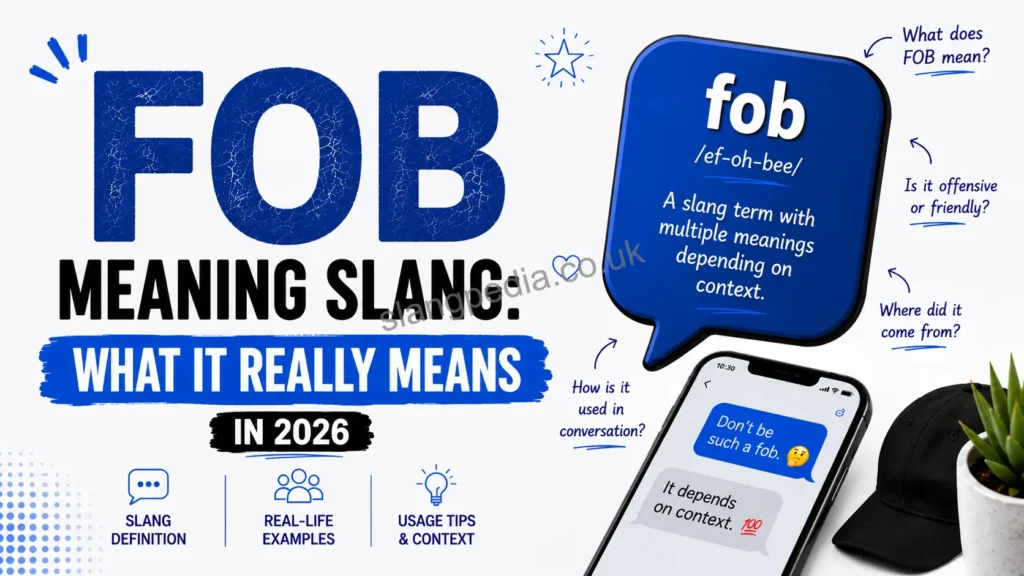
“FOB” means Fresh Off the Boat — a term used to describe someone who recently immigrated and hasn’t yet adapted to local culture — you’ll see it most on TikTok and in Discord servers when someone is describing cultural cluelessness or heavily accented speech, sometimes with affection and sometimes with cruelty.
TL;DR
- FOB stands for “Fresh Off the Boat” — it describes a recent immigrant or someone culturally unassimilated
- The tone swings hard depending on who’s saying it: affectionate among immigrant communities, cutting when used by outsiders
- It originated in Asian-American communities in the US but spread to South Asian, Latin, and UK diaspora contexts
- Predominantly used by people aged 16–30 in diaspora communities, online and in real life
- Warning: calling someone FOB without knowing the relationship is risky — it can land as a slur
What Does FOB Mean in Slang?
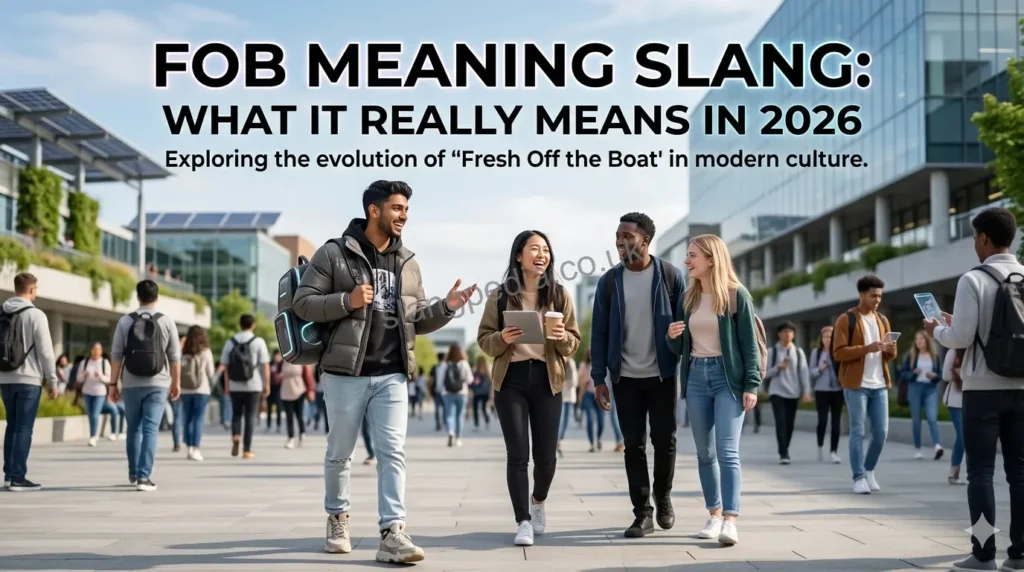
Picture this: a TikTok comment section on a video of a Korean international student struggling with an American drive-through. Someone drops, “bro is so fob rn 😭” and 400 people like it. The comment isn’t necessarily mean. But it’s not exactly kind either.
FOB = Fresh Off the Boat — someone who recently immigrated and hasn’t adapted to local culture yet.
At its core, FOB flags a gap — between where someone came from and where they are now. It points to accents, fashion choices, social cues, or behaviors that read as visibly “foreign” to the local eye.
But the nuance is everything. Inside immigrant communities, FOB is often used with warmth — almost like reclaiming an identity. Used by someone outside the group? It shifts into mockery fast.
The term overlaps with how people use off the boat to describe cultural displacement more broadly.
Where Did the Slang “FOB” Come From?
FOB has roots in early 20th-century American slang, originally tied to European immigration. But the version used online today traces mainly to Asian-American communities in the US, particularly on early internet forums and in high school hallways during the late 1990s and early 2000s.
It spread first through AIM chats, Asian-American forums like AsianAvenue, and later Tumblr. The term was used by second-generation immigrants to describe newcomers — sometimes teasing, sometimes genuinely affectionate.
By the 2010s, it had spread into South Asian diaspora spaces, Latin American immigrant communities, and UK circles with large immigrant populations. TikTok turbocharged it after 2020.
Why Is “FOB” Spelled Different Ways?
FOB is almost always written in all caps as an acronym. Some users write it lowercase as “fob” in casual texting. You’ll occasionally see “fobby” as an adjective — “she dresses so fobby” — or “fob energy” as a noun phrase describing a vibe rather than a person.
Timeline:
- Late 1990s: Term circulates in Asian-American high school and college spaces in the US
- 2005–2015: Spreads to South Asian diaspora Twitter and Tumblr; picks up “fobby” as a variant
- 2020–present: TikTok pushes it mainstream; UK usage increases notably via British-Asian creators
What Does FOB Mean in Text?
In texts and DMs, FOB tends to be direct and punchy. It rarely needs explanation — the person receiving it already knows what it means.
In private chats between friends from immigrant families, it’s often used affectionately — even as a form of self-deprecating humor. In group chats with mixed backgrounds, people are more careful with it.
Common emojis that travel with it: 😭💀🛳️ (the boat emoji gets used for obvious reasons).
Real text exchange:
Tyler: dude my cousin just got here from Lahore and he wore a full suit to the mall
Marcus: bro is so fob 💀
Tyler: he’s never had Chick-fil-A before either
Marcus: ok ngl that part’s kinda wholesome tho
In this exchange, the word signals gentle teasing — not cruelty. The context (family, newcomer) keeps it affectionate.
This kind of humor overlaps with how people deploy ick — calling out something socially jarring with a laugh rather than a lecture.
Common FOB Phrases by Community
| Phrase | Community Context | What It Signals |
|---|---|---|
| “Fobby fit” | Asian-American TikTok | Wearing clothes that read as culturally “off” by US standards |
| “Full fob energy” | South Asian diaspora (UK/US) | Behaving in a way that feels freshly arrived — accent, habits, references |
| “Fob moment” | Latin American diaspora communities | A specific action that reveals unfamiliarity with local norms |
What Does FOB Mean on TikTok?
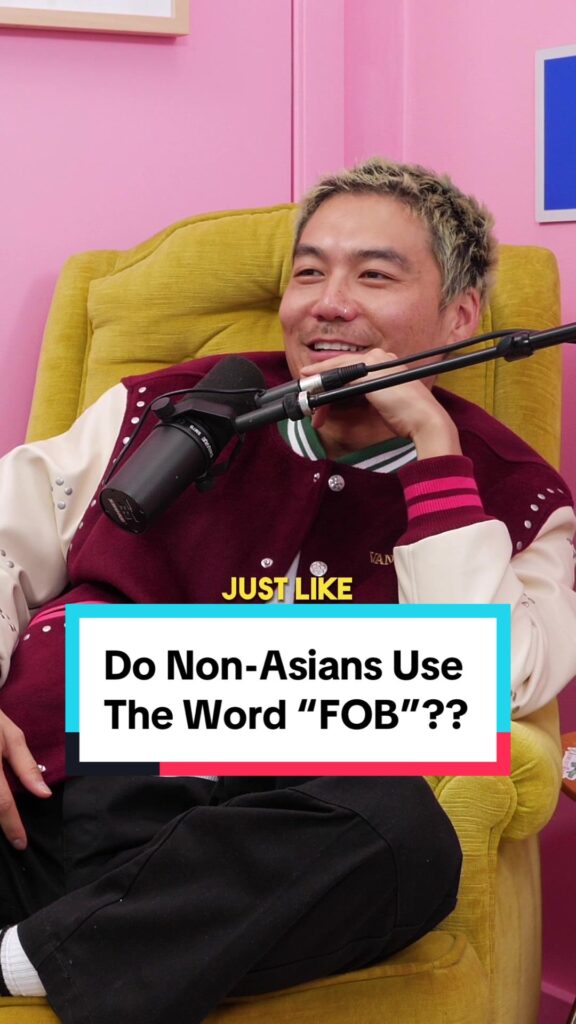
On TikTok, FOB shows up most in captions, comment sections, and reaction videos. Creators — often second-gen immigrants — use it to describe their parents, cousins, or themselves before they “assimilated.”
The content tends to be: immigrant parent videos, “my first week in America” stories, accent humor, or cultural comparison content.
US TikTok uses it more than UK TikTok, but British-Asian creators have picked it up significantly since 2022. The TikTok meaning doesn’t shift much from the texting meaning — it still means culturally fresh off the boat. What TikTok adds is the performance of it: creators lean into the FOB identity as a badge rather than a label.
FOB in Real Conversations: 5 Examples
Example 1 — Affectionate Family Group Chat
Ashley: my dad just asked google maps to “please find parking”
Cody: he said please?? so fob 😭
The word here signals fond exasperation — not mockery. It’s family using it about family.
Example 2 — Ironic Self-Description
Jess: ok I just asked if the pizza could be “not so oily” at the restaurant
Jess: fob behavior on my part I’m not gonna lie
Self-applying FOB flips the dynamic entirely. It’s self-aware humor about cultural code-switching.
Example 3 — Sarcastic Discord Reaction
Tyler: bro just said he doesn’t know who Drake is
Marcus: FRESH. OFF. THE. BOAT.
Tyler: 💀💀
The full acronym spelled out adds comedic weight. It’s exaggerated for the joke.
Example 4 — Sincere Observation, No Mockery
Ashley: he’s not being weird he just got here 3 months ago
Ashley: cut him some slack, still fob honestly
Cody: yeah fair enough
Here, FOB functions as an explanation, not an insult. It contextualizes behavior without punishing it.
Example 5 — Casual Group Chat, Mixed Tone
Marcus: why did he say “I am not understanding you” instead of “I don’t understand”
Jess: fob grammar is a whole dialect tbh
Tyler: actually kind of charming ngl
The comment starts as a tease but the thread catches itself — ending on something closer to warmth.
FOB vs. Similar Slang
| Word | Core Meaning | Tone | Best Used When |
|---|---|---|---|
| FOB | Recently immigrated, culturally unassimilated | Ranges from affectionate to cutting | Describing cultural adjustment, accent, or habits |
| Immigrant coded | Presenting in ways culturally associated with immigration | Neutral to slightly ironic | Describing aesthetics or behaviors without personal targeting |
| Off the grid | Disconnected from mainstream culture or tech | Light, usually not about ethnicity | Someone who doesn’t use social media or pop culture |
| Culture shocked | Surprised or confused by cultural norms | Sympathetic | Describing someone adjusting to a new environment |
The biggest confusion is between FOB and immigrant coded. FOB is personal — you’re calling out a specific person’s behavior. “Immigrant coded” tends to describe aesthetics or vibes, often in a more detached or even celebratory way. FOB carries more sting because it’s directed.
The Emotional Vibe Behind “FOB”
FOB exists because immigration is emotionally complicated — and language always finds the gaps.
For second-generation immigrants, the word captures a specific tension. You’re caught between two cultures. Calling someone FOB is a way of naming that gap — in yourself, in your family, in someone new you’ve just met.
When used inside the community, it often carries something tender. It’s saying: I remember being that person. I know what that adjustment feels like.
When used from the outside, it strips that tenderness away. It becomes a word for “you don’t belong here yet.”
The speed at which it spread online reflects something real: diaspora communities found in it a shorthand for an experience that rarely gets named directly. The awkward first year. The accent that gets mocked. The clothes that don’t match local expectations.
It says something vulnerable about the person it describes — and something knowing about the person using it. Words like code-switching live in the same emotional territory: they name the invisible labor of cultural adjustment.
Is “FOB” Offensive?
Yes, FOB can absolutely be offensive — context determines everything.
It is not technically classified as a slur, but it has been used as one. Specifically, it has a history as an anti-Asian slur in American schools and workplaces. When used by someone outside the immigrant community, it often lands as mockery of accent, appearance, or cultural difference.
Within immigrant and diaspora communities, the word is frequently reclaimed and used with affection. That does not make it safe for general use.
Who should avoid it:
- Anyone who isn’t part of an immigrant community themselves
- Anyone in a professional, academic, or formal setting
- Anyone unsure of the relationship or context
Formal alternative: “recently arrived,” “new to the country,” or “adjusting to local culture.”
📌 Quick note for parents and teachers: FOB stands for “Fresh Off the Boat” and describes someone who recently immigrated. It is not always used as a slur — within immigrant communities it can be affectionate — but it has a history of being used to mock accents and cultural differences. If a student is using or hearing it, the context matters significantly.
FOB Slang — FAQ
Q: What does FOB mean on TikTok? A: On TikTok, FOB means “Fresh Off the Boat” — it’s used in captions and comments to describe someone who recently immigrated or acts visibly unassimilated. Second-gen creators often use it about their parents or their own earlier experiences, often with humor and affection.
Q: Is FOB a bad word? A: It depends entirely on who’s saying it and to whom. Within diaspora communities it’s often used affectionately or as self-deprecating humor. When used by someone outside the immigrant experience to mock someone’s accent or behavior, it functions as an insult. The word has been used as an anti-Asian slur in US schools specifically.
Q: What’s the difference between FOB and immigrant coded? A: FOB is personal — it directly describes a specific person’s behavior or adjustment. “Immigrant coded” tends to describe aesthetics or vibes in a more detached, sometimes celebratory way. FOB carries more potential for offense because it targets an individual directly.
Q: Do Americans and British people use FOB the same way? A: Mostly yes, but US usage is older and more established — especially in Asian-American communities. UK usage has grown significantly via British-South Asian TikTok creators. In the UK, it’s slightly less loaded historically but still carries the same risk of offense when used outside immigrant communities.
The Bottom Line
FOB isn’t just slang for “immigrant.” It carries an entire emotional weight — the tension of living between two cultures, the awkwardness of adjustment, and the warmth that often exists inside communities who share that experience.
If you hear it in a diaspora community, it’s likely affectionate. If you hear it used by an outsider, it’s often not. That distinction is the whole difference.
You now have enough context to read it correctly every time. Have you seen FOB used in a way that surprised you? Drop it in the comments.
Content reviewed for cultural accuracy. US and UK usage verified through community sources.

Maggie Wiersma is a USA-based writer with 2 years of experience covering slang meanings, internet culture, and modern language trends. With a background in communication studies, she creates simple and engaging content that helps readers understand today’s most popular slang terms.