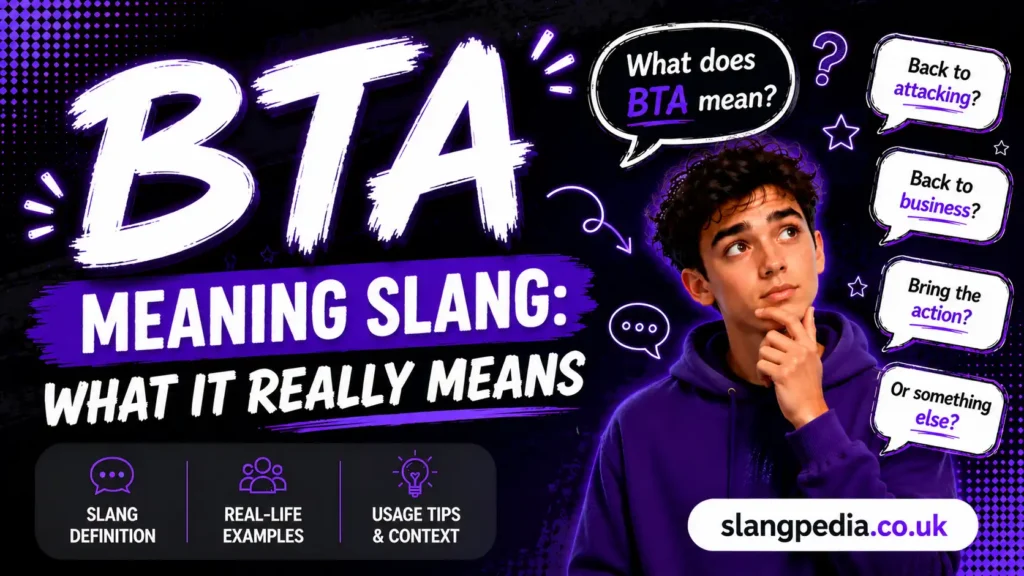
“BTA” means “be there at” — you’ll see it most on iMessage and Instagram DMs when someone is confirming an arrival time or checking where a friend is headed.
TL;DR
- BTA = “be there at” — a shorthand for naming a time or place you’ll arrive
- Tone is casual and practical, not emotional — it’s purely logistical
- Originated in texting culture, spreading mainly through iMessage and Snapchat around 2018–2020
- Used mostly by teens and young adults (16–28) in both the US and UK
- Don’t confuse it with “but then again” — same initialism, totally different vibe
What Does BTA Mean in Slang?
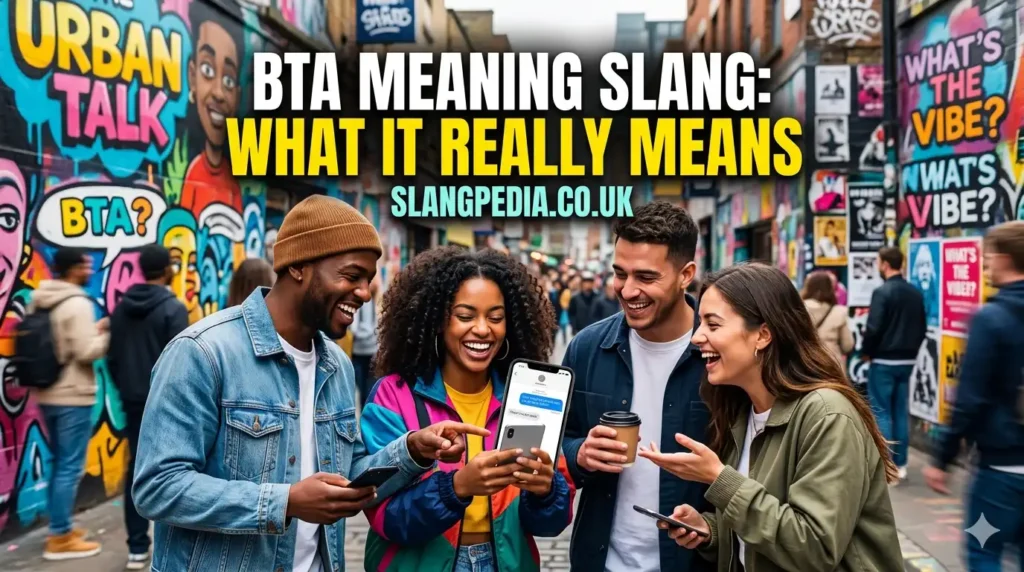
Picture this: it’s Friday night. Tyler texts the group chat, “where you at?” Marcus replies instantly — “bta 8pm, grab a table.” Nobody questions it. They all know exactly what it means.
That’s BTA in action. It stands for “be there at” and it functions like a timestamp dropped into a conversation.
The meaning is precise. It’s not hype, not emotion — it’s a calendar entry squeezed into three letters.
BTA = “be there at” — telling someone the exact time or place you’ll arrive
The slang fills a specific gap. Full sentences like “I’ll be there at eight” take too long to type mid-commute. BTA does it in one tap.
It also carries a subtle tone of reliability. When someone drops a BTA, they’re not being vague or non-committal. They’re locking it in. Using it signals that you’re organized, direct, and not about the back-and-forth.
You might also see it paired with terms like NGL in longer text strings where someone is being real about their arrival time.
Where Did the Slang “BTA” Come From?
The exact origin is unclear, but BTA spread mainly through iMessage group chats and Snapchat among American high schoolers and college students.
It emerged from the broader trend of compressing time and logistics into initialism shorthand — the same cultural wave that gave us ETA, OTW (on the way), and HMU (hit me up).
BTA first gained traction around 2018–2019, when group-chat planning replaced phone calls entirely for younger users. Nobody wanted to write paragraphs about arrival times.
By 2021, it had crossed into UK teen slang too, particularly on Snapchat and in school WhatsApp groups.
Why Is “BTA” Spelled Different Ways?
You might see it written as bta, B.T.A., or occasionally b.t.a. — all mean the same thing. The lowercase version is by far the most common in casual texting. Capitalized versions appear in more formal social media captions or when someone’s emphasizing the time. No single spelling is “correct.”
Timeline:
- 2018: BTA circulates in US high school iMessage threads as a logistics shorthand
- 2020: Snapchat and TikTok comments accelerate adoption, especially in coordination posts
- 2022–2026: Fully embedded in Gen Z texting vocabulary across the US and UK
What Does BTA Mean in Text?

In private texts, BTA is basically a soft commitment. It’s like sending a calendar invite, but cooler.
In group chats, it pulls double duty — it both answers “when you coming?” and signals that you’re actually going to show up.
Common emojis paired with BTA: 🕐 🏃 👀 📍
Real text exchange:
Jess: yo are you coming tonight?? Tyler: bta 9, parking rn Jess: ok we’re at the back bar Tyler: bet 👍
It’s clean. No fluff. BTA communicates exactly what it needs to.
On the topic of arrival confirmations, many users will also drop an OTW text right before the BTA to show they’re already in motion.
Common BTA Slang Phrases
| Phrase | Meaning | Where You’ll See It |
|---|---|---|
| “bta 7, don’t start without me” | Confirming arrival time with a light-hearted warning | iMessage group chats |
| “bta yours in 10” | Telling someone you’re headed to their place soon | Private DMs on Snapchat |
| “bta the spot at 8 sharp” | Coordinating a meetup at a specific location | Discord event channels |
What Does BTA Mean on TikTok?
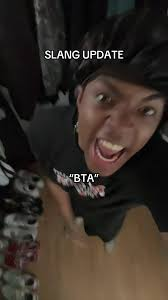
On TikTok, BTA shows up mostly in captions and comment sections — rarely in voiceovers.
Creators use it when posting about meetups, parties, or live events. A caption might read: “bta the venue at 10 — who’s coming?”
In comments, fans use it to hype up events: “bta the drop the second it goes live.”
The TikTok meaning doesn’t shift much from the texting meaning. It stays logistical, though on TikTok it can carry slightly more energy — used to build anticipation rather than just confirm timing.
It’s roughly equally popular on US and UK TikTok, though US creators tend to use it more frequently in event-related content.
BTA in Real Conversations: 5 Examples
Example 1 — Late to the party
Marcus: bta yours in like 20, traffic is brutal Ashley: lmaooo you said that 40 mins ago
BTA is used here as a running joke — Marcus keeps pushing his arrival time back and Ashley’s calling it out.
Example 2 — Sincere coordination
Cody: what time you heading to the game? Jess: bta the stadium at 6, wanna link outside the gates?
Straightforward logistics — Jess is locking in a plan and suggesting a meeting point.
Example 3 — Ironic enthusiasm
Tyler: bta the library at 8am, who’s excited 🙃 Marcus: peak life choices bro
The sarcasm is carried by the emoji and tone — BTA here highlights how unenthusiastic Tyler is about his own plan.
Example 4 — Group chat chaos
Ashley: guys where is everyone Cody: bta in 5 Tyler: bta in 5 also Jess: bta never, I’m tired
Classic group chat energy — two people align on timing, one opts out dramatically.
Example 5 — Casual check-in
Marcus: bta work around 3 if you wanna grab food after? Ashley: yes come through
BTA here initiates a plan, not just confirms one — it’s an invitation wrapped in logistics.
BTA vs. Similar Slang
| Word | Core Meaning | Tone | Best Used When |
|---|---|---|---|
| BTA | “Be there at” — arrival time/place | Casual, practical, direct | Coordinating meetups or confirming your ETA |
| OTW | “On the way” — currently in transit | Urgent, in-motion | You’ve left and want people to know |
| ETA | Estimated time of arrival | Neutral, slightly formal | Group planning, less casual contexts |
| HMU | “Hit me up” — contact me later | Open-ended, social | When you want someone to reach out, not now |
The biggest mix-up is between BTA and OTW. OTW means you’re already moving. BTA means you’re announcing a specific time you’ll arrive — you might not have left yet. Using OTW when you haven’t left yet is a red flag. BTA is the honest version.
The Emotional Vibe Behind “BTA”
BTA exists because planning in group chats became overwhelming.
There’s something specific that this word fills emotionally: it’s the antidote to vagueness. “I’ll probably be there around eightish” leaves everyone in limbo. BTA cuts through that. It’s a micro-commitment.
When someone drops a BTA, they’re projecting competence. They know where they’re going, they know when they’re arriving, and they’re telling you. In a culture where flaking is practically normalized, BTA signals that you’re one of the people who actually shows up.
It also says something about trust. You don’t BTA to strangers or colleagues. You send it to people who are already expecting you. It assumes an existing plan and adds a timestamp to it.
It spread fast because it’s genuinely useful — not ironic, not a meme format. It solved a real texting problem.
Some of the same brevity-driven logic applies to slang like sol, which also compresses a whole emotional state into three letters.
BTA might be small, but it reveals something real: Gen Z defaults to efficiency, even in social settings.
Is “BTA” Offensive?
No — BTA is not offensive in any context.
It’s not a slur, it doesn’t target any group, and it carries no negative connotations. Using it in the USA or UK is completely safe regardless of who you’re texting.
There’s no demographic that should avoid it. It’s neutral slang used across genders, ethnicities, and social groups.
In professional or academic writing, replace it with “I’ll be there at [time]” or “my estimated arrival is [time].”
📌 Quick note for parents and teachers: BTA stands for “be there at” and is used to confirm an arrival time in text messages. It’s completely harmless — think of it as a shorthand version of “I’ll arrive at eight.” You’ll most likely see it in group chats among teens organizing social plans.
BTA Slang — FAQ
Q: What does BTA mean on TikTok? A: On TikTok, BTA means “be there at” and is used in captions and comments to announce an arrival time or build anticipation for an event. It’s the same meaning as in texting — no platform-specific shift.
Q: Is BTA a bad word? A: No. BTA is completely neutral slang with no offensive meaning. It’s used to communicate arrival times and has no association with insults, slurs, or harmful content.
Q: What’s the difference between BTA and OTW? A: BTA (“be there at”) announces a specific time you’ll arrive. OTW (“on the way”) means you’ve already left and you’re currently in transit. BTA is forward-planning; OTW is real-time status.
Q: Do Americans and British people use BTA the same way? A: Mostly yes, though BTA is more common in American texting culture where it first spread via iMessage. In the UK, it appears more often in WhatsApp and Snapchat chats. The meaning is identical in both countries.
The Bottom Line
BTA is one of those rare slang terms that’s purely functional. It doesn’t carry attitude, irony, or subtext — it just compresses a whole sentence into three characters. That’s why it stuck.
Understanding BTA means understanding how Gen Z texts: efficiently, directly, and with zero tolerance for unnecessary words. When you see it, someone is locking in a time and treating you like you’re already part of the plan.
Have you seen BTA used in a way that surprised you? Drop it in the comments.
Last reviewed by the Slangpedia editorial team. Verified against native US and UK usage.

Maggie Wiersma is a USA-based writer with 2 years of experience covering slang meanings, internet culture, and modern language trends. With a background in communication studies, she creates simple and engaging content that helps readers understand today’s most popular slang terms.