“OD” means to go overboard or act excessively — you’ll see it most on TikTok and in iMessage threads when someone reacts to behavior that’s way too much.
TL;DR
- OD = overdoing it; acting, saying, or feeling something way too intensely
- Tone is flexible — can be funny, critical, impressed, or exasperated depending on context
- Rooted in AAVE and New York City street slang; dates back to at least the early 2010s online
- Used heavily by Gen Z across TikTok, Discord, and iMessage in the US and UK
- Usage warning: In older contexts, “OD” still means “overdose” — read the room before using it casually
What Does OD Mean in Slang?
Picture a Discord server. Someone posts a clip of their friend eating an entire party-size bag of chips in under two minutes. The first reply? “bro you are ODing rn 💀”
That’s the slang version of OD in action.
In everyday Gen Z usage, OD means doing something to an extreme degree. It can signal that something is too much — too funny, too wild, too dramatic, or just genuinely excessive.
The tone isn’t always negative. Sometimes ODing is a flex. Sometimes it’s a call-out. Context decides everything.
OD = going way overboard; doing or feeling something to an extreme degree
The primary keyword — OD slang — lives in this zone of performative excess. It’s distinct from sus or other skepticism-based slang. OD is about intensity, not suspicion.
It can function as a verb (“she’s ODing”), an adjective (“that’s OD crazy”), or a standalone reaction (“OD 💀”).
Where Did the Slang “OD” Come From?
OD originates directly from the phrase “overdose.” In AAVE and New York City slang communities, the word got clipped and repurposed as a general intensifier. It moved away from its medical meaning and into everyday speech.
The shift happened organically in New York — particularly in the Bronx and Brooklyn — where the word described people or situations that were just too much. Too loud. Too funny. Too aggressive. Too anything.
From there, it moved into hip-hop lyrics and then online culture.
Why Is “OD” Spelled Different Ways?
You’ll see OD, od, and occasionally o.d. — all refer to the same slang term. Lowercase “od” is most common in casual texting. “OD” in all caps can signal extra emphasis, like the speaker is really stressing the point. “O.D.” is rare online but shows up in older written formats.
Timeline:
- 2010–2012: OD circulates in New York City youth slang and early rap lyrics as a general intensifier
- 2015–2018: Spreads across Twitter and Tumblr; used in AAVE-adjacent online communities
- 2020–2026: Fully mainstream on TikTok, Discord, and iMessage among Gen Z in both the US and UK
What Does OD Mean in Text?
In texts and DMs, OD is one of the most versatile reaction words in Gen Z’s toolkit. It can stand alone as a full response or slot into a longer sentence without losing punch.
In private chats, it tends to be warmer — almost affectionate when someone’s friend does something ridiculous. In group chats, it leans harder toward public call-out energy.
Emojis that almost always travel with OD: 💀, 😭, 😂, 🤣, 😤
Real text exchange:
Tyler: just found out my professor assigned 3 essays due the same day
Jess: bro that’s OD 😭
Tyler: ODing on the stress rn fr
Jess: report him that’s actually wild
OD slides naturally next to asl in casual text threads — both are short, punchy, and carry big tonal weight in just a few characters.
Common OD Phrases and Regional Identity
| Phrase | Meaning | Where It’s Most Used |
|---|---|---|
| “You’re ODing” | You’re going way too far right now | New York, US generally, UK TikTok |
| “That’s OD crazy” | That situation is wildly extreme | US — especially East Coast |
| “ODed on it” | Consumed or engaged with something excessively | UK Discord and gaming communities |
What Does OD Mean on TikTok?
On TikTok, OD shows up most in comment sections and text overlays. It’s a go-to caption for reaction videos where someone witnesses extreme behavior.
You’ll see it under clips of people pulling off ridiculous stunts, eating disgusting food combinations, or saying something genuinely unhinged. Comments like “they are ODing” or “OD behavior 💀” are routine.
The TikTok meaning matches the texting meaning closely. There’s no major platform-specific shift.
US TikTok uses it slightly more than UK TikTok, but UK creators — especially those in grime and drill-adjacent circles — have picked it up fully. It’s genuinely cross-Atlantic at this point.
OD in Real Conversations: 5 Examples
Example 1 — Group chat reaction
Marcus: did she really just block him after one text back??
Ashley: OD behavior honestly 😭
OD here signals collective disbelief — the group is judging someone’s extreme response together.
Example 2 — Ironic flex
Cody: ate 4 slices of pizza at 2am again
Tyler: you’ve been ODing on that pizza all week lmaooo
The tone is teasing but affectionate — ODing here is almost a badge of honor.
Example 3 — Sincere overwhelm
Jess: how are you feeling about finals?
Marcus: I’m OD stressed ngl
OD used as an intensifying adjective. It replaces “extremely” in a way that feels more emotionally honest.
Example 4 — Sarcastic call-out
Ashley: he texted me 11 times in 20 minutes
Cody: yeah that’s OD. block him.
Cold, clipped, definitive. OD here signals a social verdict — this person crossed a line.
Example 5 — Casual Discord energy
Tyler: just watched 6 hours of that show in one sitting
Jess: ODing on screen time as usual 💀 same tho
Self-aware and relatable. ODing on something has become its own genre of humble confession online.
OD vs. Similar Slang
| Word | Core Meaning | Tone | Best Used When |
|---|---|---|---|
| OD | Doing/feeling something to an extreme degree | Flexible — funny, critical, or impressed | Someone goes way too far in any direction |
| Extra | Overly dramatic or performative | Mildly judgmental | Calling out someone being unnecessarily theatrical |
| Unhinged | Behaving in a chaotic or irrational way | Amused shock | Describing genuinely wild or erratic behavior |
| Wilding | Acting out of control or recklessly | Energetic, streetwise | Calling out rowdy or reckless real-world behavior |
The biggest confusion is between OD and extra. Both describe excessive behavior — but extra is almost always a mild critique of performance or theatrics. OD is broader and more intense. You can OD on stress, food, or screen time. You can’t really be extra at those things. OD has teeth that extra doesn’t.
The Emotional Vibe Behind “OD”
OD exists because English needed a word that could handle scale without sounding clinical.
“Extremely” is a textbook word. “Very” is weak. “So much” is vague. OD lands differently — it carries the weight of physical excess (the overdose origin) while staying fully detached from that dark meaning in everyday use.
When someone says you’re ODing, they’re not just describing intensity. They’re performing a reaction. It signals that they saw what you did, clocked it, and found it noteworthy enough to call out.
That social function is why it spread so fast. OD is a reaction and a verdict in one word.
It’s also worth noting: saying I’m ODing on something is often a form of self-aware confession. It’s a Gen Z way of admitting to a habit without fully owning it — half joke, half honesty.
For a similar emotional function, type shi operates in the same zone — slang that does social signaling through understatement and brevity.
OD says: I see the excess. I name it. I might even relate to it.
Is “OD” Offensive?
No, OD is not a slur and is not inherently offensive to any group.
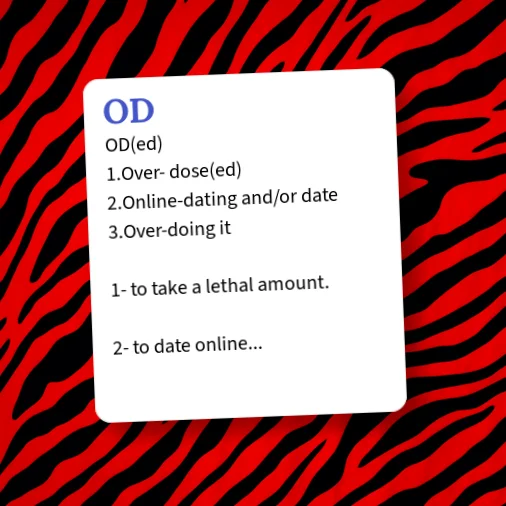
The one genuine sensitivity: the original meaning of OD is “overdose.” In conversations near someone dealing with addiction or drug-related loss, the casual use of OD can land badly. Read the room.
In most everyday contexts — texting, TikTok, Discord — OD carries zero harmful weight. It’s safe to use in both the US and UK without causing offense in casual settings.
Avoid it in professional writing, job emails, or academic work. Use “excessively,” “extremely,” or “to an unreasonable degree” instead.
Who should be careful: Anyone unsure of their audience’s background, especially around addiction recovery communities.
📌 Quick note for parents and teachers: “OD” in teen slang means going overboard or doing something excessively — it has nothing to do with drug overdose in this context. It’s not harmful language and appears widely on TikTok, in texts, and on Discord. It’s culturally borrowed from AAVE and New York street slang.
OD Slang — FAQ
Q: What does OD mean on TikTok? A: On TikTok, OD means someone is being excessive or going way over the top. It shows up in comment sections and video captions — usually as a reaction to wild, funny, or extreme behavior. It functions the same as it does in texting.
Q: Is OD a bad word? A: Not in its slang form. OD slang just means excessive or overboard. The only context where it gets sensitive is around addiction — since OD originally means overdose. In most Gen Z conversations, it’s completely neutral.
Q: What’s the difference between OD and extra? A: Extra specifically mocks someone for being unnecessarily dramatic or performative. OD is broader — it covers intensity in any form, including stress, behavior, or consumption. You’d call someone extra for making a scene. You’d say they’re ODing if they’ve genuinely gone too far in a more serious way.
Q: Do Americans and British people use OD the same way? A: Mostly, yes. OD arrived in the UK through US hip-hop and TikTok. UK users — especially in grime and drill communities — adopted it naturally. The core meaning is the same on both sides. British teens might also say “peak” or “bare” for similar intensity, but OD is understood everywhere.
Q: Can OD mean something positive? A: Yes, absolutely. “You ODed on that performance” can be a genuine compliment. Context and tone determine whether it’s praise or criticism. When used with laughing emojis or in a hype context, ODing on something is often admiration.
The Bottom Line
OD is one of those slang terms that earns its place because it’s genuinely efficient. It names excess without judgment built in — you decide the tone. That flexibility is exactly why it stuck.
Whether someone’s going OD on stress, on a hobby, or on questionable behavior, the word captures intensity in a way that flat adverbs just can’t. It’s cultural shorthand that signals you’re fluent in the moment.
Next time you see it in a comment section or text thread, you’ll know exactly what’s being said — and how to read the vibe.
Have you seen OD used in a way that surprised you? Drop it in the comments.
Reviewed for cultural accuracy. Slang meanings shift — we update regularly to reflect how words actually live online.

Maggie Wiersma is a USA-based writer with 2 years of experience covering slang meanings, internet culture, and modern language trends. With a background in communication studies, she creates simple and engaging content that helps readers understand today’s most popular slang terms.