
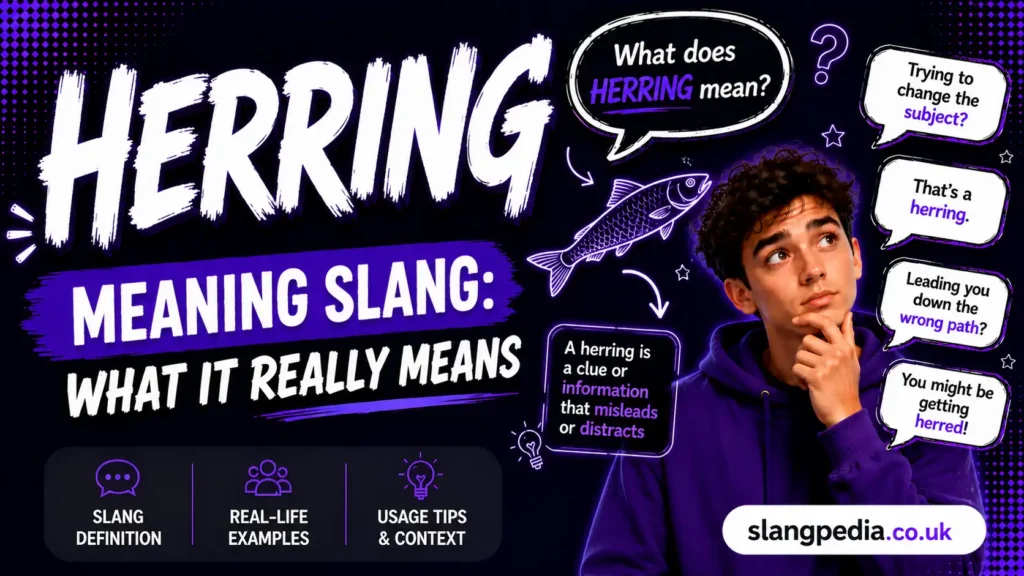
“Herring” means a deliberate distraction or misleading detail — you’ll see it most on TikTok and Discord when someone redirects attention away from the real topic on purpose.
TL;DR
- Herring = something used to throw people off the actual point or truth
- Tone is knowing and slightly smug — like you’ve spotted the trick
- Originated from the phrase “red herring,” a classic debate and mystery tactic
- Used by Gen Z on TikTok, Discord, and Twitter/X in drama, debate, and commentary content
- Warning: saying “that’s a herring” in an argument can come off as condescending if you misread the situation
What Does Herring Mean in Slang?
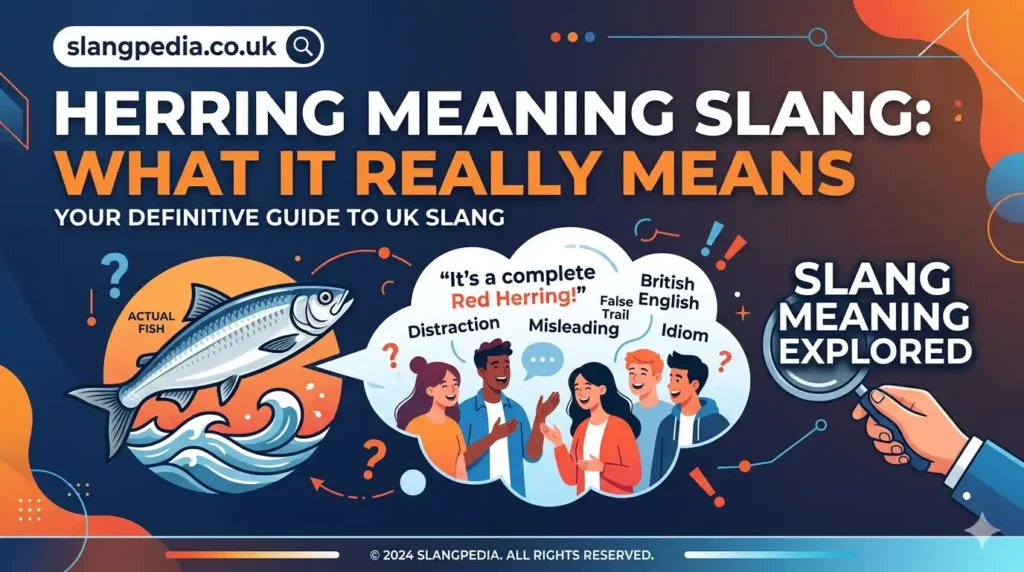
You’re watching a TikTok drama unfold in the comments. Someone drops a bombshell accusation. Then another creator jumps in — not to address it, but to start talking about something completely unrelated. Someone in the replies clocks it immediately: “bro that’s such a herring lmao, they’re not answering anything.”
That’s herring in action.
The word works as a slang shorthand for “deliberate misdirection.” It strips down the old phrase “red herring” into something snappier and more usable in casual conversation. When someone calls out a herring, they’re saying: I see what you’re doing, and it’s not working.
Herring = a tactic used to distract from the real issue or truth
The nuance matters. Calling something a herring isn’t just saying someone is wrong. It’s accusing them of being intentionally evasive. That makes it sharper — and more loaded — than just saying “you’re changing the subject.”
You’ll find it placed naturally alongside words like gaslight when people break down manipulation tactics online.
Where Did the Slang “Herring” Come From?
The phrase “red herring” has roots stretching back centuries. It was used in fox hunting — a smoked herring was dragged across a trail to throw hounds off the scent. From there it entered logic, philosophy, and detective fiction as a word for any clue or argument that misleads.
The slang shortening to just “herring” picked up speed online around 2021–2022, mainly in debate-heavy and media-analysis communities on Reddit, Twitter/X, and Discord. True crime TikTok gave it a huge boost — the genre is built on red herrings, and creators started dropping “herring” in captions and voiceovers casually.
By 2024, it had moved beyond niche commentary spaces into everyday Gen Z vocabulary. The meaning didn’t really shift — it kept the “misdirection” core. What changed was the register: it went from formal logic terminology to something you’d type mid-argument at 2am.
Why Is “Herring” Spelled Different Ways?
You might see it written as “herring,” “red herring,” or occasionally just “the fish” as a joke reference. There are no meaningful spelling variants the way some slang terms mutate. The shortening from “red herring” to plain “herring” is the only real evolution.
Some users drop “red” to sound more casual. Others keep the full phrase for clarity. Both work fine.
Timeline:
- Pre-2020: “Red herring” exists mainly in formal logic, debate class, and mystery fiction contexts
- 2021–2022: True crime TikTok and political Twitter start using “herring” as a casual shorthand in commentary
- 2024–2026: Fully mainstream in Gen Z discourse — used in drama, debates, and everyday convos online
What Does Herring Mean in Text?
In texts and DMs, “herring” almost always signals that someone has spotted evasion. It usually drops when a conversation has gone sideways — someone changed the subject, brought up something irrelevant, or answered a question nobody asked.
In group chats, it often gets used playfully. Someone shares something unrelated to the running conversation and a friend replies “herring” as a joke. In private DMs, it’s more pointed — usually used when calling out a specific person’s avoidance.
Common emojis that pair with it: 🐟, 🚩, 👀, or the classic 💀 when the misdirection is especially obvious.
Text exchange:
Tyler: why didn’t you reply to my message yesterday
Marcus: oh dude have you seen the new Kendrick track tho
Tyler: bro that is such a herring lmaooo answer the question
Marcus: ok fine I was asleep 💀
You’ll often see it alongside sus, especially when someone is calling out sketchy behavior in a group chat.
Common “Herring” Phrases by Context
| Phrase | Meaning | Where You’ll Hear It |
|---|---|---|
| “That’s a herring” | Calling out a distraction tactic | Twitter/X debates, Discord |
| “Major herring energy” | Someone is being very obviously evasive | TikTok comments, group chats |
| “Don’t herring me” | Telling someone to stop deflecting | Private DMs, iMessage |
What Does Herring Mean on TikTok?
On TikTok, “herring” shows up most in captions and voiceovers — especially on drama, commentary, and true crime content. Creators use it to flag when a public figure, news story, or another creator is sidestepping the real issue.
The TikTok meaning is essentially the same as in texting, but the delivery is more performative. A creator pointing out a herring is showing off their critical thinking to their audience.
US TikTok leans heavier into it than UK TikTok, mostly because the discourse communities on US TikTok — political commentary, drama channels, true crime — are where “herring” thrives. UK TikTok uses it too, but less frequently as a standalone term.
It’s more common in comments than captions, usually as a quick call-out.
Herring in Real Conversations: 5 Examples
Example 1 — Group chat debate
Jess: okay but why did he unfollow her
Cody: apparently her dog is really cute tho
Jess: HERRING. answer the actual question
“Herring” signals that Cody has completely dodged the real topic and Jess isn’t letting it slide.
Example 2 — Sincere call-out
Ashley: you said you’d pay me back two weeks ago
Tyler: I’ve just been really stressed with work lately
Ashley: I get that, but that’s kind of a herring — the money thing is separate
Ashley uses it thoughtfully, separating empathy from accountability.
Example 3 — Ironic/funny
Marcus: why are you eating my leftovers
Cody: did you know salmon is actually a type of herring
Marcus: you are LITERALLY using a herring right now
Cody’s response is a joke within a joke — a literal herring used as a herring.
Example 4 — Sarcastic Discord call-out
Tyler: this game update is broken af
Jess: the devs work really hard tho
Tyler: massive herring, that doesn’t fix the lag 💀
“Herring” here dismisses a deflection that shifted blame away from the actual issue.
Example 5 — Casual observation
Ashley: their whole PR statement is just one big herring
Marcus: fr they answered nothing lol
Used analytically, like media commentary — no direct confrontation, just two friends reading the situation.
Herring vs. Similar Slang
| Word | Core Meaning | Tone | Best Used When |
|---|---|---|---|
| Herring | Deliberate misdirection from the real issue | Knowing, slightly smug | Someone has clearly sidestepped a direct question |
| Gaslighting | Making someone doubt their own perception | Accusatory, serious | There’s a pattern of manipulation, not just one dodge |
| Deflection | Avoiding by switching subject | Neutral, more formal | Describing the behavior without calling it out sharply |
| Bait | Content designed to provoke a specific reaction | Playful or hostile | The person wants you to take the wrong bait |
The biggest confusion is between “herring” and “deflection.” They’re close — but deflection is a neutral description of a behavior, while herring carries the implication of intent. Calling something a herring says: they know they’re doing it. That’s what makes it hit harder in an argument.
The Emotional Vibe Behind “Herring”
“Herring” exists because online discourse is exhausting. People dodge, spin, and pivot constantly — in comment sections, in public statements, in group chats. The word gives observers a fast, satisfying way to name the trick without writing a paragraph about it.
When someone uses “herring,” they’re positioning themselves as the one who sees through the noise. It’s not just a label — it’s a social signal. It says: I’m not fooled. I track the thread. I notice what’s being avoided.
That’s why it spread so fast in true crime and drama communities. Those spaces reward people who spot inconsistencies. Dropping “herring” is a form of showing your analytical work.
What does it say about the person being called out? It suggests they’re evasive by design — not accidentally off-topic, but deliberately steering away. That’s a heavier charge than just “changing the subject.”
In a media landscape full of PR statements and carefully worded non-answers, “herring” fills a real gap. It’s the word for when you see the trick and refuse to follow it.
Words like FML exist to release frustration — “herring” does something different. It channels that frustration into a precise observation.
Is “Herring” Offensive?
No, “herring” is not a slur or inherently offensive term. It has no connection to any ethnic, cultural, or identity-based slur.
Context does change its weight, though. Calling someone’s argument a herring in a serious or emotional conversation can feel dismissive — even if you’re technically right. Used carelessly, it can shut down dialogue rather than redirect it.
In the USA and UK, it’s safe to use in casual settings without causing offense. Professionally or academically, “red herring” is still the preferred formal phrasing.
Anyone who tends toward confrontational communication should use it carefully. It implies intent on the other person’s part — which can escalate things if the situation is already tense.
Formal English alternative: “That point is a red herring” or “That’s a logical fallacy — specifically a red herring.”
📌 Quick note for parents and teachers: “Herring” is a shortened version of “red herring” — a logic term for an irrelevant distraction used to mislead. It’s not harmful or vulgar. Kids mostly use it in online debates, commentary, and social media discussions to call out when someone is avoiding a real question.
Herring Slang — FAQ
Q: What does herring mean on TikTok? A: On TikTok, “herring” means someone is using a distraction to avoid addressing the actual issue. Creators use it in commentary and drama content to call out evasive behavior from public figures or other creators. It’s most common in comments and voiceovers.
Q: Is herring a bad word? A: No, herring is not a bad word or slur. It’s a logic term repurposed as casual slang. It can feel aggressive in tense conversations, but the word itself carries no inherent offensiveness.
Q: What’s the difference between herring and gaslighting? A: A herring is a single act of misdirection — one dodge, one irrelevant point dropped to distract. Gaslighting is a sustained pattern of making someone question their own reality. Herring is about deflecting a topic; gaslighting is about distorting someone’s perception over time.
Q: Do Americans and British people use herring the same way? A: Mostly yes — both use it to call out misdirection in arguments and online debates. US usage is slightly more common because of the heavy discourse culture on US TikTok and Twitter/X. British users tend to use the full “red herring” more often in formal or written contexts, but “herring” alone lands fine on both sides of the Atlantic.
The Bottom Line
“Herring” is more than a slang term — it’s a tool for naming a very specific social move. When someone drops a herring, they’re not just changing the subject. They’re banking on you not noticing. Using the word calls that out instantly and precisely.
Next time you see it in a comment section or a group chat, you’ll know exactly what’s being flagged. The person using it has spotted the trick and isn’t taking the bait.
Have you seen “herring” used in a way that surprised you? Drop it in the comments.
Article reviewed for cultural accuracy and native speaker usage across US and UK contexts. Last verified: 2026.

Maggie Wiersma is a USA-based writer with 2 years of experience covering slang meanings, internet culture, and modern language trends. With a background in communication studies, she creates simple and engaging content that helps readers understand today’s most popular slang terms.

