“FS” means “for sure” — a quick way to agree, confirm, or show enthusiasm — you’ll see it most in iMessage threads and Instagram DMs when someone wants to say yes without typing a full word.
TL;DR
- fs = “for sure” — shorthand agreement, confirmation, or hype
- Tone is casual and low-effort; using it signals you’re relaxed, not trying too hard
- Originated in Black American slang and spread through hip-hop culture and early Twitter around 2012–2015
- Used by teens and young adults in the US and UK, though more dominant in American online spaces
- Don’t use “fs” in professional emails, academic writing, or formal contexts — it reads as careless
What Does fs Mean in Slang?
Picture this: your friend texts “you coming to the party tonight?” and instead of typing out a full reply, you fire back “fs.” Done. That’s the energy.
fs is short for “for sure” — one of the most common expressions of agreement in American casual speech. Online, it strips that phrase down to two letters and gets the same job done faster.
But it’s not just a lazy “yes.” When someone sends “fs,” they’re signaling alignment, enthusiasm, or reliability — often all three at once. It carries a laid-back confidence that “yes” or “definitely” doesn’t quite capture.
fs = “for sure” — a casual, confident way to agree or confirm
The word shows up constantly in Gen Z text threads, TikTok comment sections, and Discord servers. It can mean agreement (“fs I’ll be there”), affirmation (“fs that movie was fire”), or solidarity (“fs, that situation sounds rough”).
If you’ve seen fr in similar spots — which means “for real” — then you already understand the vibe fs is going for.
Where Did the Slang “fs” Come From?
fs comes directly from the phrase “for sure,” which has deep roots in Black American Vernacular English (AAVE). “For sure” was widely used in everyday speech long before the internet existed.
The abbreviation form — fs — started spreading on early social media platforms like Twitter and Tumblr around 2012 to 2014. It moved through hip-hop fan communities and Black Twitter first, then bled into mainstream teen internet culture through platforms like Instagram and Vine.
By 2018, it was standard Gen Z shorthand. By 2022, it had crossed over into UK online spaces too — though it remains more dominant in American digital contexts.
Why Is “fs” Spelled Different Ways?
You’ll sometimes see “FS” (all caps) or “f’s” — but these are rare. The all-caps version usually adds extra emphasis, the same way typing “FOR SURE” in a text feels louder. The lowercase “fs” is the standard, everyday form.
Some people also write “fosho” or “fo sho” — these are phonetic spellings of the same phrase from spoken AAVE. They carry the same meaning but feel warmer and more playful.
Timeline:
- 2012: “fs” begins appearing on Black Twitter as shorthand for the spoken AAVE phrase “for sure”
- 2015–2018: Spreads into mainstream teen Instagram and Tumblr culture across the US
- 2022–2026: Fully embedded in Gen Z digital vocabulary on both sides of the Atlantic
What Does fs Mean in Text?
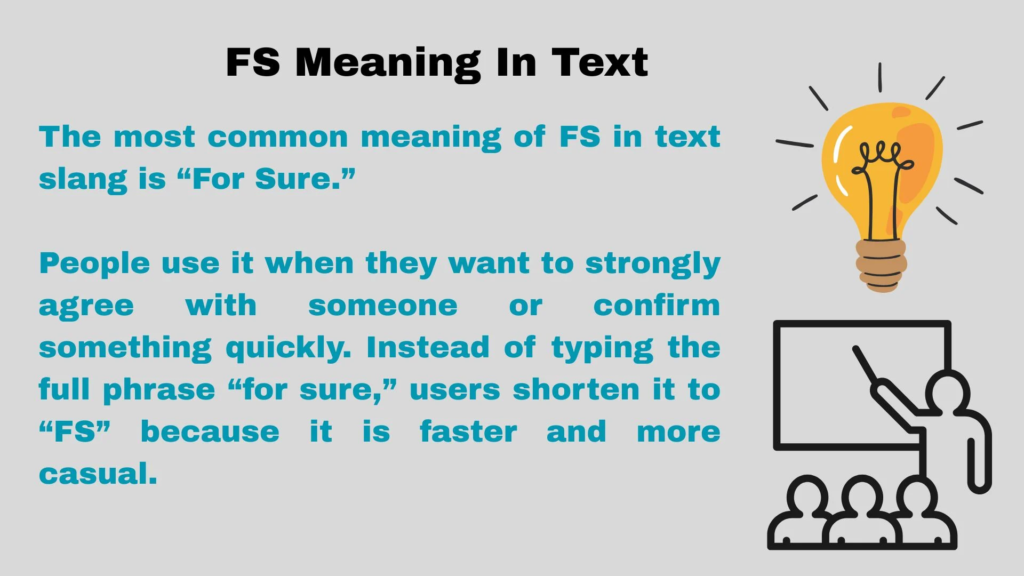
In texts and DMs, fs is one of the smoothest ways to say yes. It’s agreeable without being eager. It confirms plans without sounding stiff.
In one-on-one texts, it usually means direct confirmation. In group chats, it often works more like a reaction — agreeing with something someone said, or hyping up a plan.
Common emoji pairings: 💯, 🙌, ✅, and 🔥. These amp up the agreement energy.
A real text exchange:
Tyler: you tryna grab food after class? Jess: fs, I’m starving lol Tyler: okay bet, meet at 5? Jess: fs 💯
In that exchange, “fs” does double work — first as agreement, then as confirmation. It’s efficient and warm at the same time.
You’ll often see lowkey paired near fs in casual text conversations, adding a layer of understated emphasis.
| Phrase | Meaning | Vibe |
|---|---|---|
| “fs fr” | “for sure, for real” | Extra strong agreement, no irony |
| “fs no cap” | “for sure, not lying” | Sincere, used to emphasize truth |
| “fs bro” | “absolutely, man” | Casual solidarity, usually between guys |
What Does fs Mean on TikTok?
On TikTok, fs appears most in comments rather than captions or voiceovers. When someone posts a relatable video, you’ll see “fs 💯” or “fs bro” flooded in the comments — it’s shorthand for “I totally agree with this.”
It also shows up in caption text like “fs eating pizza at midnight hits different” — using it as an intensifier rather than a reply.
The TikTok meaning doesn’t shift much from its texting meaning. It’s still agreement and confirmation, just playing out at scale in a public comment section.
US TikTok uses it more frequently than UK TikTok. British creators tend to swap in slang like “bare” or “innit” in similar contexts — though younger UK users who grew up on American content use “fs” just as naturally.
fs in Real Conversations: 5 Examples
Example 1 — Group chat plans
Marcus: pregame at mine before the concert? Tyler: fs bro, what time?
“fs” here signals enthusiastic agreement — Marcus knows Tyler’s actually showing up.
Example 2 — Ironic overuse
Ashley: should I eat an entire pizza by myself? Cody: fs, manifesting this for you
Cody’s “fs” is playfully validating a chaotic decision. The irony is the point.
Example 3 — Sincere support
Jess: I finally quit that toxic job Marcus: fs, you deserve so much better
Here “fs” leads a genuine, warm affirmation. It lands like “absolutely” but less formal.
Example 4 — Sarcastic agreement
Tyler: I definitely studied for that exam Cody: fs you did lmao
The sarcasm comes from context — everyone knows Tyler didn’t study. “fs” becomes dry and ironic.
Example 5 — Casual Discord exchange
Ashley: that new season is actually good Tyler: fs no cap, episode 3 is insane Marcus: fs I’ve watched it twice
Multiple people stacking “fs” in a group chat creates a chorus of agreement — it’s social bonding through shared enthusiasm.
fs vs. Similar Slang
| Word | Core Meaning | Tone | Best Used When |
|---|---|---|---|
| fs | “for sure” — agreement/confirmation | Chill, reliable, low-key enthusiastic | Confirming plans, agreeing with a take, showing support |
| fr | “for real” — sincerity or emphasis | Earnest, sometimes surprised | Backing up a strong claim or reacting to something real |
| bet | “okay/agreed” — acknowledgment | Cool, transactional, confident | Accepting a plan or wrapping up a conversation |
| lowkey | “kind of/a little bit” | Understated, soft emphasis | Admitting something you don’t want to shout about |
The one people mix up most is fs vs. fr. Both signal authenticity, but “fs” is about agreement while “fr” is about sincerity. “fs that’s crazy” means you strongly agree something is wild. “fr that’s crazy” means you genuinely can’t believe it. The difference is subtle but real — and native speakers feel it instantly.
The Emotional Vibe Behind “fs”
fs exists because full words require effort — and effort, online, can accidentally read as trying too hard.
“Definitely” sounds formal. “Absolutely” sounds corporate. “Yes” sounds stiff. “fs” hits the exact middle: confident and warm, without performing enthusiasm.
It spread fast because it solves a real communication problem. Online, tone is invisible. A plain “yes” in a text reads as cold or annoyed. “fs” removes that ambiguity — it signals you’re relaxed, friendly, and genuinely on board.
There’s also a cultural layer. “fs” carries traces of AAVE cadence even when written by people who didn’t originate the phrase. Using it is a way of signaling in-group membership — that you’re clued-in to internet culture.
When someone uses “fs” with you, they’re not just agreeing. They’re also saying: I’m easy to be around. I’m not overthinking this. It’s social lubricant disguised as a word.
For a similar low-key affirming function in British slang, herring contexts show how different cultures develop their own shorthand for the same emotional need.
Is “fs” Offensive?
No. “fs” is not offensive, not a slur, and not harmful in any context.
It originated in AAVE, so it’s worth knowing its roots — but it’s been so widely adopted across cultures and platforms that using it doesn’t carry cultural appropriation concerns in the way some AAVE terms might.
Context doesn’t change its safety. “fs” works in the US and UK without causing offense to anyone.
Who should avoid it? Anyone writing in a professional or academic setting. In a work email, a school essay, or a formal message, use “of course,” “certainly,” or “absolutely” instead.
📌 Quick note for parents and teachers: “fs” stands for “for sure” — it’s casual agreement slang with no harmful meaning. Kids use it in texts and on social media to confirm plans or agree with something. It’s not rude, not coded for anything dangerous, and extremely common in Gen Z communication.
fs Slang — FAQ
Q: What does fs mean on TikTok? A: On TikTok, “fs” means “for sure” — it’s used in comments to agree with a video or validate someone’s take. It functions the same as in texting, just in a public, high-volume context. You’ll see it stacked in comments like “fs 💯” when a video hits.
Q: Is fs a bad word? A: No, “fs” is not a bad word. It’s a clean, casual abbreviation for “for sure.” There’s no offensive or inappropriate meaning attached to it in any US or UK context.
Q: What’s the difference between fs and fr? A: “fs” means “for sure” and signals agreement or confirmation. “fr” means “for real” and signals sincerity or disbelief. “fs” answers the question do you agree? — “fr” answers are you serious? They often appear together (“fs fr”) for maximum emphasis.
Q: Do Americans and British people use fs the same way? A: Mostly yes, but Americans use it more naturally and more often. UK Gen Z uses “fs” too — especially those who grew up on American social media — but British slang has more local alternatives. In the US, “fs” is practically universal among under-35s.
The Bottom Line
fs is one of the most efficient words in Gen Z’s digital vocabulary. Two letters that carry agreement, warmth, and cultural fluency all at once.
It started in AAVE, spread through hip-hop and Black Twitter, and became standard internet shorthand across both the US and UK. Now it appears in everything from iMessage threads to TikTok comment sections.
Next time you see “fs” in a text or a comment, you know exactly what it means — and what it’s doing for the conversation.
Have you seen “fs” used in a way that surprised you? Drop it in the comments.
Reviewed by native speakers for cultural accuracy. Slang evolves — if usage shifts, we update.

Maggie Wiersma is a USA-based writer with 2 years of experience covering slang meanings, internet culture, and modern language trends. With a background in communication studies, she creates simple and engaging content that helps readers understand today’s most popular slang terms.