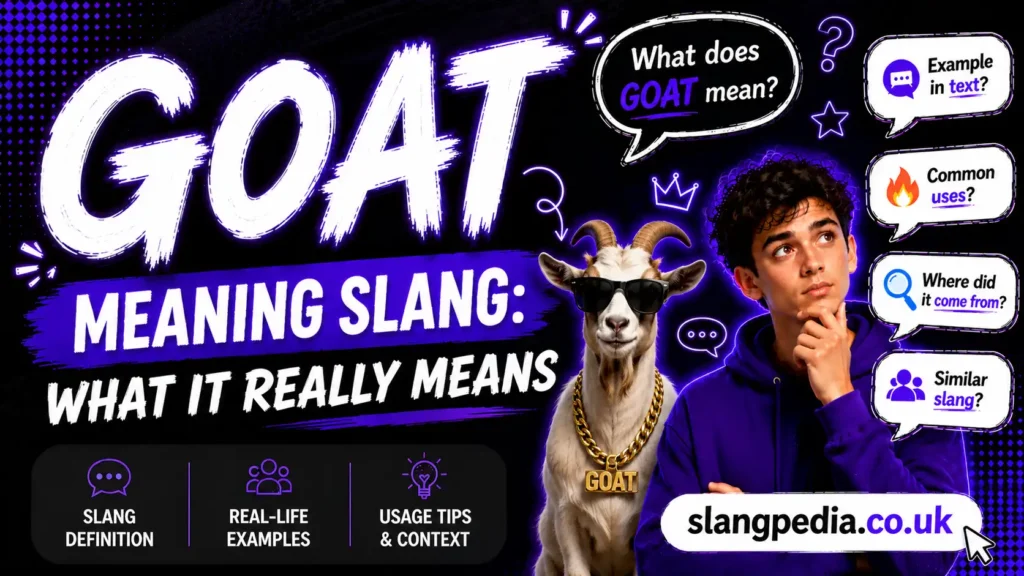
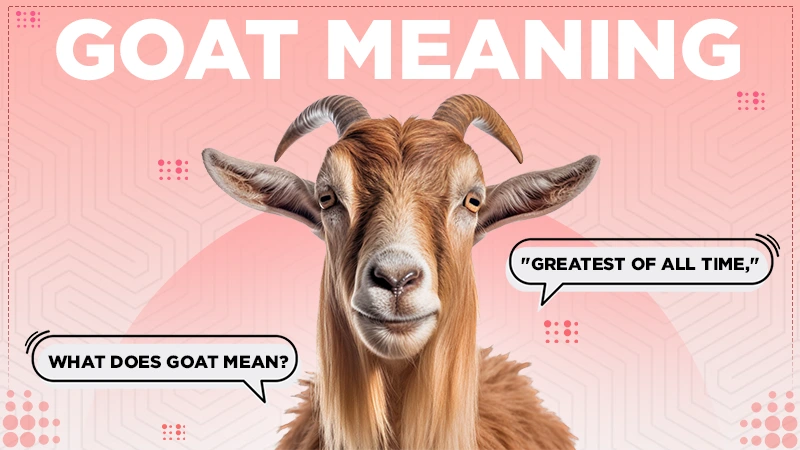
“GOAT” means Greatest Of All Time — you’ll see it most on TikTok and Instagram when someone wants to crown the absolute best at something, no debate needed.
TL;DR
- GOAT = Greatest Of All Time — the highest compliment you can give someone
- Tone is hype, celebratory, and final — it shuts down any argument
- Originated in hip-hop, popularized by LL Cool J’s 2000 album G.O.A.T.
- Used by Gen Z and millennials across all platforms, both in the US and UK
- Warning: Don’t use it for minor wins — calling your friend a GOAT for making coffee is ironic at best, annoying at worst
What Does GOAT Mean in Slang?
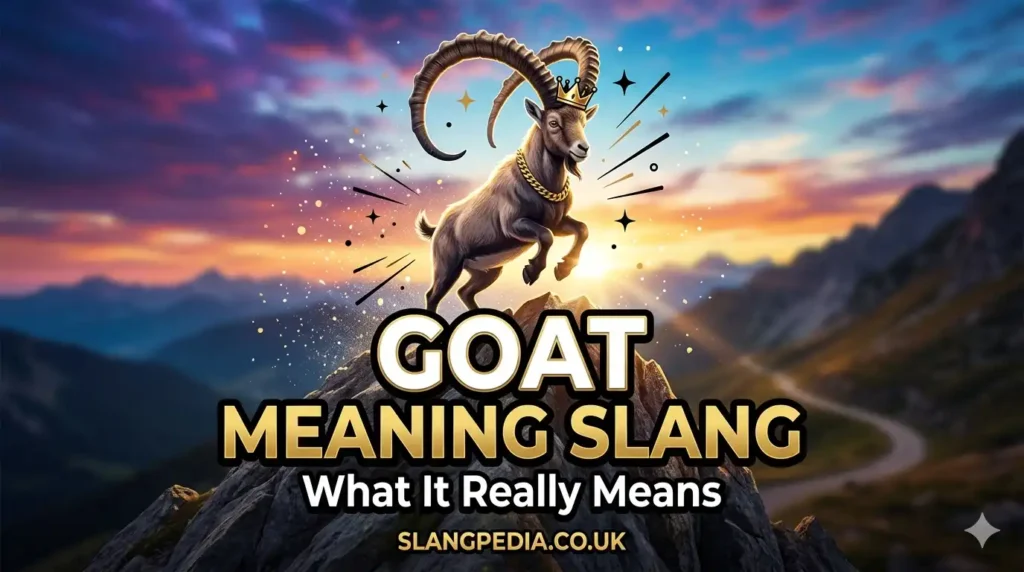
You’re deep in a TikTok comment section. Someone just posted a Ronaldo highlight reel. The top comment? Just two words: “Absolute GOAT.” No explanation. No argument. That’s the whole point.
GOAT stands for Greatest Of All Time. It’s the internet’s way of handing someone a permanent trophy — no asterisks, no runners-up.
But it’s not just about sports. People call coders, chefs, teachers, and even fictional characters GOATs. The word works across every niche.
The nuance matters, though. Calling someone a GOAT signals finality. It’s not “they’re really good.” It’s “no one will ever top this.” That’s a bold claim — which is exactly why it lands so hard online.
GOAT = the single best person or thing in a category, ever
You’ll hear it alongside IYKYK in comment sections where insiders are hyping someone only their community truly appreciates. The energy is the same: exclusive praise, loud confidence.
Where Did the Slang “GOAT” Come From?
GOAT has a traceable origin — rare for internet slang. Muhammad Ali’s wife, Lonnie Ali, trademarked the phrase “Greatest Of All Time” for his brand in 1992. Ali had called himself “The Greatest” for decades, and the acronym was a natural fit.
The slang form exploded in 2000 when hip-hop legend LL Cool J dropped his album titled G.O.A.T. (Greatest of All Time). That album hit number one. The term hit culture.
From hip-hop, it moved into sports commentary — especially NBA and NFL Twitter. By 2013–2015, the LeBron vs. Jordan debate made “GOAT” the default term for the best-ever conversation.
Gen Z picked it up natively on TikTok and Instagram by 2018. Now it’s platform-agnostic.
Why Is “GOAT” Spelled Different Ways?
Most people write it in all caps — GOAT — because it’s technically an acronym. But you’ll also see lowercase goat, especially in casual texts. Some users add the 🐐 emoji instead of typing the word at all. All three mean the same thing.
| Variant | Context | Example |
|---|---|---|
| GOAT (caps) | Formal hype, sports debate | “Jordan is the GOAT, period.” |
| goat (lowercase) | Casual texts, close friends | “bro u a goat for this” |
| 🐐 (emoji) | TikTok comments, quick reactions | “🐐🐐🐐” under a highlight reel |
Timeline:
- 1992: Lonnie Ali trademarks “Greatest Of All Time” for Muhammad Ali’s brand
- 2000: LL Cool J’s G.O.A.T. album shoots the term into mainstream hip-hop culture
- 2015: NBA Twitter adopts it as the standard term for all-time-best debates
- 2018–present: TikTok and Instagram turn it into everyday Gen Z praise language
What Does GOAT Mean in Text?
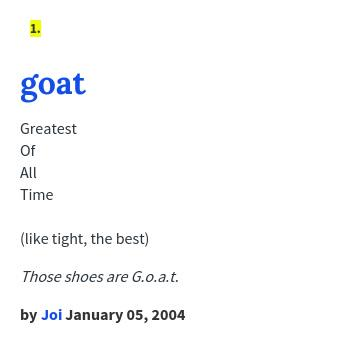
In texts and DMs, GOAT is pure, low-effort praise. You don’t need to explain it. You just drop it.
In private chats between close friends, it’s often ironic or playful — calling someone a GOAT for showing up on time. In group chats, it’s more sincere, usually reacting to something genuinely impressive.
The 🐐 emoji almost always shows up alongside it. Sometimes it replaces the word entirely.
Real text exchange:
Tyler: bro I stayed up and finished your assignment for you
Marcus: no way. you’re an absolute GOAT 🐐
Tyler: lmaooo you owe me
Marcus: GOAT behavior fr
The word signals gratitude and admiration here — and a little disbelief. It works like NFS in that it communicates a complete feeling without needing full sentences.
Common GOAT Phrases by Region
| Phrase | Region | Meaning |
|---|---|---|
| “You’re the GOAT” | USA | Direct, sincere compliment |
| “Absolute GOAT behavior” | UK/US | Praising a specific action, not just a person |
| “The 🐐 is here” | Both | Announcing someone impressive has arrived |
What Does GOAT Mean on TikTok?
On TikTok, GOAT lives in comment sections and video captions. It shows up under highlight reels, cooking videos, skill showcases, and anything where someone does something better than expected.
Creators use it in captions too: “POV: you finally found the GOAT coffee recipe.”
The TikTok meaning is identical to the texting meaning — no shift. But the volume is louder. TikTok comments are public performance, so calling something a GOAT is a way to hype a creator and signal your own good taste at the same time.
Both US and UK TikTok use it equally. The 🐐 emoji is universal shorthand. No translation needed across either audience.
GOAT in Real Conversations: 5 Examples
Example 1 — Sports group chat
Cody: Did you see that last-second shot?? Tyler: Bro Curry is the GOAT no argument
The word shuts down debate before it starts. That’s intentional.
Example 2 — Ironic/Playful
Ashley: I remembered to charge your phone charger Jess: omg you absolute GOAT 🐐
Here it’s clearly joking — and that’s the point. GOAT inflates small gestures for comedic effect.
Example 3 — Sincere Praise
Marcus: You covered my shift last minute. I won’t forget that Tyler: It’s nothing man Marcus: Nah fr you’re the GOAT
No irony, no emoji. Just genuine appreciation delivered with weight.
Example 4 — Sarcastic
Jess: I microwaved my cereal again Ashley: …the GOAT of terrible decisions
GOAT flips here — it’s applied sarcastically to something bad. The contrast is the joke.
Example 5 — Discord/Gaming
Cody: clutched a 1v4 and won the round Tyler: no way 🐐🐐🐐 Marcus: GOAT diff honestly
In gaming, “GOAT diff” means the skill gap was so wide it wasn’t even a contest. The term has evolved its own compound forms here.
GOAT vs. Similar Slang
| Word | Core Meaning | Tone | Best Used When |
|---|---|---|---|
| GOAT | Greatest Of All Time | Celebratory, final, bold | Crowning someone the absolute best |
| Legend | Iconic person, respected for actions | Warm, nostalgic | Someone has done something memorable over time |
| Slay | Executing something flawlessly | Hype, energetic, fashion-forward | Reacting to a specific performance or look |
| Elite | Top-tier quality or skill | Analytical, comparative | Ranking someone among the best, not necessarily #1 |
The confusion is usually between GOAT and Legend. Both are high praise — but GOAT is a definitive ranking. Legend is about impact and memory. You can be a legend without being the GOAT. You can’t be the GOAT without being a legend. When someone says “he’s a legend,” they honor a legacy. When they say “he’s the GOAT,” they’re ending the conversation.
The Emotional Vibe Behind “GOAT”
GOAT fills a specific emotional gap online: the need to express absolute admiration without sounding like a review site.
The internet loves argument. Every platform has ranking culture — top 10s, tiers, debates. GOAT cuts through all of it. It’s a declaration, not an invitation to discuss.
When you call someone a GOAT, you signal confidence. You’re not hedging with “one of the best” or “arguably.” You’re planting a flag.
For the person being called a GOAT, it’s validation without condition. It says: your work is beyond comparison.
The word spread fast because it’s emotionally efficient. Three syllables (or one emoji) replace a paragraph of praise. That’s exactly what social media needs.
It also carries cultural weight. GOAT started in AAVE and hip-hop before going mainstream — the same pipeline as DP and dozens of other terms that crossed from Black internet culture into the broader digital lexicon. That origin matters. It’s worth knowing where the word came from.
Is “GOAT” Offensive?
No — GOAT is not offensive in any context. It’s not a slur. It targets no group. It’s purely positive.
Context doesn’t change that. Whether you drop it sincerely or ironically, the word carries zero harmful weight.
It’s completely safe to use in the US and UK without causing offense. Anyone can use it — teenagers, adults, brands, parents.
The only caveat: using it sarcastically on someone who’s genuinely struggling could land badly in person. Read the room, as with any hype language.
In professional or academic writing, swap it for: “considered the greatest of all time” or “widely regarded as the preeminent figure in [field].”
📌 Quick note for parents and teachers: GOAT stands for Greatest Of All Time — it’s a compliment, not a taunt. You’ll see it in sports discussions, social media comments, and group chats. It’s harmless and carries no negative associations.
GOAT Slang — FAQ
Q: What does GOAT mean on TikTok? A: On TikTok, GOAT means Greatest Of All Time. It appears in comments and captions to praise someone’s skill, performance, or content. The 🐐 emoji is often used instead of the word itself.
Q: Is GOAT a bad word? A: No. GOAT is entirely positive slang. It’s a compliment meaning Greatest Of All Time. There’s no offensive or negative meaning attached to it in any context.
Q: What’s the difference between GOAT and Legend? A: GOAT is a definitive ranking — it means no one is better, ever. Legend is warmer and more about impact over time. You can be a legend without being declared the GOAT, but every GOAT is also a legend.
Q: Do Americans and British people use GOAT the same way? A: Yes — both use it identically. GOAT has no regional meaning shift between US and UK English. The 🐐 emoji is equally universal across both audiences on TikTok and Instagram.
The Bottom Line
GOAT isn’t just praise — it’s a cultural verdict. It closes debates, crowns careers, and signals that someone or something has transcended the competition permanently.
You’ll see it everywhere: comment sections, group chats, captions, Discord servers. When it lands sincerely, it hits harder than almost any other compliment online.
Now you know exactly what it means, where it came from, and how to use it without looking out of place.
Have you seen GOAT used in a way that surprised you? Drop it in the comments.
Last reviewed June 2026. Verified against current usage across TikTok, Instagram, and Discord by native US and UK contributors.

Maggie Wiersma is a USA-based writer with 2 years of experience covering slang meanings, internet culture, and modern language trends. With a background in communication studies, she creates simple and engaging content that helps readers understand today’s most popular slang terms.