“W” means win or winning move — you’ll see it most in TikTok comments and Discord servers when someone wants to hype up an achievement, decision, or person fast.
TL;DR
- W = win. It’s the shortest way to say something was a good move.
- Tone is celebratory, sometimes ironic — context decides which.
- It started in gaming communities around 2015–2016 and exploded on TikTok by 2020.
- Mostly used by teens and young adults aged 13–30 in the US and UK.
- Don’t use it in formal writing — it reads as unprofessional outside casual digital spaces.
What Does W Mean in Slang?
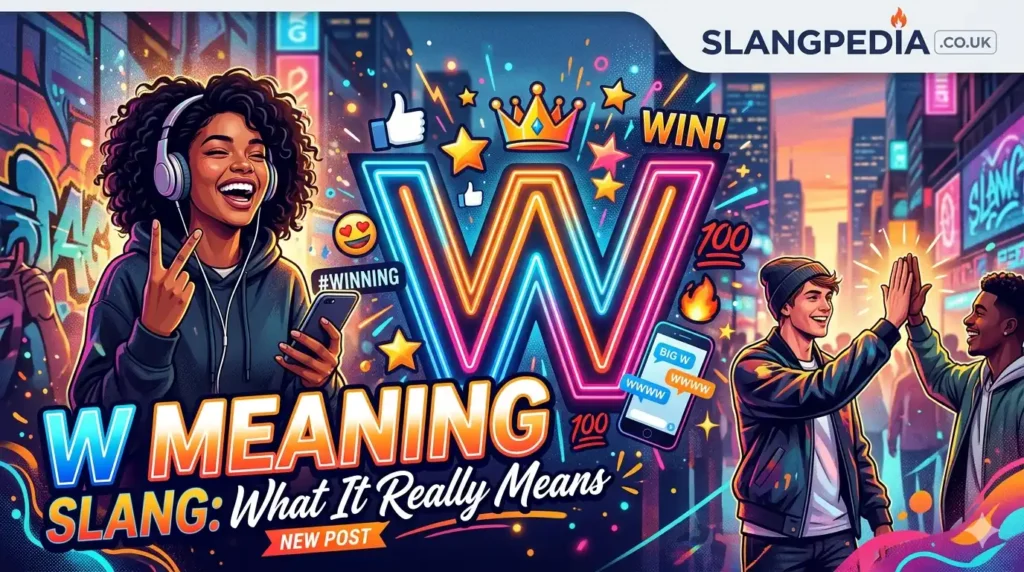
Picture this: your friend texts you that he quit his terrible job and booked a solo trip to Barcelona. You don’t type out a paragraph. You send one letter back — W.
That’s the whole deal. W is short for win. It signals instant approval, respect, or hype. No filler. No punctuation drama.
But there’s a layer underneath the basic definition. When someone drops a W in the comments, they’re not just saying “good job.” They’re saying: I see you, and that move was elite. It’s affirmation with confidence behind it. It hits harder than “nice” or “congrats” ever could.
W = a win, a good decision, or a moment worth celebrating
The slang travels well because it’s so short. One character does the work of a full sentence. It fits the pace of how Gen Z actually communicates. You’ll often see it paired with no cap when someone wants to stress they’re being 100% sincere.
Where Did the Slang “W” Come From?
W as shorthand for win came out of online gaming culture. Players started using W and L (loss) to recap matches fast in chats and forums. No time to type the whole word mid-game.
The earliest mainstream spread happened on platforms like Twitch and Reddit gaming subs around 2015–2016. Streamers used it constantly. Clip highlight titles used it. It was embedded in gaming language before most people outside that world noticed.
By 2019, it had jumped into broader Twitter and YouTube culture. Sports fans adopted it. Rap Twitter picked it up. It started attaching to real-life situations, not just games.
2020 brought TikTok virality. The word exploded in video comments, captions, and audio-over clips. It stopped being gaming slang and became general youth slang — used for everything from life choices to fashion fits to comebacks.
Why Is “W” Spelled Different Ways?
You’ll sometimes see W written as dub — both mean the same thing. “Dub” is just the spoken version of the letter W (like saying “double-u” fast). Some people write big W or massive W to amplify the praise. These variants don’t change the meaning. They just adjust the intensity level.
Timeline:
- 2015: W/L shorthand becomes standard in gaming Twitch and Reddit communities
- 2019: Sports Twitter and hip-hop culture adopt W as general praise
- 2026: W is mainstream Gen Z vocabulary used daily across TikTok, Discord, and iMessage
What Does W Mean in Text?
In texts and DMs, W is pure shorthand approval. It’s fast, warm, and says exactly enough. Private texts between friends often use it to co-sign a decision. Group chats use it more performatively — like a virtual crowd cheer.
Common emoji pairings: 🏆, 💪, 🔥, ✅
Real text exchange:
Marcus: Bro I finally asked her out and she said yes
Tyler: W fr
Marcus: lmaooo I was so nervous
Tyler: Nah that’s a massive W man congrats
In private chats, W is usually sincere. In group chats, it can get ironic — people drop W on bad decisions just to be funny. You’ll also see it linked to rizz when someone pulls off something socially impressive.
Common W Slang Phrases
| Phrase | Meaning | Typical Use |
|---|---|---|
| Big W | An especially impressive win | Hyping a major achievement |
| W rizz | Winning social charm | Complimenting someone’s flirting skills |
| Taking the W | Claiming victory or credit | After a debate, game, or argument |
What Does W Mean on TikTok?
On TikTok, W floods the comment section. It’s the go-to response for reaction videos, life updates, and “watch me do this” content.
Creators use it in captions to frame a moment as a win before the viewer even watches. “W day ✅” or “W energy only” are common caption formats.
The TikTok meaning is the same as texting — but the frequency is higher. Comments move fast. One letter is all anyone needs. UK TikTok uses it just as often as US TikTok. There’s no regional difference in how the word works here. It’s equally loud on both sides of the Atlantic.
W in Real Conversations: 5 Examples
Example 1 — Career flex
Ashley: Got the internship at the label omg
Jess: W LITERALLY W
The repeated W signals genuine excitement — not irony.
Example 2 — Sarcastic group chat
Cody: Just ate cereal with water because I forgot to buy milk
Marcus: bro that’s an L disguised as a W
Here W is used sarcastically to frame a bad choice as somehow bold.
Example 3 — Sincere co-sign
Tyler: Finally cut off that toxic friend group
Jess: That’s a W and you know it
W here signals emotional validation — it’s affirming a hard decision.
Example 4 — Ironic hype
Ashley: I woke up before 10am on a Saturday
Cody: Historic W
Exaggerating a minor thing as a W is a running joke format.
Example 5 — Quick Discord reaction
Marcus: We won the tournament at 2am
Tyler: W
Cody: W 🏆
In Discord, W alone functions as a reaction — fast and communal.
W vs. Similar Slang
| Word | Core Meaning | Tone | Best Used When |
|---|---|---|---|
| W | Win / great move | Celebratory or ironic | Hyping any achievement fast |
| L | Loss / bad move | Disappointed or teasing | Calling out a failure or mistake |
| No cap | Seriously / not lying | Sincere, earnest | Emphasizing you mean something |
| Slay | Doing something impressively | Hype, enthusiastic | Complimenting style or confidence |
The word people confuse W with most is slay. Both are positive. Both show up in hype comments. The difference: slay focuses on style and execution. W focuses on the outcome or decision. You slay a performance. You take a W for a smart move.
The Emotional Vibe Behind “W”
W exists because sometimes you don’t have words — you have a feeling. It fills the gap between reacting and explaining.
Online culture moves fast. Long responses get skipped. One letter gets screenshotted, reposted, and quoted. W survives precisely because it carries maximum meaning in minimum space.
When someone calls your move a W, they’re telling you: your judgment was right. That’s a specific kind of validation. It’s not just praise — it’s a co-sign on your decision-making. For a generation that grew up seeking that kind of peer affirmation online, that matters.
W also has a competitive edge baked in. It comes from win/loss scoring. That context doesn’t disappear — it adds weight. Calling something a W quietly frames life as a game you can win.
That’s why it spread. It’s not just cheerful. It’s got structure underneath it. For anyone exploring the same emotional territory, based works in a similar lane — validating a choice as correct or admirable.
Is “W” Offensive?
W is not offensive. It’s not a slur. It carries no hate speech history. It doesn’t target any group.
Context rarely makes it offensive. The only edge case: using W sarcastically to mock someone’s genuine loss. That’s just mean — but the word itself isn’t the problem there.
It’s safe to use in the US and UK without causing offense. Parents and teachers shouldn’t worry about it. It’s positive slang in nearly every context.
Anyone can use it. There’s no group that should avoid it specifically. In professional or academic writing, replace it with win, success, or strong decision.
📌 Quick note for parents and teachers: “W” means win and signals approval or praise. It’s not harmful or offensive. You’ll see it in your kid’s texts, TikTok comments, and Discord chats as a shorthand cheer.
W Slang — FAQ
Q: What does W mean on TikTok?
A: On TikTok, W means win or a winning moment. It appears in comments to hype up creators, in captions to frame content positively, and in reaction videos to show approval. The meaning is the same as in texting.
Q: Is W a bad word?
A: No. W is not a bad word or a slur. It’s positive slang meaning win. It has no offensive connotations in US or UK culture.
Q: What’s the difference between W and L?
A: W means win — something went right. L means loss — something went wrong. They’re direct opposites and often used together to compare outcomes or tease someone for a bad call.
Q: Do Americans and British people use W the same way?
A: Yes, almost identically. Both use W in texts, TikTok comments, and Discord. There’s no significant regional difference in meaning or tone between US and UK usage.
The Bottom Line
W is one of the most efficient words in Gen Z slang. One letter carries celebration, validation, and competitive energy all at once. It came from gaming. It took over the internet. Now it lives everywhere — texts, TikTok, Discord, real conversations.
When you see a W in the comments, someone is cheering with maximum efficiency. When someone calls your decision a W, that’s real respect.
Next time it appears in your feed, you’ll know exactly what’s behind it.
Have you seen W used in a way that surprised you? Drop it in the comments.
Article reviewed for cultural accuracy. US and UK native usage verified.

Maggie Wiersma is a USA-based writer with 2 years of experience covering slang meanings, internet culture, and modern language trends. With a background in communication studies, she creates simple and engaging content that helps readers understand today’s most popular slang terms.