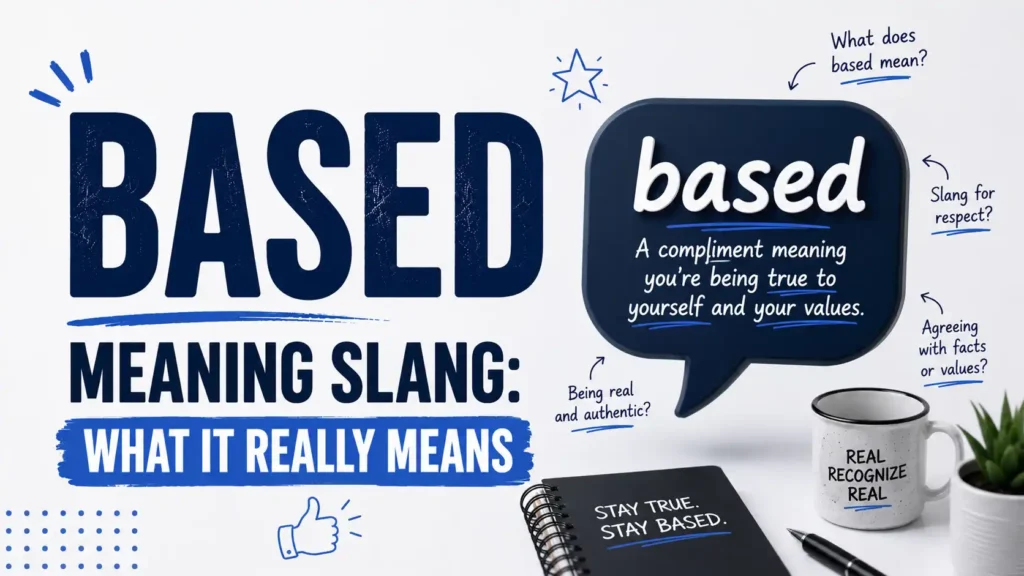
“Based” means having a strong, unapologetic opinion or identity — you’ll see it most on TikTok and Twitter/X when someone praises a person for saying exactly what they think without caring about backlash.
TL;DR
- “Based” = someone who is confident, authentic, and unbothered by what others think of them
- The tone is always a compliment — calling someone based is like saying they passed a vibe check at the highest level
- It started in hip-hop slang around 2010, popularized by rapper Lil B, before exploding on 4chan and then mainstream social media by 2020
- Gen Z and millennials aged 16–30 use it most — heavily skewed toward gaming, Twitter/X, TikTok, and Discord communities
- Usage warning: Avoid using “based” sarcastically in political contexts — it can read as ironic mockery depending on who’s watching
What Does Based Mean in Slang?
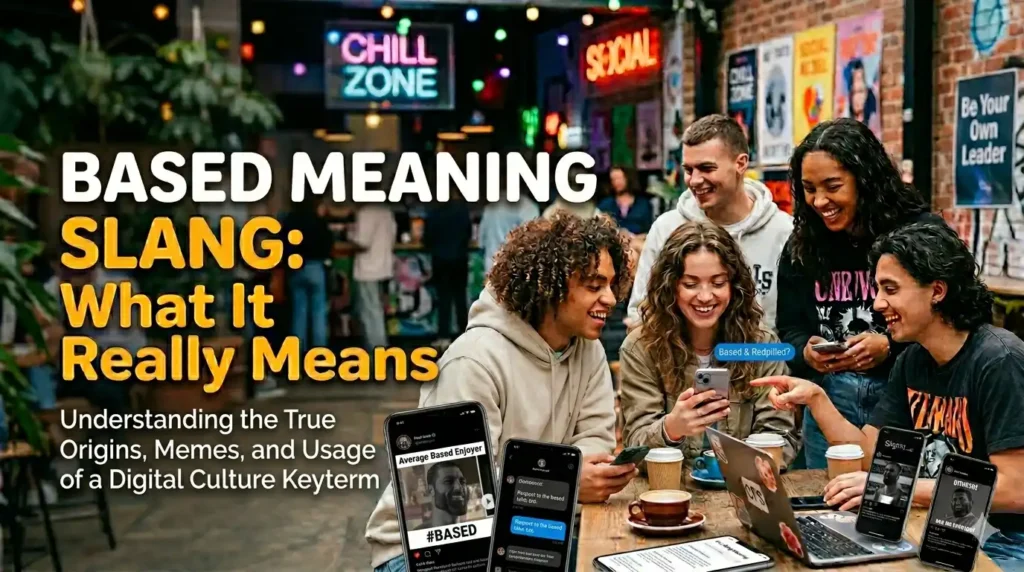
Picture this: someone in a Discord server drops a wildly unpopular take — “pineapple on pizza is actually good and I don’t care what anyone says.” Half the chat tries to ratio them. Then one person types: “based.”
That one word does everything. It says: I see your confidence. I respect it. You didn’t fold.
The slang term “based” means being authentically yourself — holding your opinion, your taste, or your identity without needing approval. It’s not about being right. It’s about not caring whether you’re right in other people’s eyes.
Based = confidently authentic, unbothered, unapologetic
The nuance matters here. “Based” isn’t just cool — it specifically signals ideological or personal courage. You can be based for liking a niche album, defending an unpopular opinion, or just living differently from the mainstream.
It sits in similar territory to no cap, where the whole point is sincerity — but “based” is more about the vibe of the person than the truthfulness of a statement.
Where Did the Slang “Based” Come From?
The word traces back directly to Lil B, a rapper from Berkeley, California. Around 2010–2011, Lil B used “based” to describe his creative philosophy — unapologetic self-expression, positivity, and not conforming to traditional rap norms. He even called himself the “Based God.”
Originally, “based” was West Coast hip-hop insider language. It meant being free from peer pressure and doing your own thing, even if it looked strange to outsiders.
By 2016–2018, 4chan’s /pol/ board picked it up. The meaning stayed — confidence, authenticity — but it drifted toward political contexts. “Based” started appearing next to right-leaning opinion posts as shorthand for “brave enough to say what others won’t.”
By 2020, TikTok and mainstream Twitter completely absorbed it. It shed most of its political baggage for casual Gen Z use. Now it just means: this person has energy I respect.
Why Is “Based” Spelled Different Ways?
“Based” only has one standard spelling — no real variants. You’ll occasionally see “baste” as a joke spelling, or “b4sed” in ironic meme contexts. These aren’t alternative spellings; they’re intentional distortions for comedic effect.
Timeline:
- 2010: Lil B uses “based” in rap to describe his philosophy of freedom and positivity
- 2016: 4chan adopts it as shorthand for politically bold or contrarian opinions
- 2020: TikTok mainstreams it as a pure compliment, stripping most political weight
- 2024–2026: Fully embedded in everyday Gen Z vocabulary on all platforms
What Does Based Mean in Text?
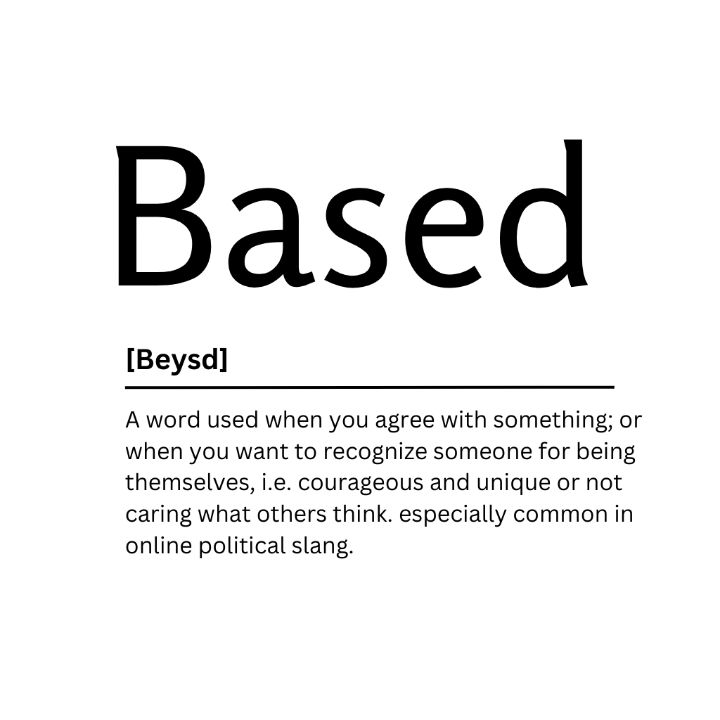
In texts and DMs, “based” works as a one-word reaction — fast, punchy, and almost always a compliment. You drop it the same way you’d drop “facts” or “real.”
It doesn’t shift much between private chats and group threads, but in group chats it hits differently. Calling someone based publicly signals approval in front of an audience — it has a crowd-facing energy.
Common emojis paired with it: 🗿 (the stone face, a classic “based” meme icon), 😤, and occasionally 🫡 for sincerity.
Real text exchange:
Tyler: I told my professor his syllabus was outdated to his face Marcus: bro actually said that?? Tyler: yeah I’m not sitting through 4 months of irrelevant stuff Marcus: based ngl
Here, Marcus isn’t just agreeing — he’s awarding Tyler social credit for not performing compliance. “Based” signals respect without needing more words.
Similar one-word respect signals like OP carry comparable weight in gaming and Reddit spaces — a quick way to honor someone’s move or take.
Common “Based” Phrases and Variations
| Phrase | Meaning | Typical Context |
|---|---|---|
| “Based and [X]-pilled” | Based + convinced of a specific worldview (e.g., “based and redpilled”) | Twitter/X, political forums — often ironic |
| “Based response” | Complimenting someone’s reply as bold and honest | Discord, Reddit comments |
| “Unironically based” | Sincerely calling something based with no irony intended | Used when “based” might otherwise read as sarcastic |
What Does Based Mean on TikTok?
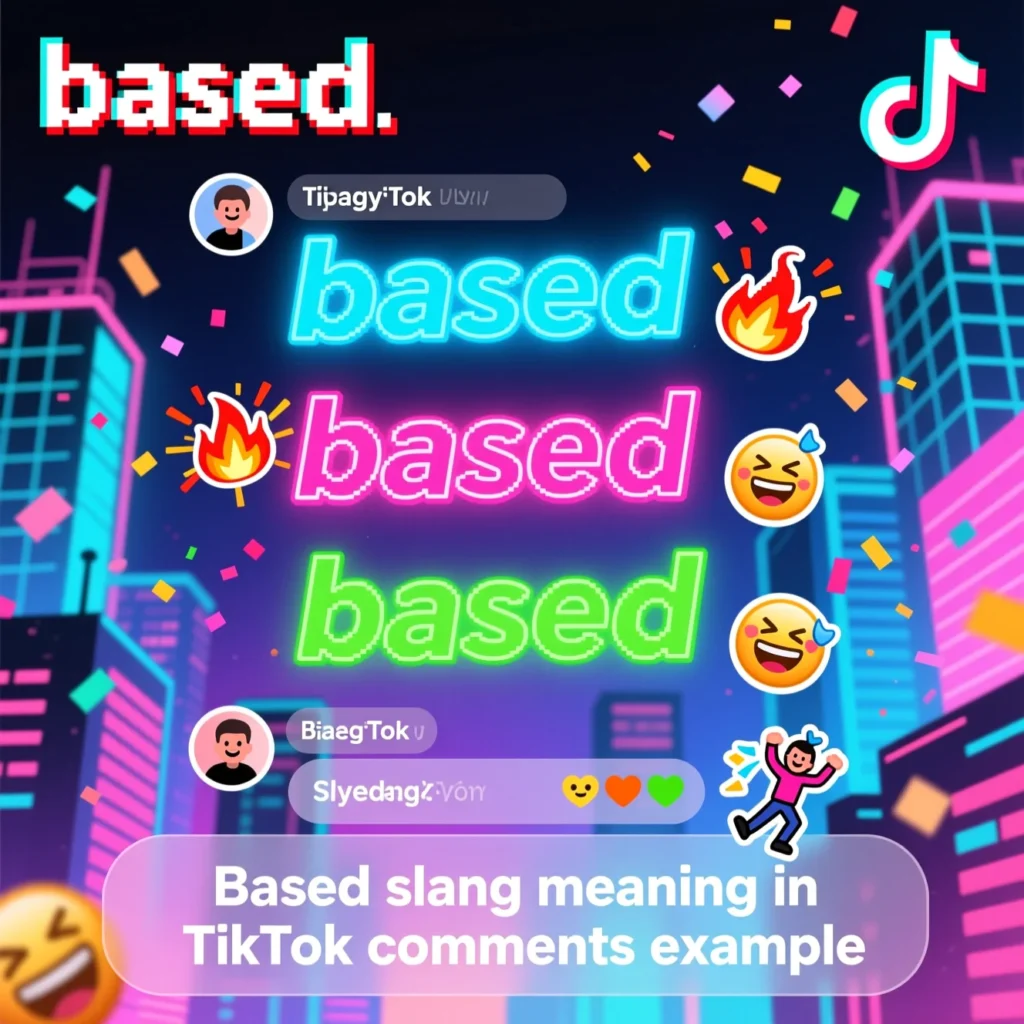
On TikTok, “based” lives in comment sections. Someone posts a controversial opinion video — maybe defending a movie everyone hated, or calling out a social trend. The top comment is almost always: “based.”
It also shows up in video captions like “based take 🗿” or as a voiceover punchline when a creator does something unexpected and self-assured.
The TikTok meaning is cleaner than the texting meaning — almost zero political connotation. US and UK TikTok both use it equally. UK creators lean into it with the same energy as American ones, though UK slang communities sometimes mix it with “real one” for added emphasis.
It’s more visible on US TikTok in terms of raw volume, but the meaning is consistent on both sides of the Atlantic.
Based in Real Conversations: 5 Examples
Example 1 — Unpopular opinion defended
Jess: I think The Last Jedi is actually the best Star Wars movie Cody: based. someone finally said it
Cody isn’t agreeing — he’s respecting Jess for saying it out loud without apologizing.
Example 2 — Ironic group chat use
Ashley: just ate cereal with water because we’re out of milk Tyler: … Marcus: based behavior from based individual
The irony here is obvious — but “based” still communicates a twisted form of admiration for the commitment.
Example 3 — Sincere compliment
Marcus: told my boss I needed the afternoon off and just left Jess: that is genuinely based of you
“Genuinely based” emphasizes sincerity — cutting through any possible irony.
Example 4 — Sarcastic deployment
Cody: I stayed up until 4am to finish a video game on a Tuesday Ashley: truly based of you. truly.
The double “truly” flips it. Cody knows he’s being gently roasted, not celebrated.
Example 5 — Casual Discord reaction
Tyler: @everyone I’m not doing the group project, fend for yourselves Marcus: based Jess: based but also we’re all failing now
Marcus gives the word immediately. Jess extends the joke while keeping the label — “based” stays even when the outcome is chaotic.
Based vs. Similar Slang
| Word | Core Meaning | Tone | Best Used When |
|---|---|---|---|
| Based | Unapologetically authentic and confident | Respectful, sometimes ironic | Someone says or does something bold without needing validation |
| No cap | Totally honest, no exaggeration | Sincere, earnest | Emphasizing that what you’re saying is the complete truth |
| Slay | Doing something impressively well | Celebratory, enthusiastic | Praising performance, style, or execution |
| Goated | Being the greatest of all time at something | Hype, superlative | Recognizing elite skill or a legendary moment |
The word people confuse most with “based” is “no cap.” Both signal authenticity — but “no cap” is about truth-telling, while “based” is about self-confidence. You can be based while saying something false. You cannot be no-cap while saying something false.
The Emotional Vibe Behind “Based”
“Based” exists because online culture desperately needed a word for earned confidence. The internet rewards people who perform — for followers, for approval, for the algorithm. “Based” celebrates the opposite: the person who doesn’t perform.
It spread fast because it’s aspirational. Nobody wants to be the person desperately seeking validation. Calling someone based is a way of saying: you have something I want to have. It’s admiration dressed as commentary.
When you call someone based, you’re also saying something about yourself. You’re positioning yourself as someone who can recognize authenticity — someone with taste and discernment. It’s not just a compliment; it’s a flex.
What does it say about the person being described? It signals they’ve passed the hardest online test: they stayed themselves under pressure. In a culture where every opinion gets ratio’d and dragged, that’s genuinely rare.
In that sense, “based” does cultural work similar to rabe — it’s a shorthand that encodes a whole set of social values in a single syllable.
Is “Based” Offensive?
“Based” is not a slur and is not offensive to any specific group.
On its own, it’s a compliment. Context can make it complicated. In political spaces — especially right-leaning Twitter/X threads — “based” sometimes signals agreement with views that other people find harmful. The word itself isn’t the problem; the company it keeps can be.
In the USA and UK, using “based” casually is completely safe. Most people under 35 understand it as a standard Gen Z compliment. In professional or academic settings, it reads as informal — swap it for “principled,” “confident,” or “authentic.”
Teachers and parents should not worry about the word itself. The formal alternative is simply: “unapologetically confident in one’s opinions.”
📌 Quick note for parents and teachers: “Based” is a Gen Z compliment meaning someone is confidently authentic and unbothered by other people’s opinions. It’s not harmful or offensive on its own. It appears most on TikTok, Discord, and Twitter/X as a reaction to bold or unusual opinions.
Based Slang — FAQ
Q: What does based mean on TikTok? A: On TikTok, “based” is a comment-section compliment that means someone said or did something boldly and without caring about pushback. It appears most on opinion videos, controversial takes, and moments where a creator goes against the grain. The TikTok usage has no strong political connotation — it’s a pure vibe compliment.
Q: Is based a bad word? A: No, “based” is not a bad word. It’s a compliment. It does not target any group, contain offensive language, or carry a harmful meaning. In some political online spaces it can appear alongside divisive content, but the word itself is neutral and widely understood as positive.
Q: What’s the difference between based and no cap? A: “Based” is about a person’s character — their confidence and authenticity. “No cap” is about a statement’s honesty — “I’m telling the truth, no exaggeration.” You can call someone based for holding a wrong opinion with conviction. “No cap” only applies to things you’re genuinely claiming are true.
Q: Do Americans and British people use based the same way? A: Yes, almost identically. Both US and UK Gen Z use “based” as a compliment for confident, unapologetic behavior. UK slang communities might blend it with local terms (“based behavior, real one”), but the core meaning is consistent across both countries. TikTok and Discord are the main platforms where this cross-cultural overlap happens.
The Bottom Line
“Based” is more than a compliment — it’s a cultural value statement. It describes people who don’t need a crowd to feel confident in who they are. Online, where everyone is performing for someone, that quality is rare and respected.
You’ll recognize it instantly next time it appears in your feed. Someone says something bold, gets pushback, doesn’t flinch — and someone in the comments calls it.
One word. Enormous cultural weight.
Have you seen “based” used in a way that surprised you? Drop it in the comments.
Article reviewed for accuracy and cultural relevance — May 2026.
Maggie Wiersma is a USA-based writer with 2 years of experience covering slang meanings, internet culture, and modern language trends. With a background in communication studies, she creates simple and engaging content that helps readers understand today’s most popular slang terms.