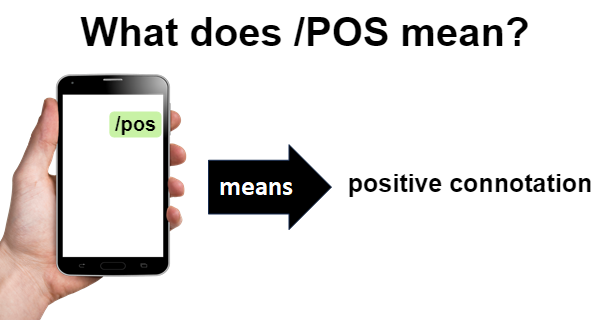
“Pos” means positive connotation — you’ll see it most on TikTok and Twitter/X when someone wants to clarify that their comment, label, or description is meant as a compliment, not an insult.
TL;DR
- Pos is shorthand for “positive” — it’s a tone tag used to signal good intent
- Tone: Warm, reassuring, clarifying — never sarcastic on its own
- Origin: Grew from the neurodivergent and mental health communities on Tumblr around 2020
- Who uses it: Gen Z, neurodivergent users, mental health advocates on TikTok, Twitter/X, and Discord
- Usage warning: Overusing it can feel patronizing if your audience already reads tone clearly
What Does Pos Mean in Slang?
You’re scrolling TikTok comments. Someone writes: “you’re so unhinged Pos.” Your first instinct might be confusion — unhinged sounds like a diss. But that little tag at the end flips everything.
Pos is a tone tag — a bracketed label placed at the end of a sentence. It tells the reader the message carries a positive meaning. Without it, a compliment like “you’re obsessed with this” could easily read as criticism.
Pos = a tag signaling that a statement is meant positively, not as an insult or sarcasm
The word “unhinged,” “delusional,” or “toxic” can all be used as terms of affection in Gen Z culture. Pos removes the guesswork. It’s especially common in communities where people struggle to read tone in plain text — like autistic or anxious users.
Think of it as putting a smiley face on a sentence, but in bracket form.
Where Did the Slang “Pos” Come From?
Pos didn’t come from rap or roadman slang. It came from accessibility culture — specifically from neurodivergent communities on Tumblr and early Twitter.
Around 2019–2020, users on Tumblr began developing a system of tone tags to help neurodivergent readers — particularly autistic people — decode the emotional intent of posts. Text strips out facial expressions, voice tone, and body language. That gap causes real miscommunication.
The tone tag system spread quickly. Tags like /j (joking), /s (sarcastic), /srs (serious), and /pos (positive) became common. The bracketed version Pos emerged as an alternative format — slightly cleaner for comment sections and Discord chats.
Why Is “Pos” Spelled Different Ways?
You’ll see it as Pos, /pos, (pos), and sometimes just pos without brackets. The bracket style depends on the platform. Discord users favor /pos. TikTok commenters prefer Pos. The meaning stays the same across all versions.
Timeline:
- 2019: Tone tags emerge on Tumblr inside neurodivergent and mental health communities
- 2021:
/posandPosspread to Twitter/X and Discord as mental health discourse grows - 2023–2026: Pos goes mainstream on TikTok — used by general Gen Z audiences, not just neurodivergent users
What Does Pos Mean in Text?
In private texts, Pos is less common — close friends usually read tone naturally. It shows up more in group chats, especially when someone makes a bold or edgy compliment.
In DMs with someone new, Pos acts like a safety net. It keeps a flirty or intense message from landing wrong.
Emojis that usually pair with it: 🥺, 💗, ✨, 😭 (used affectionately)
Example text exchange:
Tyler: bro you’re actually insane at this game Pos
Marcus: lmaooo thought you were roasting me for a sec
Tyler: nah fr, you carried that whole match
Marcus: 😭 say Pos earlier next time
In group chats, Pos often appears after a Gen Z-style compliment that uses negative-sounding words. It also pairs naturally with SSA energy — both terms show up in affirming, hype-up conversations online.
Common Pos Phrases and Local Usage
| Phrase | Meaning | Platform |
|---|---|---|
| “you’re delusional Pos” | Means someone is admirably confident or bold | TikTok, Twitter/X |
| “this is unhinged Pos” | Praising creative or chaotic energy | Discord, TikTok comments |
| “obsessed with you Pos” | Expressing admiration or a fan moment | iMessage, Instagram DMs |
What Does Pos Mean on TikTok?
On TikTok, Pos lives almost entirely in the comments section. Creators use it to hype fans, and fans use it to compliment creators without sounding passive-aggressive.
It shows up most on:
- Cosplay and fan content — “your dedication is unreal Pos”
- Transformation or glow-up videos — “you look so different Pos”
- Chaotic or niche humor content — “this is genuinely unhinged Pos”
The TikTok meaning matches the texting meaning — it’s always a positive clarifier. It’s used equally across US TikTok and UK TikTok, though UK users are slightly less likely to bracket it formally.
Pos in Real Conversations: 5 Examples
Example 1 — TikTok Comment Hype
Ashley: your energy in this video is actually feral Pos
Pos signals that “feral” is a compliment — wild, free, unfiltered energy.
Example 2 — Discord Server Banter
Cody: you are genuinely the most chaotic person in this server Pos i love it
Jess: 😭 i’ll take it
Here Pos protects the sentence from reading as a complaint in a busy group chat.
Example 3 — Sincere iMessage Moment
Tyler: you’re actually obsessed with fixing everything for everyone Pos like it matters
Marcus: that actually means a lot ngl
Used sincerely here — Pos adds warmth to a genuine compliment about someone’s character.
Example 4 — Sarcasm Shield in a Group Chat
Ashley: girl your taste is so niche it’s almost a problem Pos
Jess: ALMOST 💀
Without Pos, “almost a problem” would read as shady. With it, it’s clearly celebratory.
Example 5 — Casual Creator Comment
Cody: this video is deranged Pos please never stop posting
Pos makes “deranged” a badge of honor — chaotic creativity being praised, not criticized.
Pos vs. Similar Slang
| Word | Core Meaning | Tone | Best Used When |
|---|---|---|---|
| Pos | Signals a statement is positive/complimentary | Warm, clarifying | Complimenting someone using edgy or ambiguous language |
| [Neg] | Signals a statement is negative or critical | Blunt, serious | Giving honest criticism without sugarcoating |
| [Srs] | Signals you’re being serious, not joking | Neutral, earnest | Your statement could be mistaken for a joke |
| Fr fr | Emphasizes sincerity or agreement | Casual, affirming | Backing up a statement you really mean |
The most common mix-up is between Pos and fr fr. Both signal sincerity — but Pos is a tone clarifier, while fr fr is an intensity amplifier. Use Pos when the meaning of your words could be misread. Use fr fr when you just want extra emphasis on something already clear.
The Emotional Vibe Behind “Pos”
Pos exists because the internet broke tone.
Text is flat. It doesn’t carry a smirk, a warm voice, or a raised eyebrow. And Gen Z communicates in a dialect full of irony, hyperbole, and reclaimed insults. Calling someone “unhinged” or “delusional” can be the highest compliment — or a real critique. There’s no way to tell without context.
Pos fills that gap. It hands the reader emotional clarity on a silver plate.
But it also says something deeper. Using Pos signals that you care about how your words land. It shows awareness — that miscommunication isn’t always about bad intent, sometimes it’s just about format. That’s very online, and very Gen Z.
It spread because neurodivergent communities needed it first. Then everyone else realized they needed it too. Good tools don’t stay niche forever. The emotional labor of “but I didn’t mean it like that” gets exhausting. Pos skips that whole conversation.
It’s the same impulse behind unc — both terms exist to sharpen meaning in a digital world that constantly blurs it.
Is “Pos” Offensive?
Pos is not offensive — at all. It’s a tone clarifier, not a slur or loaded term. No specific group finds it harmful or inappropriate.
Context doesn’t make it offensive. Its entire purpose is to prevent offense by making positive intent explicit.
It’s safe to use in both the USA and UK without causing harm. The only caution: using it excessively with close friends who already read your tone well can feel unnecessary or condescending.
For professional or academic writing, skip Pos entirely. Use clear, explicit language instead — “I mean this as a compliment” works fine in formal settings.
📌 Quick note for parents and teachers: Pos is a “tone tag” — a bracketed label used to clarify that a message is positive. It’s harmless and actually promotes clearer communication. It appears most on TikTok, Discord, and Twitter/X, often alongside compliments phrased in unexpected ways.
Pos Slang — FAQ
Q: What does Pos mean on TikTok?
A: On TikTok, Pos means the comment or caption is intended as a compliment or positive statement. It’s used when a compliment uses edgy or ambiguous words — like calling someone “feral” or “unhinged” — to make sure the praise reads correctly.
Q: Is Pos a bad word?
A: No. Pos is completely inoffensive. It’s a tone tag that signals good intent. There’s nothing harmful or inappropriate about it in any context.
Q: What’s the difference between Pos and fr fr?
A: Pos clarifies the emotional tone of a statement — it means “this is meant positively.” Fr fr (for real, for real) emphasizes sincerity or agreement — it means “I genuinely mean this.” They’re related but solve different communication problems.
Q: Do Americans and British people use Pos the same way?
A: Mostly yes. Both US and UK Gen Z audiences use Pos in comments and group chats. UK users are slightly more likely to drop the brackets and just write /pos, especially on Discord. The meaning doesn’t change either way.
The Bottom Line
Pos is a small tag with a big job. It exists because Gen Z speaks in irony, hyperbole, and reclaimed language — and text alone can’t always carry the warmth behind it. Slapping Pos on the end of a compliment removes ambiguity instantly.
It started in neurodivergent communities as an accessibility tool. Now it’s mainstream communication hygiene. When you see it, you know: whoever wrote that genuinely meant something good.
Understanding Pos means understanding how online communication has evolved — tone is no longer assumed, it’s declared.
Have you seen Pos used in a way that surprised you? Drop it in the comments.
Article reviewed for cultural accuracy and native usage. Last updated: 2026.

Maggie Wiersma is a USA-based writer with 2 years of experience covering slang meanings, internet culture, and modern language trends. With a background in communication studies, she creates simple and engaging content that helps readers understand today’s most popular slang terms.