“Tea” means gossip, drama, or juicy inside information — you’ll see it most on TikTok and group chats when someone is about to spill a secret or expose a situation.
TL;DR
- “Tea” = gossip, receipts, or hot drama worth sharing
- Tone is excited, conspiratorial, and often a little chaotic
- Originated in Black drag culture and AAVE, went mainstream around 2018
- Used by Gen Z and millennials across the US and UK equally
- Warning: using it sarcastically or dryly can confuse people who take it literally
What Does Tea Mean in Slang?
Picture this: it’s 11pm and your group chat blows up. Ashley types “bestie I have TEA 👀” and suddenly everyone’s awake. Nobody’s talking about a hot drink. She’s got gossip — real, messy, can’t-look-away drama — and she’s about to share it.
That’s exactly what “tea” means in slang. It refers to gossip, inside information, or a revealing story about someone or something.
The tone isn’t always mean. Sometimes the tea is celebratory — “she got the job!” counts. But usually it’s spicy. It signals: I know something you don’t, and you’re going to want to hear it.
Tea = gossip, drama, or insider information worth knowing
The word carries an air of social currency. If you have tea, you have power in that moment. It connects closely to the phrase spill the tea, meaning to reveal what you know.
Where Did the Slang “Tea” Come From?
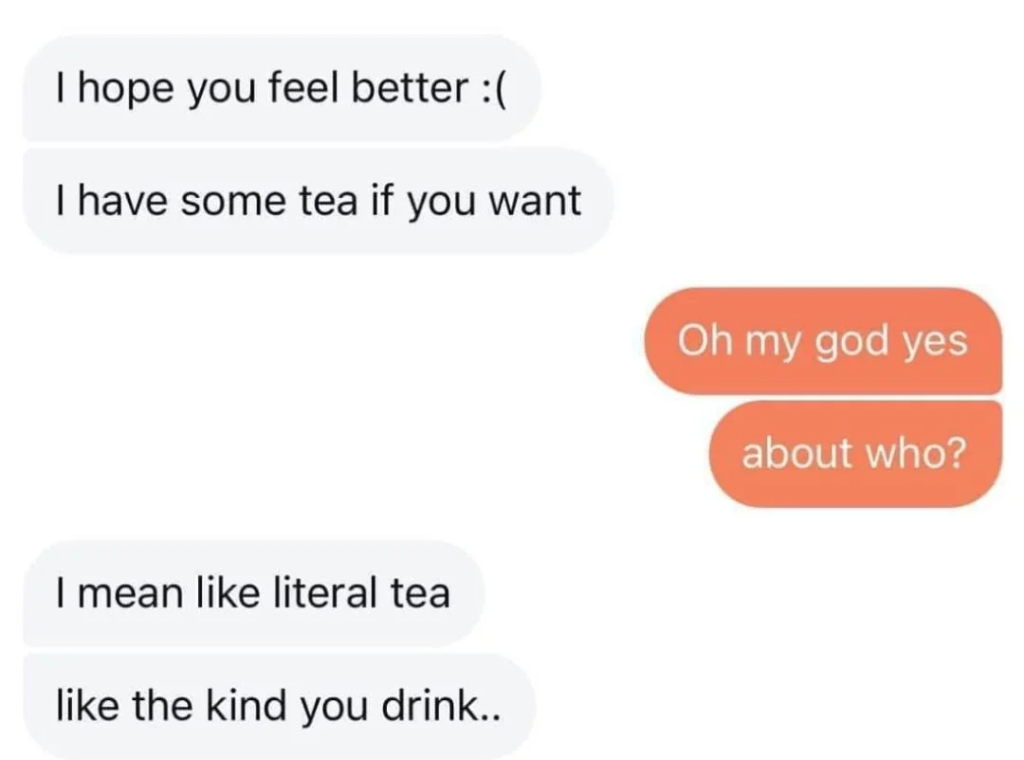
“Tea” in this sense came directly from Black drag culture and AAVE (African American Vernacular English). In drag ballroom spaces, “T” or “tea” meant truth — as in the real T, the unfiltered reality of a situation.
RuPaul’s Drag Race helped it cross into mainstream American culture in the early 2010s. By 2017–2018, TikTok and stan Twitter had fully absorbed it. UK users picked it up around the same time, partly through shared meme culture.
Why Is “Tea” Spelled Different Ways?
You’ll sometimes see it written as “T” (the original drag/AAVE form) or “the tea” with the definite article for emphasis. Neither is wrong — they carry slightly different weight. “T” feels older and more rooted in the culture. “Tea” is the mainstream evolution. Both mean the same thing.
Timeline:
- 2000s: “T” circulates in Black drag and ballroom communities as slang for “truth”
- 2013–2016: RuPaul’s Drag Race popularizes “spill the tea” with wider audiences
- 2018–2020: TikTok and Twitter embed “tea” into everyday Gen Z vocabulary
- 2022–2026: Fully mainstream in the US and UK — used by everyone from teens to journalists
What Does Tea Mean in Text?
In a one-on-one DM, “tea” usually signals something personal and private. You’re being trusted with something. In a group chat, it’s more performative — the person spilling it wants an audience.
Common emojis paired with it: ☕ (obviously), 👀, 😳, 🫖, and 🫢. The teacup has basically become its own shorthand for gossip.
Real text exchange:
Marcus: yo i have TEA about Jake and Mia ☕
Tyler: NO WAY what happened
Marcus: she found out he was talking to someone else the whole time
Tyler: i KNEW something was off with him
“Tea” here signals urgency and social intimacy. It’s an invitation to lean in.
You’ll sometimes see it paired with no cap to emphasize that the gossip is completely true and not exaggerated.
| Phrase | Meaning | Usage Context |
|---|---|---|
| “Spill the tea” | Tell me the gossip right now | Group chats, TikTok captions |
| “That’s the tea” | That’s the truth / that’s what happened | Confirming drama or a story |
| “Weak tea” | Boring gossip, not impressive | When someone overhypes mild news |
What Does Tea Mean on TikTok?
@englishwithtiffani #slang #tea #teacher #teachertiffani #vocabulary #learnenglish ♬ original sound – English with Tiffani
On TikTok, “tea” lives in captions, comment sections, and voiceovers. Creators use it to tease drama before the reveal — “okay I have some tea about this brand ☕” is a classic hook. Comments flood in with “spill it” and “I need the tea NOW.”
The meaning doesn’t shift much from texting, but the scale does. TikTok tea is often about celebrities, influencers, or viral internet drama rather than personal life.
US and UK TikTok use it equally. British users blend it naturally with existing tea-drinking culture references, which adds an extra layer of irony that American audiences sometimes miss.
Tea in Real Conversations: 5 Examples
Example 1 — Group Chat Explosion
Ashley: I have tea and I’m shaking rn
Jess: TELL US
Ashley: okay so Cody kissed someone at the party last night
“Tea” signals that what follows is too big to sit on — it demands an audience immediately.
Example 2 — Dry / Ironic
Tyler: bro the tea is that I failed my driving test again
Marcus: …that’s not tea that’s just tragedy
Used ironically here — Tyler is mocking himself by framing personal failure as gossip.
Example 3 — Sincere / Wholesome
Cody: okay good tea actually — Jess got into her dream school
Ashley: WAIT WHAT that’s the best tea I’ve heard all week
Tea doesn’t have to be negative. Positive surprises count too.
Example 4 — Sarcastic
Marcus: you want the tea on my mom’s lasagna recipe
Tyler: I literally do not
Using “tea” for something mundane is a dry, deadpan joke — usually lands well in close friendships.
Example 5 — Discord Server
Jess: mods have tea about the streamer, dropping receipts tonight
Tyler: finally someone said something
Marcus: 👀☕ I’ve been waiting for this
On Discord, “tea” + “receipts” signals documented proof — screenshots, timestamps, hard evidence.
Tea vs. Similar Slang
| Word | Core Meaning | Tone | Best Used When |
|---|---|---|---|
| Tea | Gossip or insider info | Conspiratorial, excited | Sharing a story or drama |
| Receipts | Proof or evidence | Confrontational, serious | Backing up a claim with facts |
| Shade | Subtle disrespect or criticism | Cool, indirect | Throwing low-key insults |
| Dirt | Damaging secrets | Threatening, edgy | Exposing someone negatively |
The easiest mix-up is tea vs. receipts. Tea is the story. Receipts are the proof. You can have tea without receipts — but if you have receipts, the tea is way more credible. People often use both together: “she has the tea AND the receipts.”
The Emotional Vibe Behind “Tea”
“Tea” exists because humans have always needed a way to frame gossip as entertainment rather than cruelty. The word makes sharing information feel playful. It takes the guilt out of it.
That’s why it spread so fast online. Social media turned gossip into a spectator sport. “Tea” gave it a brand.
When someone says they have tea, they’re not just sharing information — they’re performing social closeness. They’re saying: I trust you enough to tell you this. It builds intimacy fast.
When someone is described as “having tea” on them, it usually means they’re messy — involved in drama, living out loud. It’s not always a compliment.
There’s a reason the word connects to the mewing era of internet culture — both are about self-presentation and social currency. How you share tea says as much about you as what you’re sharing.
The word makes gossip feel communal rather than mean. That framing is exactly why it took over.
Is “Tea” Offensive?
No, “tea” is not offensive. It’s not a slur, and it doesn’t target any group.
Context can make it unkind — using it to spread rumors about someone is gossip, and gossip can hurt people. But the word itself carries no inherent malice.
It’s safe to use in both the US and UK without causing offense. Very young speakers (under 13) might not clock it. Older adults may take it literally and expect a beverage conversation.
In professional or academic writing, replace it with: insider information, rumor, or unverified report.
📌 Quick note for parents and teachers: “Tea” in this context means gossip or inside information — it’s not harmful slang. You’ll see it in group chats and social media captions. It signals social bonding and the sharing of news, not bullying or explicit content.
Tea Slang — FAQ
Q: What does tea mean on TikTok? A: On TikTok, “tea” means gossip, drama, or behind-the-scenes information about a person or situation. Creators use it in captions and voiceovers to tease a reveal. It functions the same as in texting but at a public, broadcast scale.
Q: Is tea a bad word? A: No. “Tea” is not a bad word or offensive slang. It simply means gossip or inside information. The content being shared might be inappropriate, but the word itself is harmless.
Q: What’s the difference between tea and receipts? A: Tea is the gossip — the story or rumor itself. Receipts are the evidence — screenshots, videos, or proof. You can have tea without receipts, but receipts make the tea more credible. Both are often used together during online drama.
Q: Do Americans and British people use tea the same way? A: Mostly yes, though British speakers sometimes layer it with irony given the UK’s actual tea-drinking culture. The slang meaning is understood the same way on both sides of the Atlantic. UK users adopted it from US internet culture around 2017–2018.
The Bottom Line
“Tea” started as a word for truth in Black drag culture. Now it’s the internet’s universal shorthand for gossip and drama. It makes sharing information feel exciting rather than mean. It signals trust and social closeness — whoever’s spilling it controls the room.
Next time you see “☕” in a caption or “I have tea” in your DMs, you know exactly what’s coming. Lean in or brace yourself.
Have you seen “tea” used in a way that surprised you? Drop it in the comments.
Article reviewed for cultural accuracy. US and UK usage verified by native speakers. Last updated: 2026.

Maggie Wiersma is a USA-based writer with 2 years of experience covering slang meanings, internet culture, and modern language trends. With a background in communication studies, she creates simple and engaging content that helps readers understand today’s most popular slang terms.