“Pearl necklace” means a sexual act involving ejaculation on someone’s neck or chest — you’ll see it most on TikTok and Twitter when someone references it through coded humor or innuendo.
TL;DR
- “Pearl necklace” is slang for a specific sexual act — ejaculation on the neck or chest area
- Tone: Usually humorous, coded, or ironic — rarely said with full seriousness in casual conversation
- Origin: The term existed in adult slang well before the internet, but spread online through hip-hop lyrics and adult content communities in the early 2000s
- Who uses it: Older Gen Z and Millennials (20–30s), mostly in joke contexts, meme culture, or risqué texting
- Usage warning: This is NSFW slang — using it casually in mixed or professional company will almost certainly cause offense
What Does “Pearl Necklace” Mean in Slang?
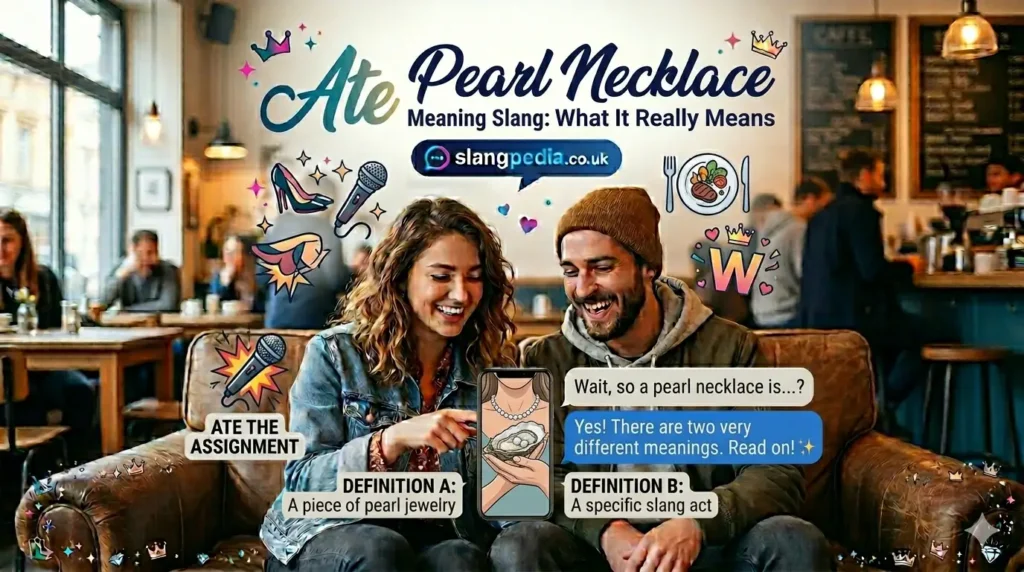
Picture a TikTok comment section under a jewelry haul video. Someone posts a sparkling white necklace. Within minutes, the top comment is just: 😏 “pearl necklace.” Hundreds of laughing emojis follow.
That’s how this term lives online — hidden in plain sight.
In literal English, a pearl necklace is fine jewelry. In slang, it refers to a sexual act where a partner ejaculates on another person’s neck or chest, creating the visual appearance of a necklace.
Pearl necklace = slang term for ejaculation on the neck or chest during sexual activity
The slang version works because it sounds completely innocent on the surface. That double meaning is the whole point — it lets people make adult jokes in public spaces with plausible deniability.
You might also encounter similar coded sexual slang used the same way across social platforms.
The tone is almost always playful or ironic. Very few people use it to describe an actual experience — most use it to be funny.
Where Did the Slang “Pearl Necklace” Come From?
The sexual meaning of “pearl necklace” predates the internet. It circulated in American adult slang through the 1980s and 1990s, mostly in underground humor and adult entertainment communities.
Hip-hop brought it into mainstream awareness. Artists referenced it in lyrics throughout the late 1990s and early 2000s, and that exposure moved the term from niche adult slang into broader pop culture.
The internet turbocharged its spread. Message boards, adult sites, and eventually social media helped it land in the vocabulary of younger generations who encountered it mostly through memes and song references — not direct experience.
Timeline:
- 1980s–90s: Circulates in American adult slang and underground humor communities
- Late 1990s–2000s: Referenced in hip-hop lyrics; becomes more widely known
- 2010s: Meme culture adopts it; spreads through Twitter, Tumblr, and Reddit
- 2020s: Lives on TikTok as coded humor — used in comment sections under innocent jewelry or fashion content
Today the slang version is widely recognized. Most people under 35 in the US and UK know what it means when they see it used ironically.
What Does “Pearl Necklace” Mean in Text?
In private DMs, “pearl necklace” is sometimes used sincerely — between partners being flirtatious or explicit. Context makes the meaning obvious.
In group chats, it almost always functions as a joke. Someone spots the phrase used innocently elsewhere, screenshots it, and shares it for laughs.
Common emojis paired with it: 😏 💎 📿 😂
Example text exchange:
Tyler: just got my mom a pearl necklace for her birthday
Marcus: bro please say that differently
Tyler: …oh my god
Marcus: 😂😂😂
That exchange captures exactly how the slang operates — the humor comes from the collision between innocent intent and loaded meaning.
Like tea, this is a term that reads completely differently depending on who’s sending it and where.
Common phrases and regional variations:
| Phrase | Usage Context | Tone |
|---|---|---|
| “She got a pearl necklace” | Used as a punchline after someone mentions jewelry | Ironic / humorous |
| “Gifted her a pearl necklace 😏” | Instagram or Twitter caption on jewelry content | Innuendo / coded |
| “Bro said pearl necklace 💀” | Reaction to someone using the term innocently | Shock humor |
What Does “Pearl Necklace” Mean on TikTok?
@thequeenbeav Replying to @AnaSandra What IS a pearl necklace? So glad you asked. When you get to the age of 50ish, you have enough life experience to know that people with dirty minds are super special. I just happen to have created an entire product around a beaver that goes gray and that you can give to your friends as a gift. The double meaning and innuendo makes it truly the best gift for GenX women out there. #over50women #genx #thegraybeaverclub ♬ Exciting, exciting, cute songs(1283711) – Korepoi
On TikTok, “pearl necklace” thrives in the comments. The platform’s content filters push users toward coded language — so the double meaning works perfectly.
It shows up most under jewelry hauls, fashion videos, and gift guides. Someone will display an actual pearl necklace, and the comments will immediately fill with knowing 😏 emojis.
It also appears in voiceover content where creators deliberately set up the double meaning for comedic effect.
@kd_fowler shock. pearl necklace meaning 😲 #fyp #foryoupage #pearlnecklace ♬ MAKE AN EDIT OF KPOPS – rikishi
The meaning stays consistent between US and UK TikTok — it’s equally recognized in both markets. British creators often lean into the irony even harder, given UK humor’s love of dry innuendo.
TikTok’s “pearl necklace” joke is less about the act itself and more about catching the innocent-sounding phrase in the wild.
“Pearl Necklace” in Real Conversations: 5 Examples
Example 1 — Jewelry haul comment section
Ashley: Just thrifted the most gorgeous pearl necklace 😍 Cody: 😏
The single emoji is doing all the heavy lifting — Cody doesn’t need words.
Example 2 — Gift panic group chat
Jess: I got grandma a pearl necklace for her birthday Tyler: jess i beg you Marcus: 💀💀💀 Jess: STOP IT I HATE ALL OF YOU
The group chat format amplifies the joke — multiple people piling on makes Jess’s genuine innocence funnier.
Example 3 — Sarcastic Twitter reply
User: Looking for the perfect anniversary gift. Pearl necklace? Cody: That’s one way to put it.
Cody keeps it deadpan — no emoji, no explanation. The restraint makes it land harder.
Example 4 — Ironic flex
Marcus: Bought myself a pearl necklace today. Feeling fancy. Ashley: Living your best life honestly.
Both participants know the joke — this is shared irony, not confusion.
Example 5 — Completely sincere (and that’s the twist)
Tyler: My nan collects pearl necklaces. She has like 40. Jess: That’s actually really sweet.
No joke here — and that’s the point. Sometimes it’s just jewelry. The slang reading is in the reader’s head.
“Pearl Necklace” vs. Similar Slang
| Word | Core Meaning | Tone | Best Used When |
|---|---|---|---|
| Pearl necklace | Sexual act involving ejaculation on neck/chest | Humorous, coded, ironic | Making a double-meaning joke in a comment or DM |
| Money shot | The climactic moment in adult content; also used in film/photography | Crude or industry-specific | Referencing adult content or a key visual moment |
| Facial | Similar sexual act; also a skincare treatment | Crude when used as slang | Same double-meaning joke setup as pearl necklace |
| Cream pie | Sexual act; also a dessert | Crude, meme-friendly | Food-adjacent joke setups |
The easiest confusion is between pearl necklace and facial — both use the same double-meaning joke structure. The difference is placement and visual metaphor. People mix them up because the comedic mechanic is identical: an innocent word that carries explicit meaning. Pearl necklace reads slightly more elegant, which is part of why the jewelry context makes it funnier.
The Emotional Vibe Behind “Pearl Necklace”
Why does this term have such lasting comedic power online?
It survives because the gap between innocent and explicit is so wide. Jewelry. Grandmothers. Anniversary gifts. The more wholesome the original context, the funnier the collision.
It also says something about how Gen Z and Millennials handle sexual topics online. Direct vulgarity gets filtered, flagged, or cringe-coded. But coded language? That’s clever. Using a term like this signals in-group knowledge without full exposure.
When someone drops “pearl necklace” in a comment, they’re saying: I know what this really means. Do you? It’s a low-stakes bonding move.
The person deploying it looks quick-witted. The person who doesn’t get it looks sheltered — but never gets called out.
That dynamic — knowing without saying — is exactly why ate and similar coded slang spread so fast on TikTok and Twitter. It rewards people who are in the loop without punishing those who aren’t.
The term isn’t aggressive or targeting anyone. It’s a shared joke with a specific audience.
Is “Pearl Necklace” Offensive?
Yes — in the wrong context, it’s absolutely inappropriate. It’s not a slur and it doesn’t target any specific group. But it is explicit sexual slang, and using it casually around people who aren’t expecting it crosses a line.
Context changes everything. In a friend group that shares this humor? Fine. In a comment on a coworker’s post? A serious problem.
It’s equally recognized in the US and UK — neither culture treats it as acceptable in formal or professional settings.
Who should avoid it:
- Anyone in a professional or academic environment
- Anyone speaking to people who haven’t established this kind of humor first
- Anyone under 18, around minors, or in mixed-age group chats
Formal English alternative: There is no polished alternative — in professional or academic writing, the slang term simply has no place.
📌 Quick note for parents and teachers: “Pearl necklace” is sexual slang that teenagers may use as a joke — usually in comments on innocuous content like jewelry videos. It refers to a specific sexual act. It’s not a targeted slur, but it is adult content. If you see it in your child’s messages, it’s likely being used for humor rather than describing personal experience.
“Pearl Necklace” Slang — FAQ
Q: What does pearl necklace mean on TikTok? A: On TikTok, “pearl necklace” is used as coded sexual humor — usually in comments under jewelry or fashion videos. It refers to a sexual act, and users deploy it as a joke because the term sounds completely innocent on the surface. TikTok’s content moderation pushes people toward this kind of coded language.
Q: Is pearl necklace a bad word? A: It’s not a slur, but it is explicit sexual slang. Whether it’s “bad” depends on context. Among friends who share that kind of humor, it reads as a joke. In professional, academic, or mixed-company settings, using it would be considered inappropriate or offensive.
Q: What’s the difference between pearl necklace and facial in slang? A: Both terms use the same comedic mechanic — an innocent word with an explicit sexual meaning. The difference is setting: “pearl necklace” gets its humor from jewelry and gift contexts, while “facial” intersects with skincare and beauty culture. The underlying sexual meanings are different acts.
Q: Do Americans and British people use pearl necklace the same way? A: Yes — the slang is equally recognized in both countries. British users sometimes deploy it with drier irony, which fits UK humor’s love of understatement. The core meaning and joke structure are identical on both sides of the Atlantic.
The Bottom Line
“Pearl necklace” is a piece of double-meaning slang that’s outlasted most internet jokes — because the setup never gets old. Innocent jewelry content will always exist. The collision between wholesome context and coded meaning keeps delivering.
You’ll spot it mostly in TikTok comment sections and group chats. The joke lives in the gap between what someone meant to say and what it sounds like.
Keep the context in mind before using it yourself — it’s funny with the right audience and a genuine problem with the wrong one.
Have you seen “pearl necklace” used in a way that surprised you? Drop it in the comments.
Slangpedia covers internet slang and Gen Z digital culture for US and UK audiences. Content is reviewed regularly for cultural accuracy.

Maggie Wiersma is a USA-based writer with 2 years of experience covering slang meanings, internet culture, and modern language trends. With a background in communication studies, she creates simple and engaging content that helps readers understand today’s most popular slang terms.