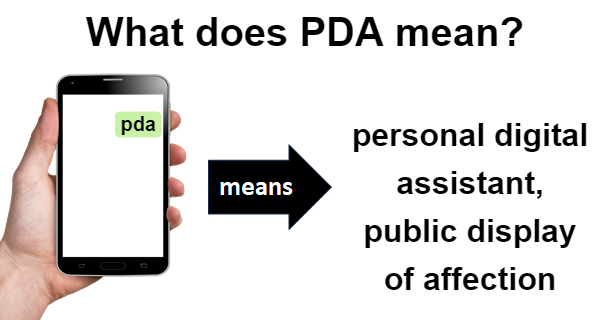
“PDA” means public display of affection — you’ll see it most on TikTok and in iMessage threads when someone is calling out a couple acting overly lovey-dovey in a shared or visible space.
TL;DR
- PDA = publicly showing romantic affection (kissing, cuddling, holding hands) in front of others
- Tone ranges from teasing and cringe to genuinely wholesome depending on context
- The abbreviation originated long before social media but exploded online through TikTok couple content and school-related meme culture
- Used by teens, young adults, and Gen Z across the US and UK equally
- Warning: calling someone’s PDA “cringe” can come off harsh — read the room before you use it critically
What Does PDA Mean in Slang?
Your friend texts you: “omg Tyler and Ashley were literally making out by the lockers again 😭 the PDA is TOO much.”
That’s PDA in full force — and everyone immediately knows what it means.
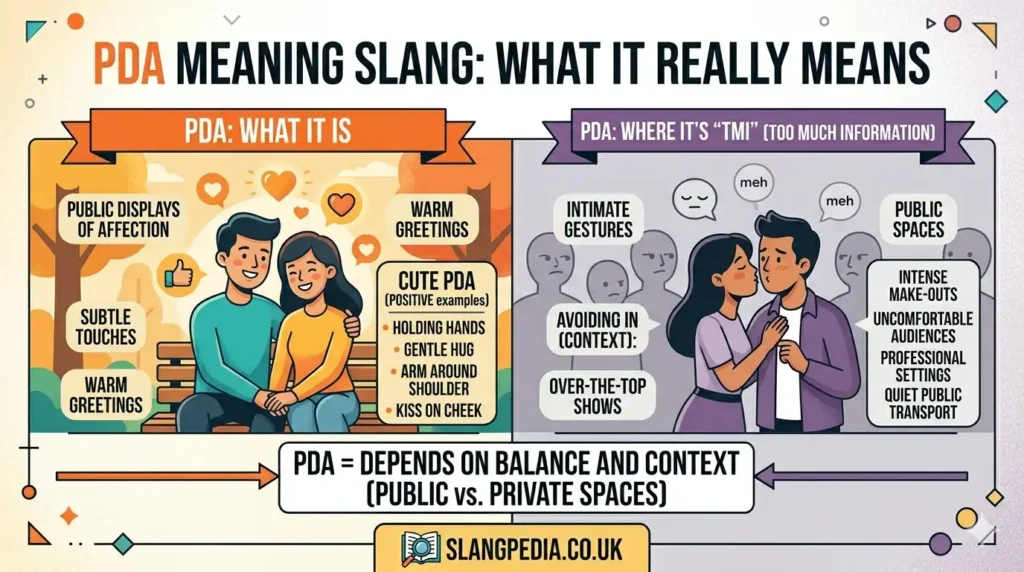
PDA stands for public display of affection. It refers to any romantic or physical affection shown openly in a shared space. That includes kissing, hand-holding, cuddling on the bus, or full-on couple behavior in a group chat’s voice call.
PDA = openly showing romantic affection where others can see it
The slang version carries a specific social charge. It’s not just describing what’s happening — it’s signaling how the speaker feels about it. Most of the time, PDA is used with mild cringe or teasing energy. Sometimes it flips positive, used to hype a cute couple moment.
In the same space where people talk about being obsessed with someone, PDA sits comfortably — it’s about romantic intensity made visible.
Where Did the Slang “PDA” Come From?
PDA as an acronym isn’t new. It dates back to at least the 1990s in American school and workplace culture. Teachers used it to describe behavior that violated conduct policies. Parents used it to describe couples at the mall.
The term belonged to adults first — then teens reclaimed it.
Around 2015–2017, PDA started flooding Twitter and Tumblr as a tool for fan communities. Shipping culture ran deep: stan accounts would post gifs of their favorite real or fictional couples with captions like “the PDA I deserve.”
TikTok cemented it post-2019. Couple content creators built entire audiences around documenting their PDA moments. The comment sections filled with reactions — from “goals” to “get a room.”
Why Is “PDA” Spelled Different Ways?
PDA doesn’t have major spelling variants — the acronym is stable. However, you’ll occasionally see “public displays of affection” spelled out in full for emphasis or irony. Some users write “pdas” (plural) to refer to multiple incidents.
Timeline:
- 1990s: “PDA” used in American school handbooks and HR policies
- 2015–2017: Teen Twitter and Tumblr adopt it as fandom and couple culture slang
- 2019–present: TikTok couple content normalizes it as everyday Gen Z vocabulary
What Does PDA Mean in Text?
In texts and DMs, PDA works as both a descriptor and a reaction. You’re either narrating a scene you witnessed or commenting on someone else’s behavior.
In private texts between friends, PDA usually comes with a tone of mock-disgust or jealousy. In group chats, it can spark a whole thread of opinions about a couple’s behavior.
Common emojis paired with PDA: 😭 🫣 💀 🥺 👀
Example text exchange:
Jess: did you see Marcus and that girl at the party last night
Cody: bro the PDA was unreal 😭
Jess: I looked away I felt like I was intruding lmao
Cody: they need to chill fr
You’ll also see PDA dropped casually alongside terms like boo when people are describing couple behavior online.
| Phrase | Meaning | Tone |
|---|---|---|
| “The PDA is too much” | Calling out excessive public affection | Teasing / cringe |
| “PDA goals” | Praising a couple’s open affection | Wholesome / hyping |
| “No PDA pls” | Asking someone to tone it down | Polite / frustrated |
What Does PDA Mean on TikTok?
On TikTok, PDA is everywhere — but it hits differently depending on the content type.
Couple creators use it in captions like “our PDA moments 🥺” to frame compilation videos of them being affectionate in public. It reads as proud and intentional there.
In comments, PDA flips into a reaction tool. Viewers drop “the PDA 😭” under a clip where a couple is being extra in a restaurant or at a concert.
US TikTok leans into couple PDA content more heavily. UK TikTok tends to use it more sarcastically — British users are more likely to clown on public affection than celebrate it openly.
The meaning stays consistent between texting and TikTok. The tone is what shifts.
PDA in Real Conversations: 5 Examples
Example 1 — School hallway chaos
Tyler: bro they kissed for like 30 seconds by the water fountain
Marcus: the PDA in this school is genuinely insane
PDA here signals secondhand embarrassment — Marcus is clowning but also a little shook.
Example 2 — Couple content hype
Ashley: just posted our beach day vlog
Jess: the PDA moments had me CRYING it’s so cute 🥺
Used sincerely here — Jess is hyping the affection, not clowning it.
Example 3 — Discord server chaos
Cody: guys can you two stop being cute in the vc for 5 minutes
Tyler: the PDA even in voice chat is wild to me 💀
Sarcastic and funny — calling out emotional closeness, not physical.
Example 4 — Group chat roast
Marcus: saw them holding hands at the grocery store
Ashley: so? that’s cute
Marcus: they were also feeding each other samples. PDA level 10.
Escalating scale used ironically — Marcus is amused, not actually offended.
Example 5 — Sincere couple moment
Jess: he held my hand in front of his whole friend group today
Tyler: that’s literally PDA from a guy who never does that. he’s down bad.
Here PDA is used as evidence of genuine feelings — it carries weight.
PDA vs. Similar Slang
| Word | Core Meaning | Tone | Best Used When |
|---|---|---|---|
| PDA | Public display of affection | Teasing, cringe, or wholesome | Describing couple behavior in public or shared spaces |
| Down bad | Being intensely into someone | Sympathetic / humorous | Describing emotional desperation over a crush |
| Couple goals | Praising a relationship publicly | Admiring / aspirational | Reacting to a couple you want to emulate |
| Simp | Showing excessive devotion to someone | Mocking / ironic | Calling out someone acting overly devoted |
The easiest mix-up is PDA vs. couple goals. Both can describe the same moment — but PDA focuses on the act being visible and sometimes uncomfortable, while couple goals focuses on the aspiration. One is observational, the other is evaluative.
The Emotional Vibe Behind “PDA”
PDA exists because people have complicated feelings about love being performed in public.
There’s a generational split baked into the word. Older generations used it as a rule — no PDA in school. Gen Z reclaimed it as a description, sometimes a flex.
When someone says “the PDA is too much,” they’re expressing a social discomfort. Witnessing intimacy you didn’t ask for can feel intrusive. The word gives that feeling a name without being cruel.
But when someone says “PDA goals,” they’re doing something different — they’re admitting they want that visible love for themselves.
The word reveals the speaker’s relationship to public romance. Are you cringing or longing? That’s the real signal.
It also fits into a wider conversation about emotional expression online — Gen Z is more openly emotional than previous generations, but still polices how emotion shows up in shared spaces. PDA is the flashpoint of that tension.
Is “PDA” Offensive?
PDA is not offensive. It’s a neutral descriptor that can carry positive or negative tone depending on context.
It’s not a slur. It doesn’t target any specific group. Using it critically doesn’t attack the people involved — it comments on the behavior.
That said, using it mockingly toward LGBTQ+ couples requires more care. Calling out a same-sex couple’s PDA can carry homophobic undertones, even unintentionally. Straight couples displaying the same behavior rarely get the same scrutiny.
In professional or academic writing, use “public display of affection” in full. The abbreviation reads as too casual for formal contexts.
Safe to use in the US and UK? Yes — widely understood and not considered harmful in casual conversation.
📌 Quick note for parents and teachers: PDA stands for “public display of affection” and describes romantic behavior shown openly in shared spaces. It’s not harmful language. You’ll see it used by teens to describe or react to couple behavior at school, in videos, or online — usually with teasing or humorous energy.
PDA Slang — FAQ
Q: What does PDA mean on TikTok?
A: On TikTok, PDA means public display of affection. It appears in couple video captions as a proud label and in comments as a teasing or admiring reaction to visible romantic behavior.
Q: Is PDA a bad word?
A: No, PDA is not a bad word. It’s a neutral abbreviation that can be used positively or critically depending on tone and context. It doesn’t carry offensive or harmful meaning on its own.
Q: What’s the difference between PDA and couple goals?
A: PDA describes the act of showing affection publicly — it focuses on visibility and can imply discomfort. Couple goals is a reaction of admiration, suggesting you want what the couple has. Both can describe the same moment with different emotional angles.
Q: Do Americans and British people use PDA the same way?
A: Both cultures understand PDA equally well, but the tone differs. Americans are more likely to use it neutrally or positively in couple content. British users tend to use it more sarcastically — UK culture is generally less comfortable with openly performed romance.
The Bottom Line
PDA isn’t just a three-letter acronym from an old school rulebook. It’s a cultural marker — a way of flagging where public love becomes too visible for the people around it.
When someone drops PDA in a text or TikTok comment, they’re navigating a real social tension: the line between cute and cringey, between romantic and performative.
Now that you know the full range — from cringe reaction to genuine hype — you’ll read it right every time it shows up.
Have you seen PDA used in a way that surprised you? Drop it in the comments.
Reviewed for cultural accuracy. US and UK usage verified by native speakers.
Maggie Wiersma is a USA-based writer with 2 years of experience covering slang meanings, internet culture, and modern language trends. With a background in communication studies, she creates simple and engaging content that helps readers understand today’s most popular slang terms.