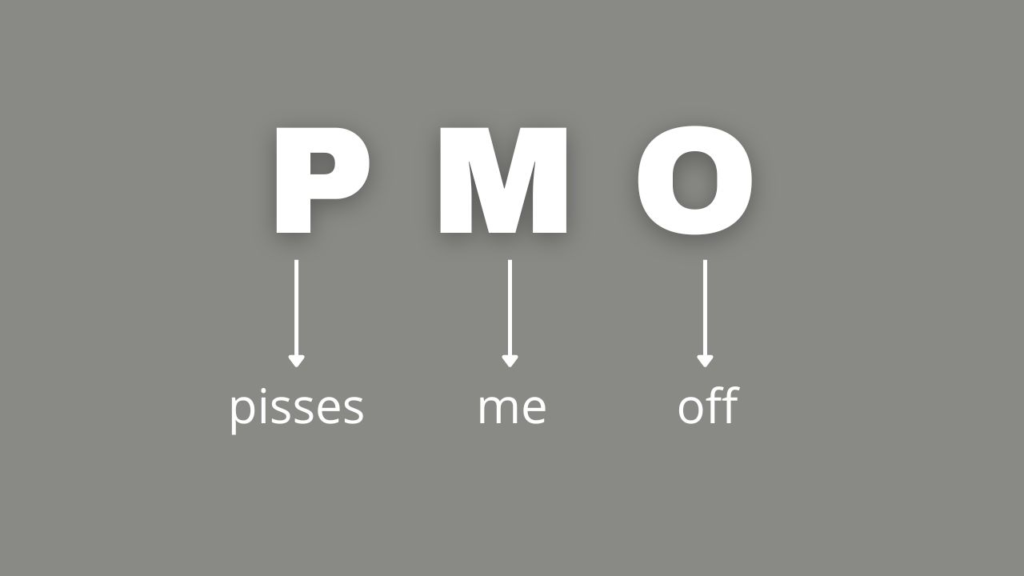
“PMO” means “piss me off” — you’ll see it most on TikTok and iMessage when someone is venting about something or someone that genuinely irritated them.
TL;DR
- PMO stands for “piss me off” — it signals real or dramatic frustration.
- The tone ranges from genuinely angry to playfully annoyed, depending on context.
- It spread through Black Twitter and TikTok around 2019–2021.
- Mostly used by Gen Z and younger Millennials in the US and UK.
- Don’t use it in professional or academic settings — “frustrated” works better there.
What Does PMO Mean in Slang?
Picture this: your group chat is popping off. Marcus texts, “Bro my professor moved the deadline up by two days WITH NO WARNING.” Tyler replies instantly: “That would literally pmo so bad.”
That’s PMO in its natural habitat — raw, quick, and emotionally loaded.
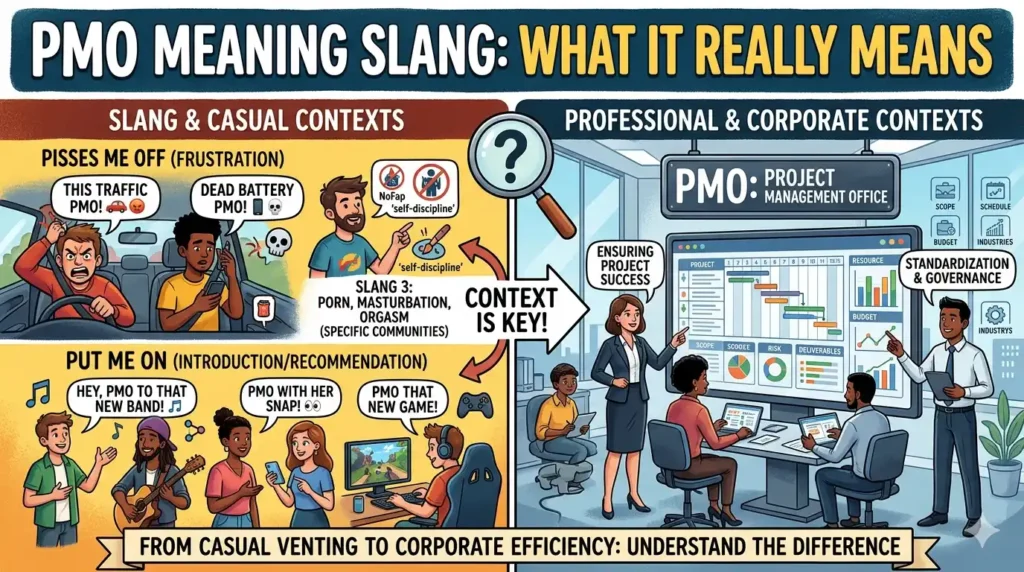
PMO stands for “piss me off.” It signals that something (or someone) has triggered genuine irritation. It’s not polite frustration. It’s the feeling you get when your phone dies at 3% battery right before you need it.
The tone depends heavily on context. Sometimes it’s sincere anger. Other times it’s exaggerated and almost funny — like when someone uses it over spilled coffee.
PMO = something (or someone) has seriously irritated the speaker
The word does something that longer phrases can’t — it compresses emotion into three letters. Similar to how ohio captures a whole vibe of chaotic wrongness in one word, PMO captures the hot flash of irritation in an instant.
Where Did the Slang “PMO” Come From?
PMO grew out of Black Twitter and African American Vernacular English (AAVE) online spaces in the late 2010s. The phrase “piss me off” itself is decades old — but PMO as an abbreviation became its own cultural unit around 2019.
It spread fast through Twitter, then migrated to TikTok comment sections and Instagram captions by 2020. Once TikTok creators started using it in reaction videos and voiceovers, it hit mainstream Gen Z vocabulary hard.
The meaning stayed consistent from origin to now — irritation and frustration. What shifted was the register. Early use was mostly sincere venting. By 2022–2023, ironic and performative uses became just as common.
Why Is “PMO” Spelled Different Ways?
You might see pmo, PMO, or occasionally p.m.o. with periods. They all mean the same thing. Capitalization is purely stylistic — lowercase reads more casual, all-caps reads more intense. The periods version is rare and mostly older usage.
Timeline:
- 2019: PMO circulates on Black Twitter as a shorthand for venting frustration.
- 2020–2021: TikTok reaction culture picks it up; it lands in mainstream Gen Z use.
- 2023–2026: Standard Gen Z vocabulary across iMessage, Discord, and Instagram captions.
What Does PMO Mean in Text?
In private texts, PMO usually signals real frustration. One-on-one, people tend to use it when they actually want to vent — not just perform annoyance.
In group chats, the vibe can flip. It often becomes comedic. Someone posts something mildly inconvenient, and three people reply “PMO” in a row. It becomes a pile-on of mock outrage.
Common emoji pairings: 😤, 💀, 😭, 🙄. The 💀 combo especially signals ironic use — “this is killing me” rather than genuine anger.
Real text exchange:
Jess: the barista spelled my name “Gess” after I said it TWICE
Ashley: LMAOOO that would pmo fr
Jess: it pmo’d and I still tipped 😭
Ashley: you’re too good for this world
Similar to OP, PMO is one of those abbreviations that feels completely natural once you know it — but baffling before you do.
What Does PMO Mean on TikTok?
On TikTok, PMO appears mostly in captions and comments — rarely in voiceovers, since it’s harder to say aloud naturally.
You’ll see it under storytime videos: “the audacity of this man literally pmo.” It also shows up on relatable content — bad customer service, annoying coworkers, slow WiFi.
The TikTok meaning aligns closely with texting use, but the tone skews slightly more performative. Creators exaggerate it for engagement. Comments saying “this would pmo” are often more about bonding with the creator than genuine rage.
US TikTok uses it slightly more than UK TikTok, though UK Gen Z has fully adopted it too.
PMO in Real Conversations: 5 Examples
Example 1 — Genuine frustration
Marcus: my landlord just raised rent with 2 weeks notice
Tyler: bro that literally pmo, you can fight that
PMO here signals real anger — Tyler is validating Marcus’s frustration, not joking.
Example 2 — Ironic overdrama
Cody: they were out of oat milk so I got almond
Jess: that would pmo I’m so sorry for your loss 💀
Jess is mocking the situation’s smallness. The 💀 signals she knows it’s not actually serious.
Example 3 — Group chat pile-on
Ashley: the group project is due tomorrow and Jake just asked what topic we picked
Marcus: PMO
Tyler: PMO
Cody: Jake is so cooked lmaoo
Back-to-back PMO replies turn it into a shared reaction. It becomes comedic through repetition.
Example 4 — Sarcastic disbelief
Jess: he texted “k” after I sent a three paragraph text
Ashley: that doesn’t pmo it DOES pmo. I would’ve left him on read forever
Ashley escalates for comic effect. The correction (“doesn’t/does”) signals sarcastic emphasis.
Example 5 — Casual solo vent
Tyler: [sends screenshot of a 2-hour lecture being recorded at 0.5x speed]
Tyler: this pmo’s me every single time. why is the audio like that
Solo use — Tyler isn’t asking for sympathy, just venting into the void. Very common on Discord.
PMO vs. Similar Slang
| Word | Core Meaning | Tone | Best Used When |
|---|---|---|---|
| PMO | “piss me off” — something irritated me | Frustrated, sometimes comic | Venting about a specific thing or person |
| NGL | “not gonna lie” — honest admission | Neutral to sincere | Admitting something you normally wouldn’t |
| SMH | “shaking my head” — disappointed/disbelieving | Disappointed, tired | Reacting to something dumb or embarrassing |
| IRL | “in real life” — outside the internet | Neutral, clarifying | Distinguishing online vs offline situations |
The closest lookalike for PMO is SMH. People sometimes swap them, but they’re not the same. SMH is more about disappointment and disbelief — it’s cooler, more detached. PMO is hotter — it’s active irritation, not quiet headshaking. Use SMH when you’re exhausted by someone. Use PMO when they’ve genuinely wound you up.
The Emotional Vibe Behind “PMO”
PMO exists because sometimes “I’m frustrated” isn’t fast enough.
Online communication moves at a speed where nuance gets lost. PMO solves that. Three letters that tell someone exactly how activated you are — no explanation needed.
It spread so fast because it’s relatable by design. The feeling of being pissed off is universal. Giving it a tidy abbreviation makes it easy to drop into any conversation without derailing it.
When someone uses PMO, they’re signaling emotional transparency. They’re not bottling it up. There’s something almost intimate about it — a mini-trust fall into the group chat.
When something (or someone) gets described as “pmo-worthy,” it usually means they crossed a clear line. Not a massive betrayal. The annoying, specific, mundane kind of wrong — like someone chewing loudly on a video call.
That specificity is the key. PMO isn’t for disasters. It’s for the thousand small things that, collectively, grind you down.
Much like ohio became shorthand for a whole category of chaotic absurdity, PMO became shorthand for a whole category of low-grade human irritation.
Is “PMO” Offensive?
PMO is not a slur and is not offensive to any specific group.
It contains mild profanity — “piss” — which makes it informal and inappropriate for professional contexts. But in casual conversation, it’s considered completely normal by most Gen Z speakers in the US and UK.
Context matters. Using PMO in a text to a friend is fine. Using it in a work email or school presentation would be unprofessional. It’s the same logic as dropping any mild swear word.
Most people won’t be offended by it. Older generations or people unfamiliar with internet slang might not recognize it — but it’s unlikely to cause genuine offense.
For professional or academic writing, use: “frustrated,” “irritated,” or “annoyed.”
📌 Quick note for parents and teachers: PMO stands for “piss me off” — a mild profanity used to express frustration. It’s not a harmful term or a slur. You’ll see it in texts, social media captions, and online comments. It’s comparable to saying “that really bugs me” in tone, just more direct.
PMO Slang — FAQ
Q: What does PMO mean in slang?
A: PMO stands for “piss me off.” It’s used to express frustration or irritation about something specific. It can be sincere or exaggerated for comic effect depending on context.
Q: What does PMO mean in texting?
A: In texts, PMO signals that something annoyed or frustrated the sender. In one-on-one chats it’s usually genuine. In group chats it often becomes a shared, slightly jokey reaction.
Q: What does PMO mean on TikTok?
A: On TikTok, PMO appears in captions and comments to react to relatable or frustrating content. It sometimes gets used performatively — more for bonding with a creator than expressing real anger.
Q: Where did PMO come from?
A: PMO grew out of Black Twitter and AAVE online culture around 2019. It spread to TikTok and Instagram by 2020–2021 and became standard Gen Z slang shortly after.
The Bottom Line
PMO is more than an abbreviation. It’s a pressure valve — three letters that let you release low-grade frustration without writing a paragraph about it.
You’ll see it sincere, you’ll see it ironic, and you’ll see it as a group chat reflex. The core feeling is always the same: something crossed a line, even a small one.
Now you know what it means, where it came from, and when to use it. Have you seen PMO used in a way that surprised you? Drop it in the comments.

Maggie Wiersma is a USA-based writer with 2 years of experience covering slang meanings, internet culture, and modern language trends. With a background in communication studies, she creates simple and engaging content that helps readers understand today’s most popular slang terms.