“FML” means “f*** my life” — you’ll see it most on TikTok, iMessage, and Twitter/X when someone wants to express frustration, embarrassment, or total exasperation at their own situation.
TL;DR
- FML stands for “f*** my life” — a dramatic expression of frustration or bad luck
- Tone is usually self-deprecating and darkly comedic, not genuinely hopeless
- Originated from the website FMyLife (FML) around 2008–2009
- Used by teens and young adults across the US and UK equally
- ⚠️ It contains an implied profanity — skip it in professional or academic writing
What Does FML Mean in Slang?
You’re running late, spill coffee on your white shirt, and then miss the bus — all before 9am. You open your group chat and type: “fml.” Your friends know exactly what you mean.
FML means “f*** my life.” It’s a venting shorthand for when everything goes wrong at once.
But here’s the nuance — it’s rarely serious. Most people use it with a wink. It signals: “This is ridiculous and I need you to acknowledge my suffering.”
FML = a dramatic, self-aware cry of frustration, usually over something embarrassing or unlucky
The tone lands somewhere between genuine annoyance and dark humor. It’s not a cry for help — it’s a relatable complaint dressed up for laughs.
You’ll often see it alongside smh when someone is shaking their head at their own disaster. Both share the same defeated-but-ironic energy.
Where Did the Slang “FML” Come From?
FML traces directly back to a website. FMyLife (fmylife.com) launched in France in 2008 as “Vie de merde” — literally “life of sh*t.” The English version went live in early 2009 and exploded.
Users posted short, anonymous stories about embarrassing or unlucky moments, ending every entry with: “FML.”
The format was contagious. People started dropping the abbreviation into texts, forums, and early Twitter. By 2010, FML was standard internet shorthand.
It moved from a website punchline into everyday chat with barely any friction. The meaning didn’t shift — the format just shrank from a story to two syllables.
Timeline:
- 2008: “Vie de merde” launches in France — the original FML format
- 2009: FMyLife.com goes live in English and spreads across US college campuses
- 2010–2015: FML enters mainstream texting and social media globally
- 2020s: Still in heavy rotation on TikTok captions and Discord — no signs of slowing
What Does FML Mean in Text?
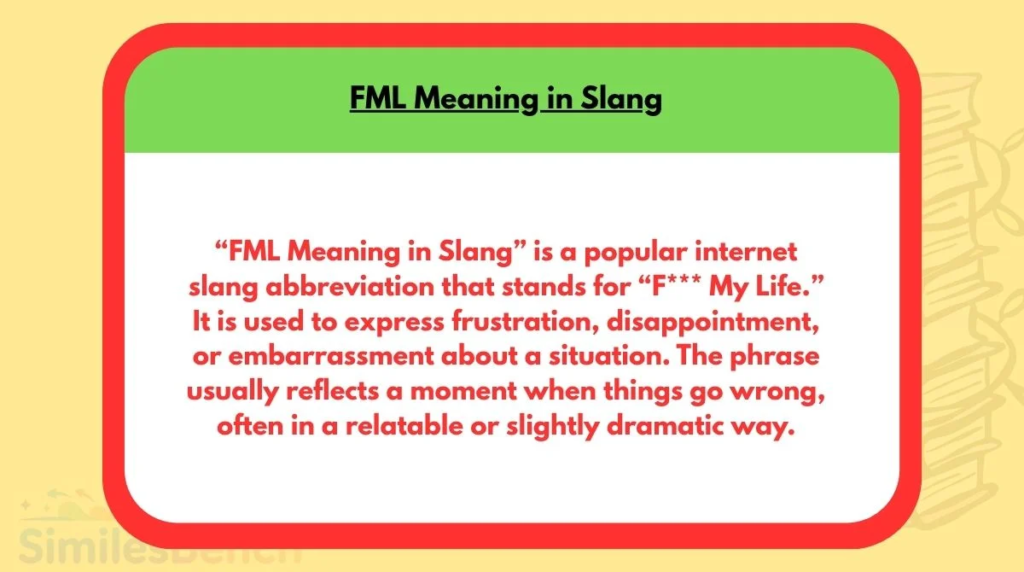
In texts and DMs, FML is pure emotional shorthand. It’s fast, punchy, and needs zero explanation.
In private chats, it often signals genuine frustration — your friend actually needs a reaction. In group chats, it leans more performative and funny.
Common emojis paired with FML: 😭 💀 🫠 🤦
Real text exchange:
Tyler: dude i showed up to my exam on the wrong day
Jess: wait WHAT
Tyler: yeah fml i have to email the professor
Jess: 💀💀 that’s literally your villain origin story
In this exchange, Tyler uses FML to signal genuine embarrassment — but Jess’s response shows she reads it as darkly funny. That gap is exactly how FML works.
You might also see people combine it with slay ironically — “just slayed my interview and left my resume at home. fml.” The contrast makes it funnier.
Common FML Phrases and Local Variations
| Phrase | Meaning | Where It’s Used |
|---|---|---|
| “fml rn” | “f*** my life right now” — extra urgent | US iMessage, Twitter |
| “actual fml” | Emphasizes it’s genuinely bad, not joking | UK TikTok comments |
| “fml moment” | Describing a situation, not feeling | Discord, group chats |
What Does FML Mean on TikTok?
On TikTok, FML shows up mostly in captions and comment sections — rarely in voiceovers.
Creators use it to frame fail videos, cringe moments, or relatable disaster content. A caption like “fml I did this in front of my entire class” sets the tone before the video even plays.
In comments, viewers drop FML as shorthand sympathy. It means: “I feel this deeply.”
The TikTok meaning matches the texting meaning exactly — no shift. It’s equally popular on US and UK TikTok. UK creators sometimes write “actual fml” for extra emphasis, but the core usage is identical across both markets.
FML in Real Conversations: 5 Examples
Example 1 — Missed alarm
Marcus: just woke up at 11:47 for my 9am class
Ashley: fml that’s not even funny
FML here signals genuine panic dressed up as humor.
Example 2 — Ironic flex gone wrong
Cody: told everyone I was great at parallel parking
Cody: hit a trash can in front of like 12 people
Jess: fml for you honestly
Jess uses FML as secondhand embarrassment — she’s cringing on his behalf.
Example 3 — Group chat commiseration
Tyler: just got assigned a group project with the people who ghosted our last one
Group chat: FML 😭😭😭
Collective FML in a group chat signals shared suffering and dark solidarity.
Example 4 — Sarcastic overreaction
Ashley: the vending machine took my money and gave me nothing
Marcus: calling the UN
Ashley: fml I’m so done with today
The sarcasm from Marcus makes Ashley’s FML land as comic defeat, not real distress.
Example 5 — Sincere moment
Cody: failed my driving test again. third time.
Tyler: bro that’s rough, fml for real though hang in there
Here FML shifts into genuine empathy — Tyler uses it to validate Cody’s frustration sincerely.
FML vs. Similar Slang
| Word | Core Meaning | Tone | Best Used When |
|---|---|---|---|
| FML | F*** my life | Self-deprecating, darkly comic | You’re the one having a bad time |
| SMH | Shaking my head | Disappointed, exasperated | Reacting to someone else’s fail |
| I’m dead | This is hilarious / I can’t cope | Playful, extreme | Something genuinely shocking or funny |
| It’s giving chaos | This situation is a mess | Observational, Gen Z irony | Describing a chaotic vibe from outside it |
The closest lookalike is SMH — both signal frustration. The key difference: FML is about your own situation. SMH is a judgment aimed outward at someone else. People mix them up, but using SMH when you mean FML makes you sound like you’re blaming someone else instead of venting about yourself.
The Emotional Vibe Behind “FML”
FML exists because people needed a way to complain without sounding like they were actually falling apart.
Before FML, venting online felt too heavy or too dramatic. FML gave people a pressure valve. It says: “Yes, this is awful — and I know how ridiculous that sounds.”
That self-awareness is the whole point. It’s not asking for a solution. It’s asking for recognition.
FML spread fast because it fits the internet’s dominant emotional register: genuine feeling wrapped in irony. Nobody wants to seem too serious online. FML lets you be real without being vulnerable.
When someone types FML, they’re telling you they trust you enough to complain. They’re not spiraling — they’re narrating their own disaster like a protagonist who knows the audience is watching.
It’s the same emotional energy as skibidi humor — chaotic, self-aware, and performed for effect. Both thrive because they don’t take themselves seriously.
FML is ultimately an act of community. It says: “Witness my suffering.” And the reply is almost always: “Witnessed. Same.”
Is “FML” Offensive?
FML is not a slur and it’s not offensive to any specific group. It targets no one except the speaker themselves.
Context does matter. It contains an implied f-word, so it’s inappropriate in professional emails, academic writing, or formal settings. In casual conversation between friends, it raises no eyebrows in the US or UK.
Most adults recognize it immediately. It won’t cause offense — but it will mark you as casual and informal.
People in customer-facing or professional roles should avoid it in written work. The formal alternative is simply: “What a frustrating day” or “This has been a really difficult situation.”
📌 Quick note for parents and teachers: FML stands for “f*** my life” and implies an f-word, but it’s not aggressive or directed at anyone. It’s a self-deprecating expression of frustration, most common in peer-to-peer texting and social media. It signals stress or bad luck — not a crisis.
FML Slang — FAQ
Q: What does FML mean on TikTok? A: On TikTok, FML means “f*** my life” — same as in texts. Creators use it in captions on fail or cringe videos, and viewers drop it in comments to show sympathy or shared frustration.
Q: Is FML a bad word? A: FML implies the f-word but it’s not a slur or hate speech. It’s considered profane in formal settings. In casual conversation between peers, most people in the US and UK treat it as mild and unremarkable.
Q: What’s the difference between FML and SMH? A: FML is about your own bad luck or embarrassment. SMH (shaking my head) is directed outward — it’s a reaction to someone else’s behavior or situation. FML = I’m the disaster. SMH = I’m watching the disaster.
Q: Do Americans and British people use FML the same way? A: Yes, almost identically. Both use FML for self-deprecating frustration in texts, group chats, and social media. UK users sometimes add “actual” in front — “actual fml” — for emphasis, but the core meaning and tone are the same on both sides of the Atlantic.
The Bottom Line
FML is more than an abbreviation. It’s a cultural ritual — a way to broadcast your bad luck with enough irony to make it bearable.
It signals self-awareness. It invites solidarity. And it keeps frustration from feeling too heavy.
You’ll see FML wherever people are being real with each other online — group chats, TikTok captions, Discord vents. Now that you know what it carries, you’ll catch the tone every time.
Have you seen FML used in a way that surprised you? Drop it in the comments.
Reviewed for cultural accuracy across US and UK usage. Definitions updated for 2026.

Maggie Wiersma is a USA-based writer with 2 years of experience covering slang meanings, internet culture, and modern language trends. With a background in communication studies, she creates simple and engaging content that helps readers understand today’s most popular slang terms.