
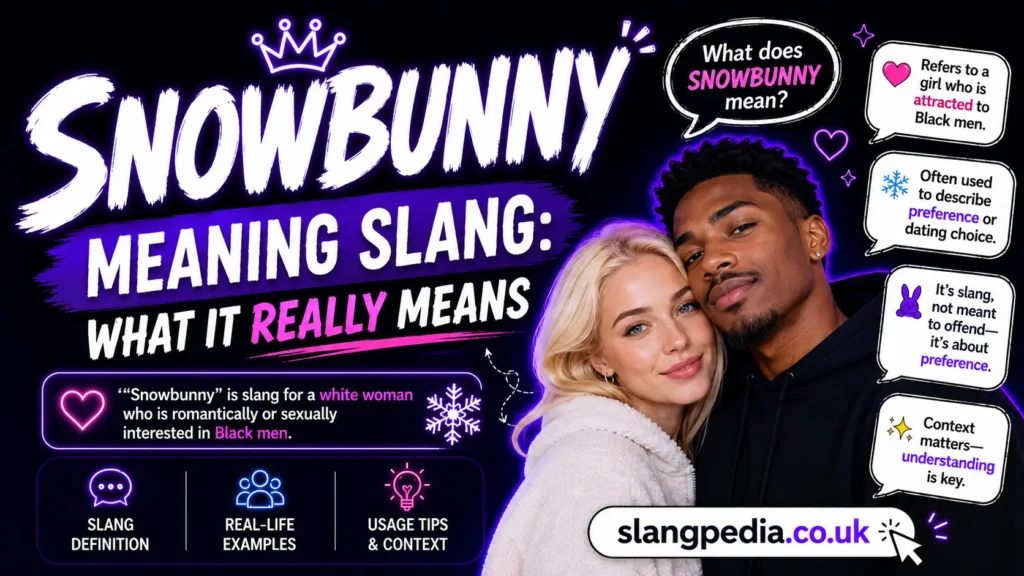
“Snowbunny” means a white woman who is romantically or sexually interested in Black men — you’ll see it most on TikTok, Reddit, and in music commentary when someone is describing dating preferences or calling out perceived fetishization.
TL;DR
- Definition: A term describing white women attracted to Black men, often implying they pursue this attraction.
- Tone: Can be neutral, but often carries judgment or irony depending on who’s using it.
- Origin: 1980s hip-hop culture; gained mainstream online presence around 2010s on Twitter and TikTok.
- Who uses it: Black men online, sometimes self-identified Black women, and people discussing dating dynamics.
- Warning: Context matters heavily—can feel exclusionary or fetishizing depending on how it’s deployed.
What Does “Snowbunny” Mean in Slang?
You’re scrolling through a TikTok comment section on a dating video. Someone writes: “These girls out here acting brand new, turning into snowbunnies every weekend.” A reply surfaces: “She’s literally married to a Black man, let her live.” The exchange feels loaded—both defensive and knowing.
That’s “snowbunny” in action.
The term describes white women (primarily) who are attracted to or pursue romantic and sexual relationships with Black men. It’s not neutral observation—it’s commentary with attitude. The word signals either fascination, mockery, or frustration depending on who’s speaking and why.
Snowbunny = a white woman pursuing or dating Black men, often framed as a pattern or preference.
The tone shifts based on context. When Black women or men use it, it can sound protective—watching out for fetishization. When someone uses it as an insult, it feels dismissive of the woman’s autonomy. On TikTok, it’s often ironic or playful. In real-life conversations, it carries more weight and sometimes sting.
The word exists because dating preferences tied to race are emotionally loaded in the US, especially after centuries of segregation and racialized beauty standards. “Snowbunny” is shorthand for that whole conversation—packed into two syllables.
Where Did the Slang “Snowbunny” Come From?
“Snowbunny” originated in 1980s hip-hop culture, emerging from Black communities in urban centers like New York and Los Angeles. Early usage appeared in rap lyrics and street vernacular before spreading online.
The term played on the contrast: “snow” as slang for white, “bunny” as a cutesy or objectifying term (borrowed from Playboy culture). Together, it created a double meaning—visible, approachable, sometimes naïve.
The exact spelling remained consistent from the start. Unlike some slang terms, “snowbunny” doesn’t have competing variants. It’s always been two words or hyphenated on rare occasions (snow-bunny), but the core spelling stayed stable.
Timeline of “Snowbunny” Across Decades
| Year | Event |
|---|---|
| 1980s | Emerges in hip-hop communities across NYC and LA as street vernacular. |
| 1990s-2000s | Referenced in rap lyrics; understood within hip-hop circles and broader Black culture. |
| 2010-2015 | Spreads to Twitter and Black Twitter specifically; becomes a running joke and social commentary. |
| 2016-2020 | Goes mainstream on TikTok; younger Gen Z learns the term through viral videos and comments. |
| 2021-2026 | Normalized in casual online discourse; appears in dating app discussions, meme culture, and music commentary. |
The shift is important: early usage was mostly in-group conversation. Modern usage is public, visible, and sometimes carries different weight when used across racial lines online.
What Does “Snowbunny” Mean in Text?
In texts and DMs, “snowbunny” works differently depending on who’s messaging and the relationship between people.
Between friends, it’s usually joking. Someone texts: “Girl, he’s got you all snowbunny mode activated 😭” — it’s teasing without real malice. In group chats with mixed audiences, the term becomes riskier. It can read as exclusionary or like you’re mocking someone’s dating choice.
One-on-one, if someone calls you a snowbunny, it lands heavier. It depends on tone and history. Sometimes it’s flirting. Sometimes it’s accusing you of fetishizing.
Real text exchange:
Jade: yo did u see marcus is dating that girl from school
Tyler: lol she’s giving full snowbunny energy
Jade: nah he seems happy leave them alone
Tyler: im playing 😭 good for him fr
Common emojis paired with “snowbunny”: 😭 (laughing), 🍃 (casual vibes), ❄️ (the obvious one), 🐰 (the rabbit reference).
The meaning stays the same, but the judgment shifts based on punctuation and emoji choice. A laughing emoji softens it. No emoji makes it feel more serious or critical.
Common “Snowbunny” Phrases in Text & Social Media
| Phrase | Context | Meaning |
|---|---|---|
| “She’s giving snowbunny” | TikTok/Twitter | Describing someone’s dating pattern or aesthetic choice. |
| “Full snowbunny energy” | Group chat | Joking about someone’s vibe or choices, usually playful. |
| “Not the snowbunny discourse” | Twitter threads | Critiquing the obsession with policing women’s dating preferences. |
What Does “Snowbunny” Mean on TikTok?
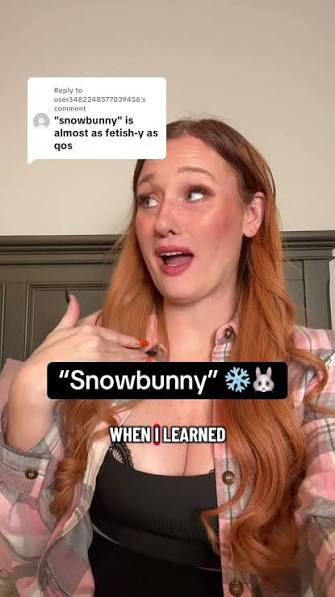
TikTok is where “snowbunny” lives most visibly right now. You’ll see it in comments on dating videos, relationship content, and music clips—especially hip-hop or R&B.
The TikTok meaning is mostly the same as elsewhere, but the tone shifts. It’s less serious and more meme-ified. Videos comparing dating preferences go viral, and “snowbunny” appears in comments as shorthand for: “Yeah, that’s the pattern we’re talking about.”
It also shows up in creator bios ironically. Some white women on TikTok use it about themselves as a joke. Black creators use it as commentary on dating dynamics and racial fetishization.
US TikTok dominates the term’s usage. UK TikTok uses it too, but it’s less embedded in the cultural conversation because UK racial demographics and history differ from the US. UK audiences still understand it, though.
The term is less common in captions and more common in comments. You’ll rarely see a TikTok creator title a video “snowbunny dating” directly. It appears organically when people react or discuss.
“Snowbunny” in Real Conversations: 5 Examples
Example 1 — Friendgroup teasing
Marcus: I’m bringing my new girl to the cookout
Tyrell: Ayo is she… the type?
Marcus: STOP 💀
One word does the heavy lifting here—implication without saying it. Tyrell signals he’s noticed the pattern. Marcus shuts it down with humor instead of defending.
Example 2 — Sincere relationship moment
Zoe: My boyfriend said some weird stuff about me being a snowbunny
Jamie: Ew, that’s gross. That’s a him problem, not you.
Zoe: Right? It’s giving fetish energy.
Here, “snowbunny” becomes evidence of something wrong. Jamie validates Zoe’s discomfort with how the term was deployed—as an objectification.
Example 3 — Twitter-style banter
Ashley: Not y’all acting shocked she’s dating outside her race
Cody: Snowbunny behavior is the least of it
Ashley: Let women live challenge (impossible)
Sarcastic and critical. Cody’s using “snowbunny” to reference a broader pattern he sees. Ashley counters with feminist logic—mocking people who police women’s choices.
Example 4 — Casual Discord chat
Tyler: bro she follows every rapper on Instagram
Jordan: oh she’s FULL snowbunny mode
Tyler: 😭😭😭
Playful observation. No malice—just friends noticing something and laughing about it together.
Example 5 — Music commentary
Sahira: This artist just became famous and snowbunnies showed UP
Kai: Every. Single. Time. The algorithm is wild.
Meta-commentary on attraction patterns tied to fame and visibility. Both speakers are expressing something they’ve noticed—humor mixed with mild exasperation.
“Snowbunny” vs. Similar Slang
| Word | Core Meaning | Tone | Best Used When |
|---|---|---|---|
| Snowbunny | White woman attracted to Black men | Observational, sometimes judgmental | Discussing dating patterns or racial fetishization |
| Jungle fever | Attraction across racial lines (outdated) | Derogatory, offensive | Avoided—has history of racist framing |
| Coal burner | Racist slur for white women dating Black men | Hateful, violent | Never—slur used by white supremacists |
| Mudsharking | Racist slur (same context as above) | Hateful, violent | Never—explicitly racist slur |
The biggest difference: “snowbunny” is insider language from Black culture with some judgment, but it’s not a slur. Terms like “jungle fever,” “coal burner,” and “mudsharking” either come from racist ideology or carry violent baggage.
“Snowbunny” critiques behavior and patterns. The others dehumanize or weaponize. That’s the critical distinction.
The Emotional Vibe Behind “Snowbunny”
Why does this word exist at all? Because dating in America is inseparable from race, history, and power.
For generations, Black men were forbidden from dating white women legally and socially. When those barriers fell, the dynamic reversed—sometimes white women pursued Black men as a rebellion or fetish, not as equals. “Snowbunny” is the word that holds that complicated history.
It spread so fast online because it names something people see constantly but can’t quite articulate in mixed company. It’s a way to signal: “I see the pattern. I notice the fetishization.” It’s protective language, even when it sounds harsh.
When someone uses “snowbunny,” they’re often expressing frustration about desirability politics and racial hierarchies embedded in dating. The speaker is usually saying: “This matters. This pattern exists. Don’t pretend you don’t see it.”
What does it say about the speaker? Often that they’re attuned to racial dynamics and tired of pretending they don’t exist. What does it say about the person being described? Less clear—it depends on intent. Sometimes it’s neutral observation. Sometimes it’s suggesting she’s making a fetishizing choice.
The word exists because silence isn’t always neutral.
Is “Snowbunny” Offensive?
Not inherently, but context absolutely matters.
It’s not a slur in the sense that “n-word” is, or “c-word” is. But it can feel reductive if used to dismiss a woman’s agency in dating choices. It’s not offensive to Black men—it’s about them, yes, but it’s analyzing women’s behavior, not attacking men’s worth.
The real offense question: Is it fair to label someone’s romantic preference as a “pattern” or “behavior problem”? That’s where the debate lives. Some argue it’s important racial critique. Others say it polices women’s dating autonomy.
Safe to use in USA and UK? Yes, mostly. It’s not going to get you canceled or reported. But it’s risky in mixed company if you don’t know your audience. Using it casually around someone you just met is different than using it with close friends who share context.
Who should avoid it? Anyone outside the cultural conversation should probably skip it. If you’re not engaged in discussions about race and dating, using “snowbunny” reads as performative or potentially disrespectful.
Professional/academic alternative: “Interracial dating preferences” or “racial dynamics in dating” are the neutral terms. “Fetishization of Black men” is direct.
📌 Quick note for parents and teachers: “Snowbunny” is slang describing white women who date or are attracted to Black men. It’s not inherently harmful, but it can carry judgment. It appears on TikTok, Twitter, and in music commentary. Context matters—sometimes it’s casual teasing, sometimes it’s social critique about dating and race.
“Snowbunny” Slang — FAQ
Q: What does snowbunny mean on TikTok?
A: It describes white women attracted to or dating Black men. You’ll see it in comments on relationship or music videos, usually as shorthand for an observed dating pattern. The tone ranges from joking to serious social commentary depending on who’s commenting and why.
Q: Is snowbunny a bad word?
A: It’s not a slur, but it can feel reductive or judgmental depending on how it’s used. The term itself isn’t vulgar or offensive to any group, but calling someone a snowbunny in a mean tone can feel insulting.
Q: What’s the difference between snowbunny and jungle fever?
A: “Snowbunny” is modern slang from Black culture that critiques dating patterns. “Jungle fever” is an outdated, derogatory term from racist frameworks. Snowbunny has insider context. Jungle fever is just racist.
Q: Do Americans and British people use snowbunny the same way?
A: Americans use it far more, especially on TikTok. It’s embedded in ongoing US conversations about race and dating. British people understand it, but it’s less culturally central because UK demographics and racial history differ. Both use it online similarly when they do use it.
Q: Why is it called a snowbunny and not something else?
A: “Snow” is slang for white (from powder/drugs culture). “Bunny” comes from Playboy culture—cute, desirable, sometimes objectified. Together, it’s a contrast term: visible, approachable, coded as naive or pursuing a specific type. The metaphor stuck because it was memorable.
The Bottom Line
“Snowbunny” is how people name racial dynamics in dating without saying it directly. It critiques fetishization, calls out patterns, and sometimes just teases friends about their choices.
Understanding it means understanding that dating in America isn’t separate from race. The word exists because that reality exists.
Next time you see it in a comment or hear it in conversation, you’ll know the history and the weight it carries. You’ll recognize whether someone’s using it to protect, judge, or just laugh.
Have you seen “snowbunny” used in a way that surprised you? Drop it in the comments.
Table: Generational Awareness of “Snowbunny”
| Generation | Familiarity | Primary Platforms | Tone |
|---|---|---|---|
| Gen X/Millennials | High awareness; remember origin in hip-hop | Music, Twitter, in-person circles | More serious, historical context |
| Gen Z (18-24) | Very high; grew up with it on TikTok | TikTok, Twitter, Discord | Meme-ified, casual, ironic |
| Gen Z (16-18) | High; learned from older Gen Z | TikTok, Instagram, Discord | Playful, less historical awareness |
| Gen Alpha | Not yet; too young | N/A | N/A |
Regional Variance: USA vs. UK Usage
| Factor | USA | UK |
|---|---|---|
| Prevalence | Very common; especially Black Twitter/TikTok | Less common; less cultural relevance |
| Context | Tied to specific US racial history and segregation | Understood but less embedded |
| Tone | Can be serious; carries weight | More likely to be casual or borrowed |
| Platforms | TikTok, Twitter, YouTube | Same, but lower frequency |
| Who uses it most | Black creators, Gen Z creators | Smaller demographic; often American-influenced |
Last verified: 2026. Cultural slang evolves constantly. This guide reflects current usage across TikTok, Twitter, Discord, and mainstream Gen Z spaces.
Maggie Wiersma is a USA-based writer with 2 years of experience covering slang meanings, internet culture, and modern language trends. With a background in communication studies, she creates simple and engaging content that helps readers understand today’s most popular slang terms.
Pingback: Kink Meaning Slang: What It Really Means in 2026 - Slang Pedia