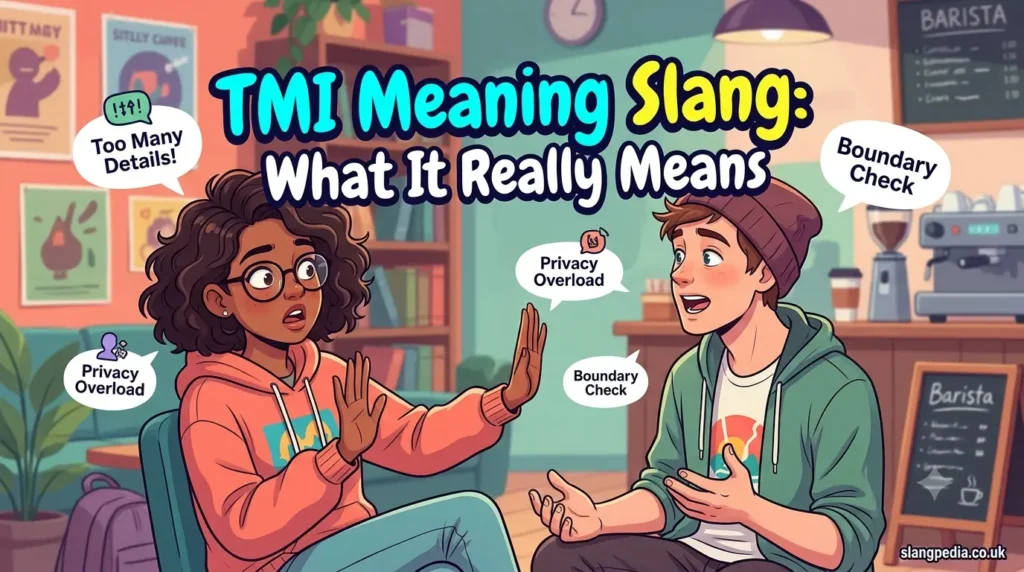
“TMI” means you just shared something way too personal or intimate—you’ll see it most in group chats and TikTok comments when someone overshares details they shouldn’t have.
TL;DR
- Definition: TMI = “Too Much Information.” It signals someone shared something too intimate, graphic, or personal.
- Tone: Usually lighthearted mockery, but sometimes genuine discomfort or cringe.
- Origin: Emerged in early 2000s forums and texting. Went mainstream through TikTok in the 2020s.
- Who uses it: Gen Z and millennials on every major platform. Teens especially.
- Warning: Can feel mean-spirited in group chats. Use ironically to stay safe.
What Does TMI Mean in Slang?
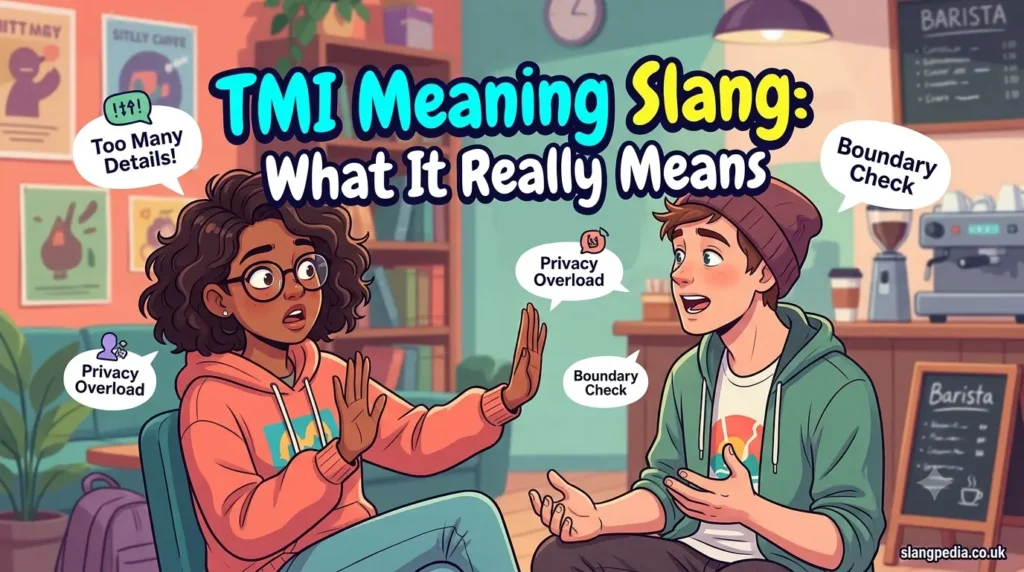
You’re in a group chat. Someone sends a paragraph about their digestive issues. Someone else replies: “TMI bro 💀.” That’s the word in action.
TMI = Too Much Information. A reaction that says: “I didn’t need to know that.”
But here’s the nuance. TMI isn’t just “I have information I don’t want.” It’s specifically about intimate, graphic, or embarrassing details. If your friend tells the group chat she got period cramps, that’s relatable. If she describes them in medical detail, that’s TMI.
The tone matters. In friend groups, TMI is affectionate roasting. “Ew TMI 😭” feels warm. But in a comment section, it can sting. TMI signals the speaker crossed an invisible line—they made things awkward by oversharing.
People also use it to shut down conversations getting too real. Someone mentions therapy? Normal. Someone describes their trauma in graphic detail? You might see TMI as a way to pump the brakes, not out of cruelty, but discomfort.
The phrase also carries FTP energy—a quick, low-effort callout that doesn’t require explanation. Everyone gets it instantly.
Where Did the Slang “TMI” Come From?
TMI started in early 2000s internet forums and AIM chats. It wasn’t Gen Z slang—it was millennial. The acronym spread through texting culture naturally because it was efficient. Why type “that’s too much information” when you could send three letters?
By the early 2010s, TMI lived in memes and Tumblr. It was used mostly ironically, especially in fandoms where people would joke about oversharing fictional character details.
TikTok revived it around 2020–2021. Short-form video made oversharing visual. Someone would show their morning routine in graphic detail, and comments would flood with “TMI 💀.” It became a core part of TikTok comment culture.
Timeline:
| Year | Event |
|---|---|
| 2003–2005 | Emerged in forums and early texting. Millennial shorthand. |
| 2010–2015 | Spread through meme culture and Tumblr. Mostly ironic use. |
| 2020–2026 | TikTok made it mainstream. Used daily in comments and group chats. |
The acronym never changed spelling because acronyms don’t—TMI is always TMI. There’s no “T-M-eye” or “teem.” It’s locked in.
What Does TMI Mean in Text?
In texts and DMs, TMI is way more casual than it is in public comments.
With close friends, TMI feels like inside-joke banter. You send something mildly embarrassing. They reply “TMI 😭😭” even though they don’t actually mind. It’s affectionate roasting.
In group chats, the meaning stays the same—someone overshared, and you’re calling it out. But the tone shifts. Group settings make it feel more like actual criticism. One-on-one, you’re safe. In a group of ten people, someone saying “TMI” can feel like public mockery.
TMI pairs with laughing-crying emojis, skull emojis (💀), or the vomit emoji (🤢) for dramatic effect. You almost never send just “TMI” alone. It needs visual support.
Real text exchange:
Marcus: just had the worst bathroom situation of my life
Jess: STOP 💀 TMI
Marcus: you asked what i was doing
Jess: i said “how’s your day” not give me a play-by-play
In this exchange, Jess isn’t genuinely upset. She’s playing the “grossed out” character. It’s a familiar rhythm in friend groups.
The snowbunny energy of texting—where every message is slightly performative—means TMI doubles down on the bit. Someone says TMI, you lean into the oversharing for comedy.
| Context | Tone | Example |
|---|---|---|
| Close friend 1-on-1 | Joking, affectionate | “TMI bro 😭” (they actually want to hear more) |
| Group chat | Lighthearted callout | “TMI” (mixed reactions, some laugh, some cringe) |
| Stranger/acquaintance | Genuine boundary-setting | “TMI” (actual discomfort; conversation needs to shift) |
What Does TMI Mean on TikTok?
On TikTok, TMI lives in comments. It shows up under three types of videos:
Oversharing in day-in-the-life content. Someone films their morning routine and mentions they have diarrhea. Comments: “TMI 💀.”
Relationship drama. A creator describes their toxic ex in graphic detail. Comments section floods with “TMI” and eye-roll emojis.
Medical or bodily function content. Someone details a pimple extraction, period symptoms, or digestive issues. You’ll see “TMI” instantly.
TikTok’s TMI is different from texting TMI. On TikTok, it’s purely reactive. You’re commenting on someone else’s choice to post. In texts, you’re participating. On TikTok, you’re an audience member saying, “I didn’t sign up for this.”
It’s equally popular on US TikTok and UK TikTok. The comment means the same thing everywhere. But British creators and commenters use it slightly less frequently—they’re more likely to say something sharper or more sarcastic.
TMI in Real Conversations: 5 Examples
Example 1 — Medical overshare
Tyler: wait how bad was your surgery recovery?
Ashley: literally couldn’t sit for two weeks the discharge was INSANE
Tyler: okay TMI my guy
What this signals: Tyler asked a genuine question but didn’t expect detailed bodily descriptions. He’s setting a boundary humorously.
Example 2 — Ironic group chat bit
Group chat (Marcus, Cody, Jess):
Marcus: spent $60 on coffee today
Cody: TMI we don’t need your financial trauma
Jess: 💀💀💀
What this signals: Cody is joking. He’s roasting Marcus’s spending, not actually uncomfortable. This is playful mockery.
Example 3 — Sincere discomfort
Mom: how’s your love life sweetie?
You: actually going really well! we’ve been—
Mom: TMI!! I don’t need details!
What this signals: Your mom genuinely doesn’t want to hear relationship details. It’s a real boundary, not a joke.
Example 4 — TikTok comment sarcasm
Creator’s caption: “storytime: why i ghosted my boyfriend”
Comment: “TMI i came for dance videos”
What this signals: Sarcasm. The commenter is saying the creator’s oversharing is off-brand. It’s lightly critical.
Example 5 — Casual agreement
Discord server conversation:
Person A: my therapist says i need to journal my emotions
Person B: that’s actually healthy
Person A: so i wrote 10 pages about my childhood trauma and—
Person B: okay TMI 😭
What this signals: Person B actually cares but is drawing a casual line. They’re saying, “I support you, but maybe not in the Discord server.”
TMI vs. Similar Slang
| Word | Core Meaning | Tone | Best Used When |
|---|---|---|---|
| TMI | Shared something too intimate/graphic | Lighthearted mockery | Someone reveals unnecessary personal details |
| Overshare | Gave too much detail generally | Neutral/analytical | Describing the act of revealing too much |
| Cringe | That made me uncomfortable | Stronger judgment | Something awkward or embarrassing happened |
| Ew | Gross me out | Visceral reaction | Something physically disgusting was mentioned |
The closest lookalike is overshare. But here’s where people get confused: “overshare” is a verb describing what happened. TMI is a reaction to it. You can overshare without anyone saying TMI. But if someone says TMI, they’re responding to an overshare.
Also, “overshare” feels slightly more formal. TMI is pure slang. You’d write “they tend to overshare” in an essay. You’d text “TMI 💀” to a friend.
The Emotional Vibe Behind “TMI”
TMI exists because humans have invisible social contracts about intimacy. You don’t tell coworkers about your colonoscopy. You don’t describe your sex life to your parents. These aren’t written rules—they’re felt rules.
When someone breaks those rules, discomfort spreads. TMI names that discomfort instantly. It says: “You violated our unspoken agreement about what’s shareable here.”
The phrase spread so fast online because the internet constantly breaks these boundaries. Videos, screenshots, group chats—they make oversharing easy. TMI became a quick way to re-establish boundaries. It’s a social reset button.
When someone uses TMI, it signals: “I see you tried to bond by being vulnerable. But you went too far. Pull it back.”
The word also reveals something about the speaker. Using TMI means you have pretty firm boundaries. You notice when lines get crossed. You’re not uncomfortable with intimacy itself—you’re uncomfortable with uninvited intimacy.
What does it say about the person being described? Sometimes they genuinely didn’t know the boundary existed. Other times they crossed it on purpose for shock value or comedy. TMI works either way—it’s a callout, not a judgment call on intent.
On TikTok, using TMI in comments also signals something: you’re part of the culture. You know the unwritten rules. You’re in the in-group. That’s why it’s so popular in comment sections. It’s a tribal marker.
The word is powerful because it’s FTP—brief, universal, understood instantly across platforms. And it’s gentle. TMI feels like teasing, not attack. That’s why it survived 20+ years online.
Is “TMI” Offensive?
No. TMI is not offensive. It’s not a slur. It doesn’t target any group.
That said, context matters. Saying “TMI” to someone sharing genuine anxiety or trauma can feel cruel, even if it isn’t meant to be. If someone opens up about depression, and you respond with “TMI 💀,” you’re closing the door. The word itself isn’t offensive—but using it to mock vulnerability is.
In close friendships, TMI is harmless banter. In professional settings or with strangers, it lands differently. A coworker shares a medical detail. You say “TMI.” Now they feel embarrassed. They probably shouldn’t have shared it, but your response stung.
It’s safe to use in the USA and UK without causing offense to any protected group. You can say it to anyone. But who you say it to and why matters.
Parents and caregivers shouldn’t avoid saying it—kids hear it constantly online anyway. But adults should model the difference between joking “TMI” with friends and gently setting boundaries with vulnerable people.
📌 Quick note for parents and teachers: TMI means “Too Much Information.” It’s how young people react when someone shares something too intimate or graphic. It’s not harmful by itself. The slang is everywhere—TikTok, texts, group chats. Context is key: “TMI” with friends is joking. “TMI” used to mock someone opening up about real problems crosses a line.
TMI Slang — FAQ
Q: What does TMI mean on TikTok?
A: On TikTok, TMI is a comment reaction to videos where creators overshare. Someone posts about medical issues, relationship drama, or bodily functions. The comments fill with “TMI 💀.” It’s a quick way to say the content crossed an invisible boundary.
Q: Is TMI a bad word?
A: No. TMI isn’t profanity or a slur. It’s an acronym for “Too Much Information.” The only issue is how it’s used. Saying TMI to someone genuinely vulnerable can feel mean, even though the word itself is neutral.
Q: What’s the difference between TMI and overshare?
A: “Overshare” describes the action—someone revealed too much. “TMI” is the reaction—you’re responding to the overshare. You can overshare without hearing TMI. And TMI is slang; overshare is standard English.
Q: Do Americans and British people use TMI the same way?
A: Yes, mostly. Both use it in texts and comments. British people sometimes use sharper language (like “Christ” or “Mate, no”) instead of TMI. But Gen Z in the UK texts TMI just as much. The meaning is identical.
The Bottom Line
TMI is Gen Z shorthand for “you crossed a boundary.” It’s not mean—it’s a social reset button. The word serves a real function: it lets people re-establish limits around intimacy in spaces where oversharing is constant.
Understanding TMI means understanding how young people manage vulnerability online. They share a lot. But they also know when sharing goes too far. TMI is how they say it without making things worse.
Next time you see TMI in a comment or group chat, you’ll know exactly what it means. The person isn’t attacking the oversharer. They’re just calling out that something felt too intimate for that moment or audience.
Have you seen TMI used in a way that surprised you? Drop it in the comments.

Maggie Wiersma is a USA-based writer with 2 years of experience covering slang meanings, internet culture, and modern language trends. With a background in communication studies, she creates simple and engaging content that helps readers understand today’s most popular slang terms.