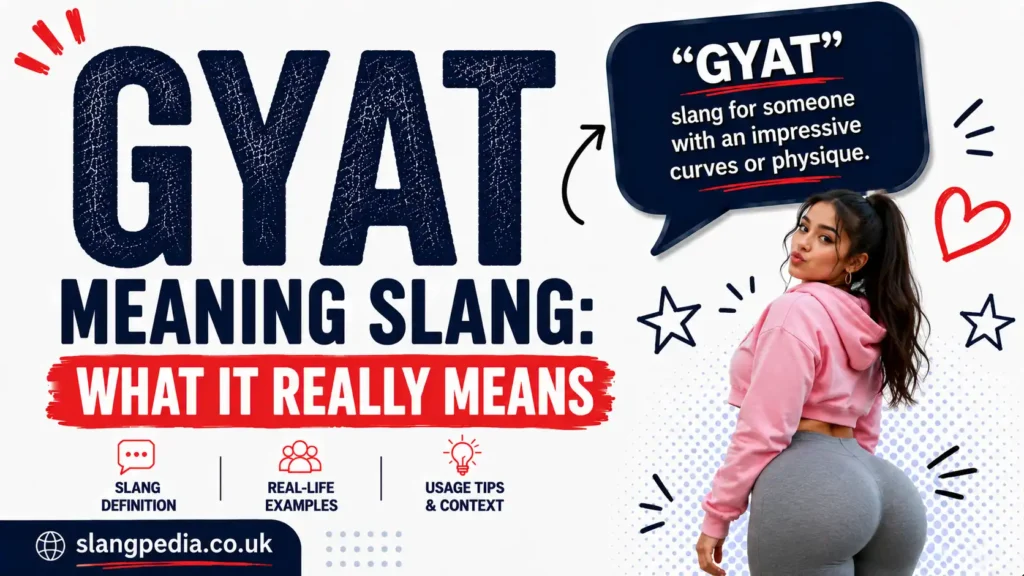
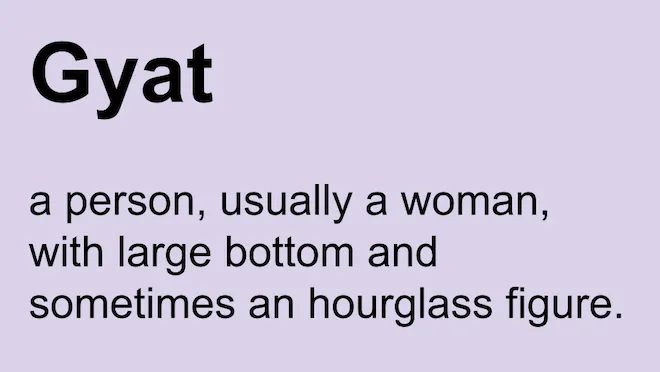
“Gyat” is an exclamation of surprise, attraction, or appreciation — you’ll see it most on TikTok when someone reacts to a hot person or unexpected moment.
TL;DR
- Gyat = an exclamation expressing attraction, amazement, or thirst, similar to “damn” or “yo”
- Tone: playful, exaggerated, often ironic or sincere depending on context
- Origin: TikTok and hip-hop subculture, became mainstream around 2023–2024
- Who uses it: Gen Z on TikTok, Discord, Instagram, especially in viral content
- Warning: Can feel corny if overused; works best in group chats and online videos, not formal settings
What Does Gyat Mean in Slang?
You’re scrolling TikTok and a creator posts a photo in a mirror. Your friend texts: “gyat she’s fine 💀” Another comment under a thirst trap reads: “gyat no mercy” That’s the word at work.
Gyat is an exclamation that signals thirst, attraction, or shock. It’s a reaction—not a description. When you say “gyat,” you’re not explaining; you’re responding. The word carries attitude. It can be sincere when someone genuinely finds someone attractive. It’s ironic when friends hype each other up as a joke. It’s exaggerated when TikTokers drop it in captions for clout.
The core emotion: unfiltered appreciation mixed with playfulness. It lives in that space between “wow” and “damn.” Think of it as the digital equivalent of a head snap or double-take. The word itself has no real meaning outside the feeling it creates—that’s why it spread so fast.
Gyat = an exclamation of attraction, amazement, or thirst
The tone matters. “Gyat she’s cute” is different from “gyat no mercy”—one feels genuine, the other performative. Context shifts everything. In a Discord server with close friends, geeked and gyat can feel like natural reactions. In a TikTok comment section, gyat often feels like you’re trying too hard. That distinction matters if you want to sound native, not borrowed.
Where Did the Slang “Gyat” Come From?
Gyat originated in hip-hop and Black internet culture, then exploded through TikTok around 2023. The exact spelling is recent—it likely evolved from phonetic spelling of how people pronounced drawn-out “got” or “dang” in hip-hop flows. Artists and rappers used it informally; then TikTok creators weaponized it.
The word wasn’t formal slang until TikTok. By 2023, it became the standard reaction to thirst traps and attractive content. UK TikTok adopted it slightly slower than US TikTok, but by 2024, it was global. The word spread because it was punchy, felt exclusive to online spaces, and required no explanation—the context did all the work.
Why Is “Gyat” Spelled Different Ways?
Spelling variants include “gyatt” (double-t for emphasis), “gya,” and sometimes “yat” alone. Gyatt (with two t’s) became the most common alternate—it feels heavier, more emphatic. “Gya” is shorthand for people typing fast. “Yat” is rare and regional. The double-t version became especially popular in TikTok captions because it looks more intentional and fun.
Timeline:
- 2022–2023: Hip-hop influencers and TikTok creators start using “gyat” in captions and voiceovers
- Mid-2023: The term goes viral across US TikTok; “gyat” becomes the standard spelling for thirst reactions
- 2024–2026: UK, Canada, and Australia adopt it; becomes normalized in group chats; spelling variants stabilize
What Does Gyat Mean in Text?
In texts and DMs, gyat works as a standalone reaction. Someone sends a photo; you reply: “gyat” That’s it. No explanation needed. In group chats, it becomes a running joke—your friends send attractive celebrities or people they find hot, and everyone floods the chat with “gyat gyat gyat.”
The meaning doesn’t shift between private and group chats. But the tone does. With one person, it can feel flirty or sincere. In a group, it’s almost always ironic—you’re riffing with friends, not confessing attraction. Emoji combinations matter: gyat 💀 (dying laughing), gyat 🔥 (fire/hot), gyat no cap 🫡 (serious/no lie). The skull emoji especially signals you’re joking.
Real text exchange:
Tyler: [sends mirror selfie]
Jess: gyat no mercy
Marcus: LMAOOOO she said it
Tyler: y’all are weirdos 💀
Gyat = a reaction to something attractive or shocking in texts
| Context | Tone | Example |
|---|---|---|
| Private DM | Flirty or sincere | “gyat ur actually fine tho” |
| Group chat | Ironic / joking | “gyat NO 💀💀💀” |
| Responding to photo | Exaggerated / performative | “gyat periodt 🔥” |
In text, geeked is sometimes paired with gyat—”geeked and gyatting over this person”—but gyat stands alone more often. It’s the quicker reaction. The more universal one.
What Does Gyat Mean on TikTok?
On TikTok, gyat lives in captions and comments. Creators post thirst traps; comments flood with “gyat” or “gyat no mercy.” Other creators use it in voiceovers: “POV: you see someone that makes you go gyat” or “This fit had me like gyat 😭”
The word appears most on US TikTok, especially in beauty, fashion, and fitness content. UK TikTok uses it too, but less reflexively—it feels slightly more American still. The meaning stays the same as texting: a thirst reaction, but amplified for audience. TikTok gyat is performed. It’s for the camera.
It shows up in comment battles, duets, and stitches where friends hype each other. Trending sounds sometimes feature the word. The beauty of gyat on TikTok: it requires zero words of explanation. New users understand it instantly from context.
Gyat in Real Conversations: 5 Examples
Example 1 — Thirst trap reaction
Name: “bro she’s been at the gym”
Reply: “gyat not even close”
When someone sees visible effort—new fit, glow-up, clear gains—gyat signals unfiltered acknowledgment without being creepy about it.
Example 2 — Ironic group chat
Name: “posting a selfie with no makeup on lmao”
Reply: “GYAT 💀💀💀 stop it”
The exaggeration here is the joke. Gyat signals you’re playing along, hyping someone up ironically, not actually hitting on them.
Example 3 — Sincere moment
Name: “how do you think they look?”
Reply: “gyat fr fr tho, you should shoot your shot”
Adding “fr fr” (for real for real) or “no cap” removes irony. This gyat is genuine. The speaker actually means it.
Example 4 — Discord sarcasm
Name: “just saw my crush at the mall”
Reply: “gyat what’d they look like”
Delivered deadpan, this gyat is sarcasm—the speaker doesn’t need to know; they’re mocking the drama. Tone is everything.
Example 5 — Casual group vibe
Name: [friend sends Instagram explore page video of attractive person]
Entire server: “GYATTTTTT” “NO” “HELP ME” “I’M CRYING”
This is pure group energy. Everyone’s reacting at once. Gyat becomes a shared language—no context needed.
Gyat vs. Similar Slang
| Word | Core Meaning | Tone | Best Used When |
|---|---|---|---|
| Gyat | Exclamation of attraction / shock | Playful, exaggerated | Reacting to someone hot or unexpected moment |
| Geeked | Hyped up, excited, or high | Energetic, often ironic | Someone’s being extra funny or excited |
| Damn | General exclamation | Can be sincere or casual | Any surprise or attraction (more formal) |
| No cap | Serious, no lie | Emphatic, sincere | Confirming something is real or truthful |
Key difference: Gyat is purely reactive—you don’t think before saying it. “No cap” is argumentative—you’re defending a claim. Geeked is about energy and excitement; gyat is specifically about attraction. Damn is universal; gyat is generational. People often confuse gyat and geeked because both pop up in excited group chats, but geeked usually means someone’s being funny, while gyat means someone’s being fine.
The Emotional Vibe Behind “Gyat”
Gyat exists because Gen Z needed a word that felt online-exclusive and required no filter. It fills the gap between thinking and speaking. In real life, you stare. Online, you type “gyat.” The word gives you permission to be unfiltered.
It spread so fast because it’s harmless and fun. It’s not mean. It’s not exclusive. Anyone can use it in any context—the word carries no baggage. That’s rare. Most slang ties to a specific community or moment; gyat just means “wow, that hit.”
When someone says gyat, they’re signaling playfulness. They’re not trying to be deep. They’re reacting viscerally. That honesty appeals to Gen Z—we like words that sound how they feel. No pretense. No overthinking.
It also says something about internet culture’s obsession with thirst. Gyat weaponizes attraction as content. Thirst traps work because of gyat reactions. The word and the content type created each other. You post because you want gyat responses. You gyat because seeing something gyat-worthy is part of the experience.
ATP (answer the phone, for real) shares this same energy—a reaction that feels specific to online spaces and friend groups. Both words exist because online communication needed faster, more honest ways to respond.
Is “Gyat” Offensive?
No, gyat is not inherently offensive. It’s not a slur. It doesn’t target any group. It’s not safe or unsafe based on the word itself—context determines everything.
That said, constant gyat-ing at someone can feel creepy or objectifying. One comment under a photo: fine. Hundreds of the same word: harassment. The word isn’t the problem; the repetition and intent are. Using gyat ironically with friends is normal. Using it sincerely to bombard someone online is not.
Is it safe in the USA and UK? Yes. Both countries use it the same way. It won’t offend people. It might make adults cringe—they might think it sounds dumb. But cringe ≠ offensive.
Who should avoid it? Not really anyone, except maybe in formal writing or professional emails. Save it for friends, TikTok comments, group chats. Your resume doesn’t need gyat.
📌 Quick note for parents and teachers: Gyat is an exclamation of attraction or amazement used by Gen Z online, especially on TikTok and in group chats. It’s not inherently harmful—just playful and exaggerated. It can become problematic if used to harass someone repeatedly. Treat it like any internet slang: know it exists, but don’t use it trying to sound young.
Gyat Slang — FAQ
Q: What does gyat mean on TikTok?
A: It’s an exclamation of attraction, amazement, or thirst. You see someone attractive or something shocking, and you comment or caption “gyat” to signal your reaction. It’s the modern version of “damn” or “no way.”
Q: Is gyat a bad word?
A: No. It’s not a slur or curse word. It’s exaggerated slang. It can become problematic if used to harass someone repeatedly, but the word itself is harmless. Think of it like “wow”—neutral until intent matters.
Q: What’s the difference between gyat and geeked?
A: Gyat means you’re reacting to something attractive or shocking. Geeked means you’re hyped up, excited, or joking around. Gyat is about attraction; geeked is about energy. Both show up in group chats, but they signal different things.
Q: Why does gyat have different spellings?
A: The double-t version (gyatt) became popular because it looks more emphatic and intentional in text. It’s the same word—just spelled heavier. “Gya” is shorthand. The variants emerged as TikTok normalized the word; people wrote what felt right.
The Bottom Line
Gyat isn’t just a word—it’s a cultural reaction to how Gen Z communicates online. It’s unfiltered, playful, and requires no explanation. The word filled a gap that “damn” and “wow” couldn’t quite reach.
Next time you see it in a TikTok comment or group chat, you’ll know exactly what’s happening: someone’s reacting honestly to something that caught their attention. It’s fast. It’s fun. It’s online-native in a way that older slang isn’t.
Understanding gyat means understanding how Gen Z talks when no adults are listening. Have you seen gyat used in a way that surprised you? Drop it in the comments.
Quick Reference Table: Gyat Across Platforms
| Platform | Usage Frequency | Tone | Example |
|---|---|---|---|
| TikTok | Very high | Performative, exaggerated | Caption: “POV: gyat no mercy 😭” |
| Instagram DMs | High | Flirty, joking | “gyat your new fit hits” |
| Discord | Medium-high | Ironic, group energy | Server reaction to attractive person posted |
| iMessage | High | Varies (sincere to ironic) | “gyat why is she so fine tho” |
| Twitter/X | Medium | Mixed—some users, not mainstream | Retweet + “gyat” |
| Low | Minimal; seen as TikTok overflow | Occasional in younger subreddits |
Article verified against current TikTok, Discord, and iMessage usage among Gen Z in USA and UK (2026). Spellings and tone reflect active online speech patterns across platforms.

Maggie Wiersma is a USA-based writer with 2 years of experience covering slang meanings, internet culture, and modern language trends. With a background in communication studies, she creates simple and engaging content that helps readers understand today’s most popular slang terms.