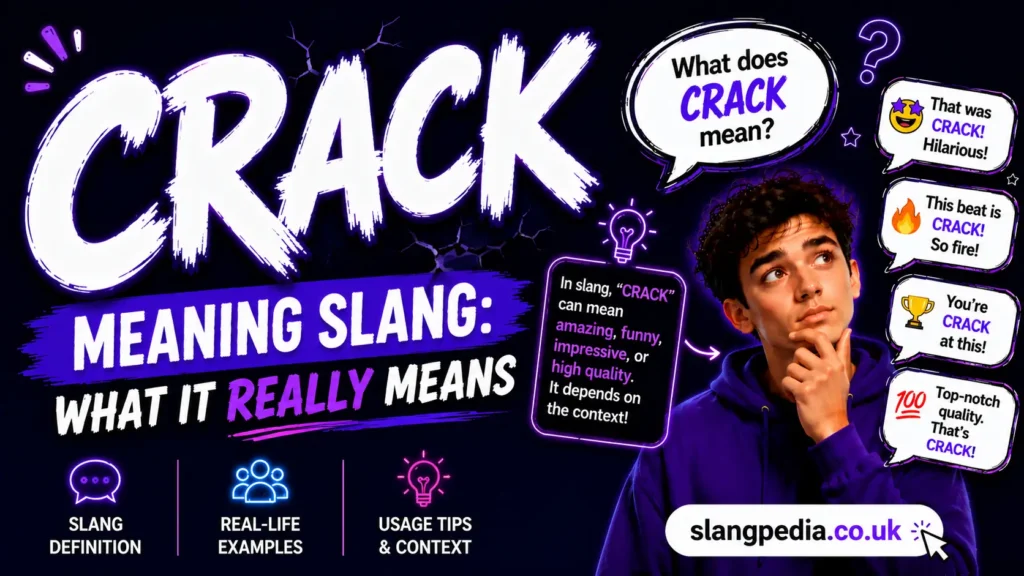
“Crack” means something so addictive, funny, or entertaining that you can’t stop watching, eating, or talking about it — you’ll see it most on TikTok comments and group chats when someone wants to hype up a video, show, or snack as irresistible.
TL;DR
- “Crack” describes anything addictively good — content, food, music, even drama.
- The tone is high-energy, half-joking, always exaggerated for effect.
- It comes from the real drug reference but now lives almost entirely as a compliment.
- Gen Z and younger millennials use it most, across the US and UK.
- Warning: said about a person (“she’s crack”) it can sound harsher than intended.
What Does “Crack” Mean in Slang?
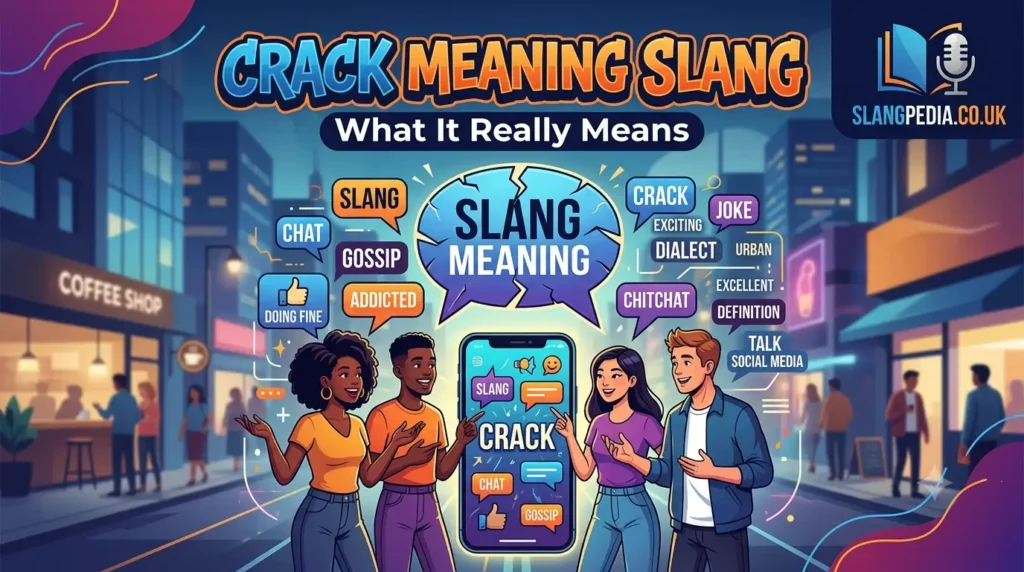
Picture a TikTok comment section under a cooking video. Someone writes: “this recipe is actual crack, I made it three times this week.” Nobody thinks they mean drugs. Everybody gets it instantly.
Crack = something so good or addictive you can’t stop consuming it.
That’s the core meaning. The nuance is in the exaggeration. Calling something “crack” signals you’ve lost a little control over your own habits, and you’re fine with it. It’s self-aware, not embarrassed.
The tone matters more than the literal claim. Saying a show is “crack” doesn’t mean it’s good art — it means you binged six episodes at 2 a.m. and have zero regrets. People also use it for snacks, games, even certain ZIP MEANING SLANG-adjacent food combos that just hit different.
This usage has spread far beyond its origin, and it shows up across platforms, group chats, and comment sections daily.
Where Did the Slang “Crack” Come From?
The exact origin is unclear, but it spread mainly through internet comment culture and early-2010s Tumblr and YouTube communities, where “crack” already had a long history as slang for anything highly addictive, borrowed loosely from the drug’s reputation for intense dependency.
By the time TikTok exploded around 2019–2020, “crack” had fully detached from any drug context for most younger users. It became a stand-in for “addictively entertaining,” applied to everything from snacks to fan edits.
Why Is “Crack” Spelled Different Ways?
Most spellings stay standard — “crack” rarely gets altered. Some users stretch it for emphasis, writing “craaack” in comments to show intensity. Occasionally it’s typed as “krack” in captions, mostly as stylistic flair rather than a meaningful variant.
Timeline:
- 2000s–2010s: “Crack” spreads online as slang for addictive food, music, or shows.
- 2019–2021: TikTok comment culture adopts it heavily for viral food and content trends.
- 2026: It’s mainstream slang, used casually across US and UK youth culture.
What Does “Crack” Mean in Text?
In texts and DMs, “crack” almost always describes something addictive in a positive way. It rarely shifts meaning between private and group chats — the tone stays the same either way.
Common emoji pairings include 🔥, 😭, and 💀, usually to add exaggerated emphasis. People type it fast, lowercase, no punctuation.
Text exchange example:
Tyler: bro this new burger spot is crack
Jess: STOP I went yesterday and went back today 💀
Tyler: see this is what I’m talking about
Jess: certified crack tbh
| Phrase | Meaning | Common Context |
|---|---|---|
| “this is crack” | extremely addictive/good | food, shows, songs |
| “stop being on crack” | playful insult, “you’re being ridiculous” | banter, disagreements |
| “certified crack” | confirmed addictive quality | group chat agreement |
This usage connects naturally to other intensity slang, like how people throw in SO MEANING SLANG to stack emphasis in the same sentence.
What Does “Crack” Mean on TikTok?
On TikTok, “crack” shows up constantly in comments and captions under food videos, viral sounds, and binge-worthy series clips. Creators caption their own videos “this sound is crack” to hype engagement.
It mostly describes content, not people, on this platform. The meaning matches texting — addictive, can’t-stop-watching. It’s roughly equal across US and UK TikTok, though US food and snack content uses it slightly more.
“Crack” in Real Conversations: 5 Examples
Example 1 — Food obsession
Tyler: this ramen spot is actual crack
This signals genuine, slightly exaggerated love for a food experience.
Example 2 — Sarcastic complaint
Ashley: stop watching that show it’s literally crack for your brain
This uses “crack” ironically, mocking a friend’s binge habit.
Example 3 — Sincere compliment
Marcus: ngl your playlist is crack, sent it to everyone
Here it’s sincere praise about music taste with no irony at all.
Example 4 — Group chat hype
Cody: who’s coming tonight this party gonna be crack
This signals high anticipated energy, used to build excitement before an event.
Example 5 — Casual self-deprecation
Jess: I’ve watched this clip 40 times it’s crack send help
This shows self-aware humor about a personal addictive habit, no shame attached.
“Crack” vs. Similar Slang
| Word | Core Meaning | Tone | Best Used When |
|---|---|---|---|
| Crack | Addictively good/entertaining | Exaggerated, playful | Describing food, shows, music |
| Fire | Excellent quality | Confident, hype | Praising something impressive |
| Bussin’ | Extremely good (often food) | Energetic, casual | Specifically food-related praise |
| Goated | Best of all time | Reverent, hype | Ranking something as the greatest |
The biggest mix-up is “crack” versus “bussin’.” Both get used for food, but “bussin'” is a flavor judgment, while “crack” is about compulsion — you keep coming back even if it’s not objectively the best.
The Emotional Vibe Behind “Crack”
Calling something “crack” lets people admit they’ve lost control without admitting weakness. It’s confession dressed up as a joke. That’s the emotional gap it fills.
It spread fast because everyone has something they overconsume — a show, a snack, a sound. “Crack” gives that habit a label that feels funny instead of shameful.
When someone uses it, they’re signaling self-awareness and humor about their own impulses. When it’s used about another person — “she’s crack” — it suggests they’re irresistibly compelling, sometimes in a way that borders on backhanded.
It works alongside other exaggeration slang the same way SO MEANING SLANG stacks intensity onto a sentence — both let speakers perform big feelings without sounding too sincere.
Is “Crack” Offensive?
No, “crack” isn’t offensive in its common slang use. It’s not a slur and doesn’t target any specific group.
Context does matter. Using it directly to joke about drug addiction or someone’s real substance use crosses a line and can land badly. Used about food, shows, or content, it’s harmless and widely accepted in the US and UK.
People in recovery communities, or anyone speaking to someone affected by addiction, should avoid using it casually around that topic. For professional or academic writing, “addictive” or “compulsively engaging” works as the formal alternative.
📌 Quick note for parents and teachers: This slang usually describes addictive entertainment, food, or content — not drugs. It’s casual, common, and not aimed at any group. Context around real substance use is the one place to stay alert.
“Crack” Slang — FAQ
Q: What does “crack” mean on TikTok?
A: It describes content so addictive or entertaining you can’t stop watching it. It shows up in captions and comments under food, sound, and binge-style videos.
Q: Is “crack” a bad word?
A: Not in slang use. It only becomes sensitive if it’s used to joke about real drug addiction or someone’s personal struggle with substance use.
Q: What’s the difference between “crack” and “bussin'”?
A: “Crack” means you can’t stop consuming something, regardless of quality. “Bussin'” specifically means food tastes amazing. They overlap but aren’t interchangeable.
Q: Do Americans and British people use “crack” the same way?
A: Mostly yes. Both use it for addictive food, shows, and content. UK slang also has an older, unrelated use of “crack” meaning fun or banter, which can occasionally cause confusion.
Q: Why do British people sometimes use “crack” to mean something totally different?
A: In UK slang, “what’s the craic” (often spelled “crack”) means “what’s going on,” rooted in Irish English. It’s unrelated to the addictive-content meaning and usually clear from context.
The Bottom Line
“Crack” works because it turns overconsumption into a joke everyone recognizes. It’s less about the literal drug reference now and more about admitting you’re hooked on something harmless.
Next time you see it under a video or in a group chat, you’ll know exactly what’s being confessed — and that it’s said with a grin, not a warning.
Have you seen “crack” used in a way that surprised you? Drop it in the comments.
This article is reviewed periodically for accuracy and cultural relevance by native English-speaking editors.
Maggie Wiersma is a USA-based writer with 2 years of experience covering slang meanings, internet culture, and modern language trends. With a background in communication studies, she creates simple and engaging content that helps readers understand today’s most popular slang terms.