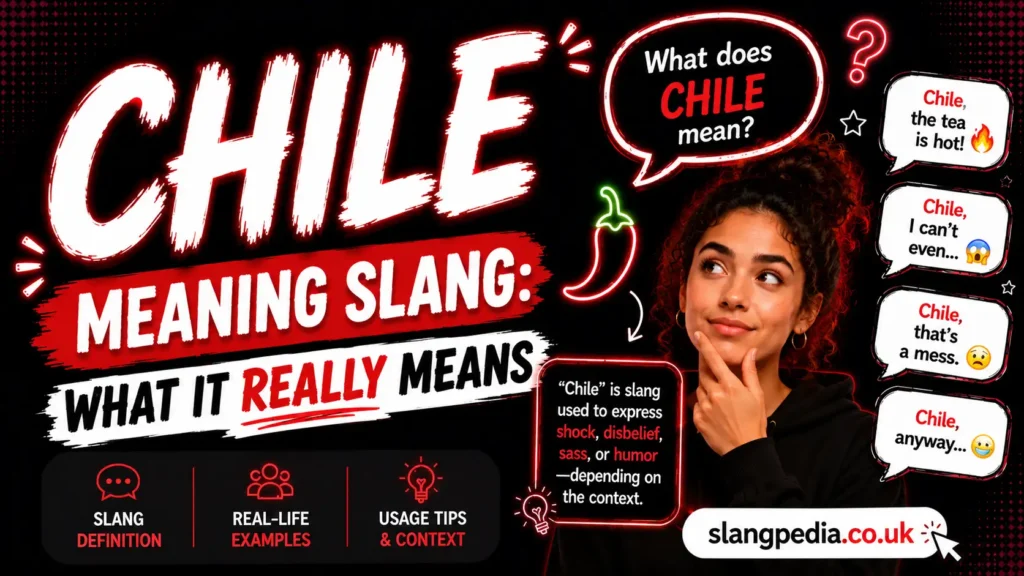
“Chile” means a verbal exclamation of emphasis or disbelief — you’ll see it most on TikTok and in texts when someone is reacting to drama, calling out a lie, or adding attitude to their point.
TL;DR
- Definition: An exclamation expressing emphasis, skepticism, or exasperation — mostly used to react to gossip or questionable claims.
- Tone: Sarcastic, playful, or dramatic — never mean-spirited, unless context says otherwise.
- Origin: AAVE (African American Vernacular English) roots that spread widely through Black TikTok, Twitter, and group chats around 2019–2020.
- Who uses it: Gen Z and younger millennials across race and region — especially popular in LGBTQ+ and Black internet spaces.
- Warning: While widely used, respect the cultural origin — avoid overusing it if you’re outside Black communities, and never use it to mock AAVE.
What Does “Chile” Mean in Slang?
You’re scrolling through a group chat. Your friend drops a screenshot: “He said he never liked her.” Immediate response: “Chile…😭”
That “chile” isn’t about the country. It’s an expression of disbelief mixed with humor. Someone used “chile” to say: “I can’t believe that lie” or “Oh honey, that’s wild.”
The word signals attitude without being rude. It’s a vocal eye-roll—the digital version of putting your hand on your hip. When someone says “chile,” they’re adding seasoning to their reaction. It undercuts drama and makes space for humor at the same moment.
Chile = A verbal exclamation expressing disbelief, emphasis, or exasperation
Most people think “chile” just means agreement, but it’s much more specific. It’s reaction-based. Someone shares something shocking or questionable, and you respond with “chile” to acknowledge the ridiculousness. You might see it paired with period slang for extra emphasis in longer sentences: “Chile, that’s not it. Period.”
The tone matters. “Chile” can feel warm or skeptical depending on context. With close friends, it’s playful. With strangers, it might read as dismissive.
Where Did the Slang “Chile” Come From?
The roots run deep in AAVE—African American Vernacular English. Speakers used “chile” (often pronounced “child” in some regional dialects) as an exclamation for decades before it went viral online.
The word parallels Southern and African American speech patterns where “chile,” “honey,” and “girl” function as interjections rather than nouns. It wasn’t created for the internet—the internet just amplified it.
Between 2019 and 2021, Black creators on Twitter and TikTok normalized using “chile” in digital spaces. It spread fastest through LGBTQ+ Black communities online, then broader Gen Z audiences adopted it. By 2024, it was mainstream enough that even corporate brands tried using it—with mixed results.
Timeline:
- Pre-2010: Established in AAVE and Southern Black speech communities.
- 2019–2020: Explodes on Twitter, TikTok, and Discord through Black creators and LGBTQ+ spaces.
- 2023–2026: Mainstream Gen Z usage across all platforms, though still most natural in Black and queer spaces.
What Does “Chile” Mean in Text?
In texts and DMs, “chile” functions as a reaction word, not a narrative descriptor. You won’t use it to tell a story—you use it to respond to one.
Texting shift: In group chats, “chile” often appears alone or with an emoji. In one-on-one DMs with close friends, it might get more elaborate (“chile, i can’t even right now”). The emoji matters hugely—💀 shows you’re laughing at the absurdity; 😭 means you’re shocked.
Real text exchange:
Tyler: so he said he was “too busy” to hang but posted stories at the club
Jess: chile 💀
Tyler: and he had the nerve to ask me why i’m mad
Jess: CHILE. that’s crazy work
Chile usage in common contexts:
| Context | Example | Vibe |
|---|---|---|
| Reacting to betrayal or lies | “Chile… I saw him texting her” | Disappointed but understanding |
| Expressing disbelief at drama | “Chile, she really said that?” | Shocked and amused |
| Emphatic agreement | “He’s not it. Chile, period.” | Confident and supportive |
You’ll rarely see “chile” used seriously in professional group chats or academic texts. Save it for spaces where your close friends or online community live—that’s where the word breathes. It pairs naturally with tea slang when discussing gossip: “Girl, the tea AND the chile—I can’t.”
What Does “Chile” Mean on TikTok?
On TikTok, “chile” lives in comment sections and video captions. It appears most in:
- Storytime videos (reactions to the unfolding drama)
- Relationship and dating content (responding to red flags)
- Fashion/outfit hauls (“Chile, that price tag?”)
- Lip-sync videos (emphatic reactions to lyrics)
TikTok “chile” mirrors texting usage—it’s a reaction, not narrative. The platform amplifies tone through emojis and video context. US TikTok and UK TikTok use it equally, though UK creators sometimes code-switch it more deliberately as borrowed slang.
The meaning stays consistent: disbelief, emphasis, or playful exasperation. However, TikTok’s comment section speed means “chile” works best as a one-word or two-word drop. Longer explanations get buried instantly.
Chile in Real Conversations: 5 Examples
Example 1 — Reacting to a lie
Marcus: my ex said she never cheated You: Chile 😭
Marcus just shared something unbelievable. “Chile” signals: I don’t buy that story.
Example 2 — Group chat hyping up a friend
Cody: I just got the job Ashley: CHILE YES, let’s gooooo You: chile, that’s our girl right there
Ashley and you are celebrating. “Chile” here means: I absolutely believe this for you, and it’s amazing.
Example 3 — Ironic response
Friend: he said he’s “independent” You: chile, he literally asked me for gas money yesterday
You’re calling out the contradiction with dry humor. “Chile” delivers the punchline.
Example 4 — Sincere concern
Jess: should I text him back? You: chile, if you’re asking, you already know the answer
“Chile” wraps care and wisdom together without sounding preachy.
Example 5 — Casual Discord vibe
Tyler: bro the game just crashed You: chile not again Tyler: i’m about to lose it You: lfg restart
You’re commiserating casually. “Chile” acknowledges frustration without drama.
Chile vs. Similar Slang
| Word | Core Meaning | Tone | Best Used When |
|---|---|---|---|
| Chile | Disbelief or emphasis | Playful skepticism | Reacting to drama, lies, or wild claims |
| Period | Absolute finality | Assertive, no debate | Ending an argument or making a firm point |
| Tea | Gossip or interesting truth | Curious, scandal-focused | Sharing or requesting juicy information |
| Girl | Generic interjection (varies by context) | Casual, warm | Emphasizing a point with friends |
The key difference: “Period” shuts things down; “chile” opens reaction. When someone says period, the conversation is over. When someone says chile, they’re inviting you into their skepticism. “Chile” and “tea” also differ—tea is about what happened (the story). Chile is about how you feel about what happened (the reaction).
People often confuse “chile” and “period” because both add attitude. But period = finality. Chile = questioning. Use period when you want the last word. Use chile when you want to share disbelief.
The Emotional Vibe Behind “Chile”
Why does this word exist? Because sometimes English doesn’t have room for the exact feeling you want to express.
“Chile” fills an emotional gap: the space between laughing and calling someone out, between care and skepticism. It’s protective too. When a friend shares bad news about a relationship, responding with “chile” signals: I see the problem, and I’m on your side.
The word spread so fast because Gen Z needed vocabulary for online drama. Text-based conversations move faster than speech. You can’t raise your eyebrow through a screen. Words like “chile” do that work—they pack tone into text.
Using “chile” signals cultural literacy. It shows you understand how people (especially Black and queer communities online) communicate authentically. When non-Black people use it, it can feel like borrowing style without understanding roots—but used respectfully and rarely, it’s generally welcomed.
When someone describes you using chile, it stings a little. “Chile, she really thought that was okay?” means people are judging your choice. It’s not hate, but it’s not a compliment either. The word npc slang sometimes appears alongside chile for extra dismissal, but chile alone is gentler—it’s critique wrapped in humor.
Is “Chile” Offensive?
No, “chile” is not offensive on its own.
However, context matters. The word originates in AAVE and Black cultural spaces. If you use it constantly or as a costume to seem “relatable,” that reads as appropriation. If you drop it occasionally in genuine conversation with friends who use it too, most people won’t mind.
Is it a slur? Absolutely not. It’s an interjection with deep cultural roots.
Does it shift in different contexts? Slightly. In professional settings or formal writing, avoid it—it signals casual speech, and formal contexts demand different register. Between friends in private chats or on social media, it’s safe and expected.
Safe to use in the USA and UK without causing offense? Yes, if you use it naturally and sparingly. Don’t perform “chile” to seem cool. Don’t use it mockingly to imitate AAVE. Do use it when reacting genuinely in group chats with people who already use it.
Non-Black people should recognize: you’re borrowing vocabulary from Black cultural creation. Respect that origin. Use it, but don’t overuse it.
Formal English alternative: “That’s unbelievable,” “I’m skeptical,” or “That doesn’t add up” for professional contexts.
📌 Quick note for parents and teachers: “Chile” is a casual interjection expressing disbelief or exasperation. It’s not offensive and carries no explicit content. It appears frequently in TikTok comments, group chats, and social media among Gen Z. Recognizing it helps you understand teen communication without concern.
Chile Slang — FAQ
Q: What does “chile” mean on TikTok?
A: It’s a reaction word expressing disbelief, emphasis, or exasperation. Creators and commenters use it to respond to shocking or questionable claims in videos. Paired with emojis (💀, 😭), it signals humor or shock simultaneously.
Q: Is “chile” a bad word?
A: No, “chile” isn’t profane or derogatory. It’s a casual interjection. Use it respectfully, recognizing its roots in AAVE and Black cultural spaces. Avoid overusing it if you’re outside those communities.
Q: What’s the difference between “chile” and “period”?
A: “Period” ends the debate—it’s final and absolute. “Chile” opens reaction and invites skepticism. Use period to make a firm point. Use chile to express disbelief or join in shared reactions.
Q: Do Americans and British people use “chile” the same way?
A: Yes, mostly equally. Both use it for reactions and emphasis. UK users sometimes code-switch it more intentionally as borrowed slang, while US users integrate it more fluidly into everyday speech.
The Bottom Line
“Chile” does one job perfectly: it translates the tone of your voice into text. It’s skepticism, humor, and attitude wrapped into one syllable.
You don’t need to use it constantly. When it fits—when you’re reacting to something wild with friends who speak your language—it lands naturally. Recognize where it comes from, use it respectfully, and it belongs in your toolkit.
Have you seen “chile” used in a way that surprised you? Drop it in the comments.

Maggie Wiersma is a USA-based writer with 2 years of experience covering slang meanings, internet culture, and modern language trends. With a background in communication studies, she creates simple and engaging content that helps readers understand today’s most popular slang terms.