
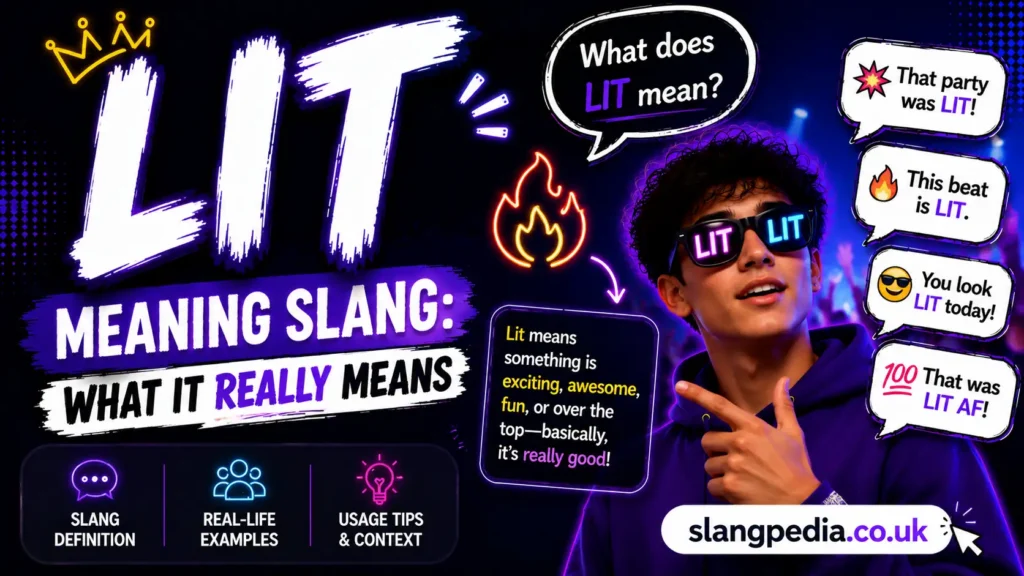
“Lit” means something was amazing, exciting, or a really good time — you’ll hear it most on TikTok and in group chats when someone’s describing a party, song, or moment that was genuinely fire.
TL;DR
- “Lit” = an event or thing was excellent, fun, and worth talking about
- Tone: positive, hype, enthusiastic — never negative or sarcastic
- Origin: hip-hop culture and African American Vernacular English (AAVE) from early 2010s
- Who uses it: Gen Z, Gen X, college students, musicians, content creators across both US and UK
- Warning: Can feel outdated if overused; younger Gen Z (born 2010+) use it less frequently than older Gen Z did in 2016–2020
What Does “Lit” Mean in Slang?
Your friend texts you: “that party last night was SO lit fr fr” or drops a fire song and comments: “this beat goes crazy lit.” They’re not saying it’s literally on fire. They mean it was incredible, worth the hype, genuinely fun. The moment hit different. Your vibe was right.
Lit is pure positive energy. It signals approval, excitement, and cultural approval. When someone calls something lit, they’re saying: this deserves your attention. This mattered. This was the move.
The tone matters more than the word. “Lit” isn’t just good — it’s exciting good. A normal Thursday isn’t lit. A surprise concert announcement is lit. Your ex’s new relationship isn’t lit (that would be sarcasm). Getting tickets to see your favorite artist? Lit.
Lit = something was genuinely fun, exciting, or excellent
This word slots naturally alongside other hype words. When something goes viral, people comment: “this is so lit.” When a DJ drops a track that hits, chat explodes: “LIT.” You’ll notice fire used almost interchangeably — both signal something good, though “lit” skews slightly more toward events and moments, while “fire” can describe a person, skill, or object.
The word carries confidence. Using “lit” means you’re not being ironic. You’re not hedging. You actually think this thing deserves hype.
Where Did the Slang “Lit” Come From?
“Lit” started inside hip-hop culture and African American Vernacular English (AAVE) in the early 2010s. The word originally meant being intoxicated or drunk—”lit up” was standard slang.
Around 2011–2014, the meaning shifted. Instead of intoxication, “lit” began describing a vibe: a party was lit, a night was lit, an atmosphere was lit. The energy was on fire. The excitement was visible and contagious.
From hip-hop, the word jumped to mainstream internet culture. Rappers used it constantly. TikTok, Instagram, and Twitter users adopted it by 2016. By 2017–2018, “lit” became a defining term of Gen Z internet slang. Every YouTuber, streamer, and content creator used it.
Today, “lit” has cooled slightly in peak usage (especially among people born after 2010). But it’s not dead. It still shows up across all platforms. British TikTokers and Gen Z in the UK use it equally with Americans.
Timeline:
- 2011–2014: Hip-hop and AAVE speakers shift meaning from intoxication to “an amazing vibe”
- 2016–2018: Goes viral on TikTok, Twitter, and Instagram; becomes mainstream Gen Z currency
- 2020–2026: Still used widely, but with less frequency than peak years; coexists with “fire” and “goes hard”
What Does “Lit” Mean in Text?
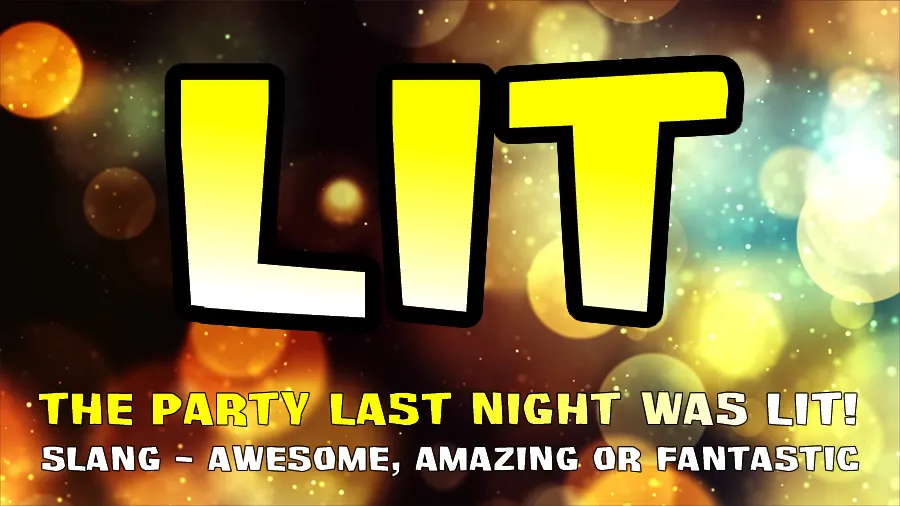
In texts and DMs, “lit” shows up in three main ways:
Standalone: Your friend sends a fire song. You reply: “lit.” One word. That’s it. Maximum hype, minimal effort.
Description: “last night was so lit no cap” — describing an event that already happened. The moment still feels good in retrospect.
Comment on someone’s update: Friend posts a photo from vacation. Someone replies: “this trip is lit” or “the vibes are lit.”
The meaning doesn’t shift between private chats and group DMs. “Lit” means the same thing everywhere. But in group chats, it hits different. One person says it, another person agrees, and suddenly everyone’s remembering why the moment was lit. It becomes shorthand for a shared experience.
Emojis that go with “lit”:
- 🔥 (fire — the most common pairing)
- 💯 (100 — full approval)
- 🎉 (party — literal lit vibes)
- 👏 or 🙌 (applause — hype acknowledgment)
Real Text Exchange
Marcus: yo you coming to jake’s thing on saturday
Cody: yeah bro heard it’s gonna be lit
Marcus: facts the last one was insane
Cody: 🔥🔥 im in
Marcus is confirming an event sounds good. Cody agrees and acknowledges a previous lit moment. The emoji doubles down. They’re building hype together.
In professional or formal texting, no one uses “lit.” It stays in personal chats, Discord servers, and casual group DMs. If your boss texts you about a meeting going well, they won’t write “that was lit.” Code-switching matters.
| Slang Term | Context | Emotional Signal |
|---|---|---|
| Lit | Party, night out, event | Hype, approval, excitement |
| Slay | Personal achievement | Pride, confidence, respect |
| Fire | Song, skill, person | Excellence, impressive |
| Goes hard | Track, joke, person | Strength, impact, serious |
What Does “Lit” Mean on TikTok?
On TikTok, “lit” appears three ways:
In captions: A creator posts a thirst trap or fun video. Caption reads: “the energy is lit 🔥” or “this summer was LIT.”
In comments: Someone drops a fire edit, song, or joke. Comments flood in: “LIT,” “this is so lit,” “HE ATE 🔥.”
In voiceovers: A TikToker recounts a crazy story. Voiceover: “and that’s when the party got lit.” Usually mid-story for dramatic effect.
Content types that use “lit”:
- Party recaps (summer parties, house parties, club nights)
- Music drops and covers
- Vacation or travel edits
- Funny moment compilations
- Outfit of the day or fashion hauls
- Concert clips
TikTok “lit” means exactly what text “lit” means. No code-switching. The tone is identical. It’s just delivered faster, louder, in front of thousands of people instead of your group chat.
US TikTok and UK TikTok use “lit” equally. British creators post “my friday night was lit” with the same frequency as American creators. The word crossed the Atlantic fully. It’s not America-specific anymore.
The only difference? UK TikTokers sometimes pair “lit” with British expressions like “proper lit,” which emphasizes the vibe even more.
“Lit” in Real Conversations: 5 Examples
Example 1 — Party recap
Tyler: yo that rave was actually insane bro
Jess: fr fr it was so lit
Tyler’s still processing the excitement. Jess confirms using standard Gen Z affirmation. This signals genuine, uncomplicated enthusiasm.
Example 2 — Sarcastic pushback
Marcus: bro you’re coming to my calculus study session
Ashley: that sounds absolutely lit
Marcus definitely knows it’s sarcasm. The word “absolutely” gives it away. Ashley’s using “lit” to mock the situation. Same word, opposite energy.
Example 3 — Music moment
Cody: just heard this new artist
Cody: literally lit no cap
His excitement is real. “No cap” means he’s not exaggerating. The double emphasis (literally + no cap) shows he means it.
Example 4 — Casual group chat
Friend 1: last night was so lit
Friend 2: facts bro
Friend 3: yessss 🔥
Friend 1 starts the memory. Friends 2 and 3 pile on. Low-effort, high-agreement. This is how lit gets used most: as shorthand for “yeah, that was genuinely fun and I’m glad it happened.”
Example 5 — Event promotion
Festival account: summer fest 2026 is gonna be LIT
This is hype marketing. The brand is using Gen Z language to feel relatable. Effective, slightly cringe, but the audience knows what they mean.
“Lit” vs. Similar Slang
| Word | Core Meaning | Tone | Best Used When |
|---|---|---|---|
| Lit | Event or moment was amazing | Hype, enthusiastic | Describing parties, nights out, events |
| Fire 🔥 | Song, skill, person is excellent | Impressed, approving | Commenting on quality (music, ability, looks) |
| Slay | Person succeeded, looked good, won | Celebratory, confident | Personal achievements, fits, performances |
| Goes hard | Track or person is serious/skilled | Respect, intensity | Music drops, athletic moments, roasts |
The confusion usually happens between “lit” and “fire.” People use them almost interchangeably. But here’s the difference: Fire is about quality. Lit is about the vibe and energy. A person can be “fire” at basketball (skilled). A party is “lit” (the energy was amazing). A new song is both — it’s fire (sounds good) and makes the party lit (gets people hyped).
When someone says “that party was fire,” they’re emphasizing how good it was. When they say “that party was lit,” they’re emphasizing how much fun everyone had.
The Emotional Vibe Behind “Lit”
Why does “lit” exist? Because sometimes “fun” isn’t enough. Sometimes “good” undersells the moment.
“Lit” fills the gap between normal and unforgettable. It’s the word for moments that feel rare, that deserve to be talked about, that made you feel alive. When you use it, you’re saying: this mattered. This was worth your time.
The word spread fast online because it’s effortless. One syllable. Universally understood. Impossible to misuse (unless you’re being sarcastic, and people catch that immediately). It works in texts, captions, comments, voiceovers, and real speech equally well.
What does it say about the speaker? They’re enthusiastic. They’re hype. They don’t take themselves too seriously, but they do take their vibe seriously. They notice good moments and celebrate them. They’re in community with the people around them — parties only feel lit when people agree they’re lit together.
What does it say about the person being described? If someone says “oh yeah, he’s pretty lit,” they’re saying he’s fun, brings good energy, makes things interesting. He’s the type of person who makes moments better by being there.
Using “lit” is a form of cultural bonding. When you say it, you’re signaling: I’m tuned in. I notice good vibes. I’m not the type to be cynical or detached. Consider slay — it’s similar energy, but “slay” is about individual excellence. “Lit” is about collective excellence. It’s team energy.
Is “Lit” Offensive?
No. “Lit” is not offensive, not a slur, and safe to use in the USA and UK without causing offense.
The word has roots in AAVE and hip-hop culture. That’s important to acknowledge. But “lit” is not a slur or word that shouldn’t be used by non-Black people. It’s traveled into mainstream usage. People of all backgrounds use it and accept it.
Context matters slightly: using “lit” sarcastically to mock someone can feel mean-spirited, but the word itself isn’t harmful. A parent using “lit” to describe their kid’s school play might feel uncool or dated, but it’s not offensive.
In professional or academic writing, avoid “lit.” Use words like “excellent,” “engaging,” “successful,” or “exciting” instead. “The conference was lit” reads wrong in a report. “The conference sessions generated excellent engagement” reads right.
📌 Quick note for parents and teachers: “Lit” means something was fun, exciting, or excellent. It’s not harmful slang. You’ll hear it in TikTok videos, group chats, and casual conversation. It’s been mainstream Gen Z slang since 2016. If your teen or student uses it, they’re just describing something positively.
“Lit” Slang — FAQ
Q: What does “lit” mean on TikTok?
A: On TikTok, “lit” means a moment, event, or song was amazing and worth celebrating. It shows up in captions, comments, and voiceovers. Creators use it to hype up party videos, concert clips, and fun moments. Same meaning as everywhere else — enthusiasm and positive vibes.
Q: Is “lit” a bad word?
A: No. “Lit” is not a bad word or slur. It’s casual slang that means something was excellent or fun. You can use it around parents, teachers, and most adults without consequences. It’s not vulgar or offensive.
Q: What’s the difference between “lit” and “fire”?
A: Both are positive, but “lit” describes an event or vibe being amazing. “Fire” describes quality and skill. A party is lit (great energy). A song is fire (sounds incredible). A person can be fire at something (skilled) or bring lit energy (fun to be around).
Q: Do Americans and British people use “lit” the same way?
A: Yes, completely. British Gen Z uses “lit” identically to American Gen Z. TikTokers in the UK drop it in comments and captions the exact same way. Sometimes British users add “proper lit” for emphasis, but the meaning is identical across both countries.
Q: Why do people say “no cap” with “lit”?
A: “No cap” means “no lie” or “I’m being serious.” People pair it with “lit” to emphasize they’re genuinely excited, not being sarcastic. Example: “this concert was lit no cap.” It removes any doubt that they mean it.
The Bottom Line
“Lit” is a celebration word. It describes moments worth talking about, events that felt right, vibes that connected with people.
The word emerged from hip-hop culture and became a defining Gen Z term by 2016. Today, it’s still everywhere — TikTok comments, group chats, real conversations. It means the same thing across US and UK audiences.
Understanding “lit” matters because it’s how your peers describe joy, enthusiasm, and community. When someone says a night was lit, they’re not just saying it was good. They’re saying it felt alive.
Have you seen “lit” used in a way that surprised you? Drop it in the comments.

Maggie Wiersma is a USA-based writer with 2 years of experience covering slang meanings, internet culture, and modern language trends. With a background in communication studies, she creates simple and engaging content that helps readers understand today’s most popular slang terms.
Pingback: Chile Meaning Slang: What It Really Means in 2026 - Slang Pedia
Pingback: Ops Meaning Slang: What It Really Means in 2026 - Slang Pedia