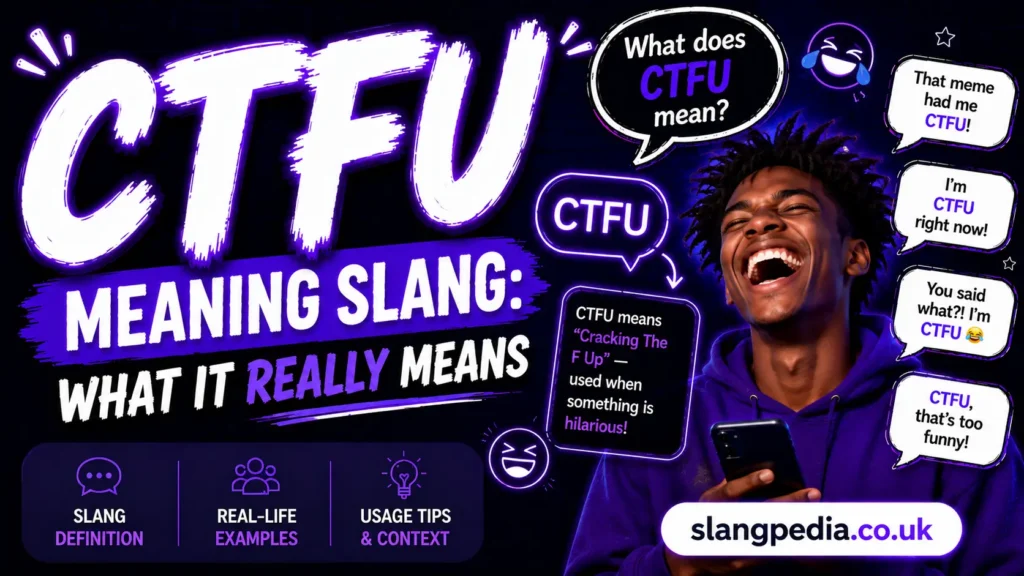
“CTFU” means something is so funny you can’t stop laughing — you’ll see it most in group chats and TikTok comments when someone reacts to a clip or a joke that hit way too hard.
TL;DR
- CTFU stands for “cracking the f*** up” — basically dying laughing.
- The tone is loud, reactive, and a little chaotic — bigger than a regular “lol.”
- It spread through Black Twitter and hip-hop-adjacent online spaces in the early 2010s.
- Teens and young adults use it most, especially in texts, Discord, and comment sections.
- Warning: it’s not formal English, so it doesn’t belong in school or work writing.
What Does CTFU Mean in Slang?
Picture this: someone drops a video in the group chat of their dog falling off the couch mid-nap. Within seconds, three people reply with the same thing — “CTFU 💀💀💀.” Nobody types out a sentence. They don’t need to.
CTFU stands for “cracking the f*** up.” At its core, it just means something is extremely funny. But it carries more punch than “lol” or “haha.” It signals a real, physical reaction — like you actually lost it laughing, not just smiled at your phone.
CTFU = laughing uncontrollably at something hilarious
The nuance matters here. Saying “lol” can feel like a polite reflex. CTFU says the opposite: you were caught off guard, and the laugh was real. It’s often paired with a video, a meme, or a screenshot of someone’s chaotic text.
People also use it sarcastically — reacting to something awkward or unintentionally funny rather than a planned joke. That double use is part of why it stuck around. It works for genuine comedy and secondhand embarrassment, similar to how pog flexes between hype and sarcasm depending on who’s typing it.
Where Did the Slang “CTFU” Come From?
CTFU traces back to Black Twitter and broader African American Vernacular English (AAVE) online spaces in the early 2010s. It built on the older, more explicit phrase it abbreviates, trimming it down for fast typing during live tweeting and group texts.
The term spread the same way most acronym slang does — through reaction tweets, retweets, and screenshots that got reposted across platforms. As Vine, then later Twitter threads and group chats, picked it up, CTFU became shorthand for any clip worth a real laugh.
Why Is “CTFU” Spelled Different Ways?
Most people write it as one clean block: CTFU. Some stretch it with extra letters for emphasis, like “CTFUUU,” to show the laugh was bigger than usual.
You’ll also see it lowercase in casual texting and uppercase in captions or comments for visibility. Neither spelling changes the meaning — it’s purely about emphasis and platform habit.
Timeline:
- 2011–2012: CTFU starts circulating on Black Twitter as shorthand reaction text.
- 2014–2017: Vine and early meme pages push it into wider youth slang use.
- 2026: CTFU is common across TikTok comments, Discord, and group texts in the US and UK.
What Does CTFU Mean in Text?
In texts and DMs, CTFU works as a quick, low-effort reaction. It almost always responds to something visual — a video, a screenshot, a voice memo gone wrong.
In a private chat, it can feel more personal, like you’re laughing specifically at an inside joke. In a group chat, it often piles up — three or four people sending it back to back after one clip.
Common emoji pairings include 💀, 😭, and 🤣. These add visual weight to the reaction without needing more words.
Sample exchange:
Tyler: bro watch this clip of my cousin trying to parallel park Jess: CTFU 💀 he almost hit the mailbox twice Tyler: AND he got out like nothing happened Jess: I can’t, this is too much
This kind of exchange is common alongside other reaction terms, including low-key admitting something was embarrassing.
| Phrase | What It Signals |
|---|---|
| CTFU | Genuine, big laugh reaction |
| Dead 💀 | Similar laugh, more dramatic |
| I can’t 😭 | Laughing while feigning disbelief |
What Does CTFU Mean on TikTok?
On TikTok, CTFU shows up mostly in comment sections, not captions. People drop it under clips involving fails, pets, sibling chaos, or unexpected plot twists in a video.
The meaning stays consistent with texting — it’s still about a strong, real laugh. But on TikTok, it often appears alongside other commenters doing the same thing, creating a stacked comment thread of pure reaction.
CTFU shows up on both US and UK TikTok, though it leans slightly more common in American comment sections, where the original phrase it abbreviates is used more casually in everyday speech.
CTFU in Real Conversations: 5 Examples
Example 1 — Group chat chaos
Marcus: y’all see what happened in the group call 😭 Ashley: CTFU I’m still thinking about it
The reaction signals shared, ongoing laughter from something chaotic.
Example 2 — Sarcastic reply
Cody: my flight got delayed 6 hours Jess: CTFU bro the universe really said no
Here, CTFU pokes fun at someone else’s bad luck.
Example 3 — Sincere compliment on a joke
Tyler: that meme you sent is actually the funniest thing today Marcus: CTFU glad you liked it lol
This use confirms a joke genuinely landed.
Example 4 — Self-deprecating moment
Ashley: I just walked into a glass door in front of everyone Cody: CTFU no way
The word reacts to secondhand embarrassment, not just comedy.
Example 5 — Casual one-word reply
Jess: [sends video, no caption] Tyler: CTFU
A single word can carry the entire reaction with no extra context needed.
CTFU vs. Similar Slang
| Word | Core Meaning | Tone | Best Used When |
|---|---|---|---|
| CTFU | Laughing hard at something funny | Loud, reactive | Replying to a funny video or story |
| LMAO | Laughing my ass off | Casual, default | General everyday laughter |
| Dead | Overwhelmed by something funny | Dramatic, exaggerated | Something almost too funny to handle |
| Dying | Can’t stop laughing | Intense, breathless | Extreme secondhand embarrassment |
The biggest mix-up happens between CTFU and “dead.” Both describe big reactions, but “dead” leans more theatrical, almost performative. CTFU feels more like an honest, immediate reflex — less about performance, more about an actual laugh you couldn’t hold in.
The Emotional Vibe Behind “CTFU”
CTFU exists because typing “haha” never really captured how hard something hit. People wanted a way to show a laugh had weight — that it wasn’t polite, it was real.
That’s part of why it spread fast. Online culture rewards reactions that feel authentic over reactions that feel scripted. CTFU reads as instinctive, not curated.
When someone uses it, they’re signaling they were genuinely caught off guard. It’s a small flex too — proof they’re plugged into the joke, the clip, or the chaos being described.
For the person being described, it usually means they did something memorable enough to earn a real reaction, even if that thing was embarrassing. It sits in the same emotional lane as low-key confessions — both terms let people admit something true without overexplaining it.
Is “CTFU” Offensive?
No, CTFU is not offensive on its own. It is not a slur and does not target any specific group.
Context can shift the feeling slightly — if the laugh is aimed at someone’s misfortune, it can come across as teasing. But the phrase itself carries no inherent insult.
It’s generally safe to use casually in both the US and UK among friends, group chats, and comment sections. People who work in formal settings, or anyone writing for school or professional contexts, should avoid it. The polite, professional alternative is simply: “that’s really funny” or “I couldn’t stop laughing.”
📌 Quick note for parents and teachers: CTFU means someone is laughing hard at something funny. It’s not threatening or explicit in normal use, though it abbreviates a phrase with profanity in it. You’ll mostly see it in texts, TikTok comments, and casual chats among teens and young adults.
CTFU Slang — FAQ
Q: What does CTFU mean on TikTok? A: On TikTok, CTFU appears mainly in comments under funny or chaotic videos. It signals the commenter genuinely laughed hard at the clip.
Q: Is CTFU a bad word? A: CTFU itself isn’t a bad word, though it abbreviates a phrase containing profanity. Most people read and use it as a casual laugh reaction, not as a curse.
Q: What’s the difference between CTFU and “dead”? A: CTFU reads as an honest, instant laugh reaction. “Dead” tends to feel more dramatic and exaggerated, even when the actual amusement level is similar.
Q: Do Americans and British people use CTFU the same way? A: Mostly yes — both use it to react to something funny online. It’s slightly more common in American group chats and comment sections than in UK ones.
Q: Why do people stretch it out, like “CTFUUUU”? A: Stretching the spelling adds emphasis, showing the laugh felt bigger or lasted longer. It works the same way as adding extra letters to “lol” or “omg.”
The Bottom Line
CTFU isn’t just an acronym — it’s a quick, honest signal that something actually landed. It fills the gap between a polite “haha” and a real, uncontrollable laugh.
Once you know the tone behind it, spotting it in comment sections or group chats gets easy. It’s casual, reactive, and meant to feel real, not performed.
Have you seen CTFU used in a way that surprised you? Drop it in the comments.
This article is reviewed periodically for accuracy and cultural relevance, with input from native speakers across the US and UK.

Maggie Wiersma is a USA-based writer with 2 years of experience covering slang meanings, internet culture, and modern language trends. With a background in communication studies, she creates simple and engaging content that helps readers understand today’s most popular slang terms.