“Demure” means quietly modest, composed, and effortlessly low-key — you’ll see it most on TikTok and Instagram when someone describes a restrained, classy vibe without trying too hard.
TL;DR
- Demure = intentionally modest, soft, and understated — not shy, just composed
- Tone is positive and aspirational; using it signals self-awareness and taste
- It exploded on TikTok in 2024 via creator Jools Lebron’s viral “very demure, very mindful” series
- Used by Gen Z women and LGBTQ+ communities most, but spreading fast across genders
- ⚠️ Don’t use it sarcastically at someone’s expense — it can read as mean-girling
What Does Demure Mean in Slang?
You’re scrolling TikTok at midnight. Someone posts a makeup-free selfie at their desk with a green tea, caption: “very demure, very mindful.” The comment section explodes: “this is the vibe,” “demure szn,” “she understood the assignment.”
That’s demure culture in action.
In slang, demure doesn’t mean timid or mousy — that’s the dictionary definition. Online, it means composed, intentional, and quietly confident. It’s the opposite of loud or “that girl” energy.
The word signals restraint as a flex. You’re not trying too hard. You’re not performing. You’re just… calm.
demure = doing the most by doing the least, in the most graceful way possible
It sits close to mindful in vibe — both words got reclaimed online as aesthetic identifiers, not just personality traits.
The tone is warm and sincere when used genuinely. It can turn ironic when someone uses it to describe something obviously chaotic.
Where Did the Slang “Demure” Come From?
The slang use of demure traces directly to TikTok, mid-2024. Creator Jools Lebron (a trans woman of color) posted a series of videos about being “very demure, very mindful” at work and in daily life. The phrase immediately went viral.
Lebron’s framing was specific: demure wasn’t about being invisible. It was about not oversharing, not overdoing it, and carrying yourself with soft dignity. The LGBTQ+ community and Black TikTok amplified it first.
Within weeks, it jumped to mainstream Gen Z use across the US and UK.
Why Is “Demure” Spelled Different Ways?
Unlike many slang terms, demure keeps its original spelling — no alternate versions like “demoor” or “demewer” stuck. Some users type “demuree” for emphasis (like stretching a vowel sound), but this is rare and stylistic, not a real variant.
Timeline:
- 2024: Jools Lebron coins “very demure, very mindful” on TikTok; LGBTQ+ and Black TikTok pick it up immediately
- Late 2024: Mainstream US and UK Gen Z adopt it; brands start using it in marketing (often cringe-ly)
- 2025–2026: The word settles into everyday vocabulary as an aesthetic adjective and ironic descriptor
What Does Demure Mean in Text?
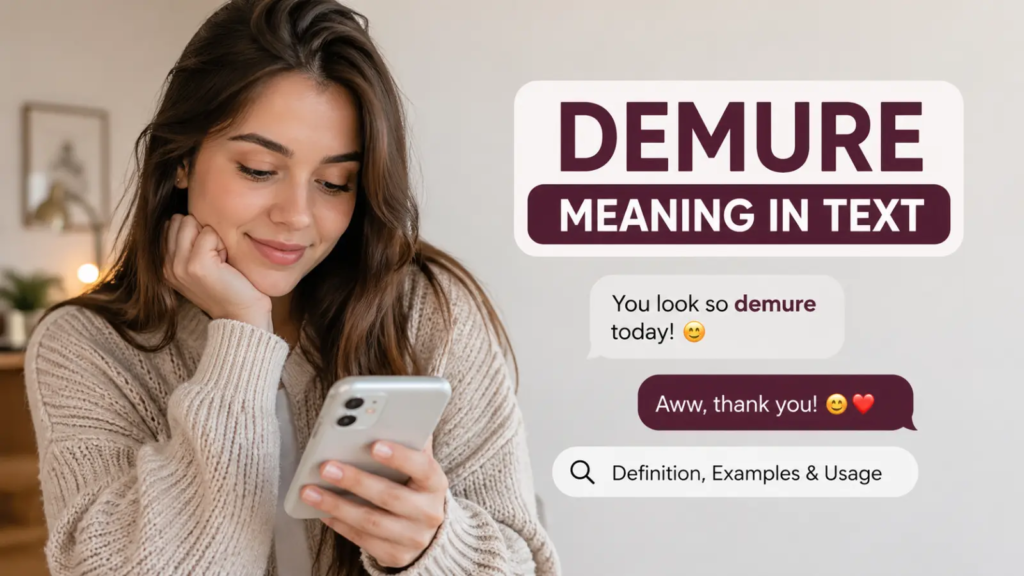
In texts and DMs, demure works as both a compliment and a gentle aesthetic judgment. It’s softer than “slay” and more specific than “cute.”
In private chats, it’s usually sincere — you’re genuinely complimenting someone’s energy. In group chats, it can get playful or ironic fast.
Common emojis paired with it: 🫧 🍵 🌿 🤍 — all calm, clean, minimal.
Real text exchange:
Jess: just showed up to brunch with a silk blouse and zero drama
Ashley: demure behavior honestly 🍵
Jess: exactly. very mindful of me
Ashley: she understood the assignment
The word travels well in texts because it’s short, specific, and image-friendly. It conjures a whole aesthetic in one word.
| Phrase | Meaning | Vibe |
|---|---|---|
| “very demure” | Maximal restraint, intentionally soft | Sincere compliment |
| “demure era” | Going through a calm, collected phase | Self-deprecating or proud |
| “demure behavior” | Someone acted low-key and classy | Approving, slightly ironic |
What Does Demure Mean on TikTok?
On TikTok, demure is both a caption word and a comment compliment. It shows up most in:
- “Get ready with me” videos with minimal, clean makeup
- Soft life / quiet luxury content
- Work outfit posts
- Self-care routines that aren’t over-the-top
The TikTok meaning matches the texting meaning — composed, modest, intentional. But TikTok adds a visual layer: the demure aesthetic has a look (neutral tones, clean spaces, gentle lighting).
It’s more popular on US TikTok but has genuine UK traction too, especially in London lifestyle content. UK users sometimes pair it with “chic” or “sleek.”
Demure in Real Conversations: 5 Examples
Example 1 — Work outfit approval
Tyler: bro you wore that to the office?
Marcus: kept it demure. no distractions.
Demure here signals intentional self-editing — dressing to not stand out.
Example 2 — Ironic chaos energy
Ashley: just ate a whole rotisserie chicken alone in my car
Cody: very demure. very mindful of you 🍵
Used sarcastically here — the contrast between the act and the word is the joke.
Example 3 — Sincere compliment
Jess: she walked in, said hi to everyone, sat down, didn’t make it a thing
Tyler: that’s actually so demure of her
Demure used sincerely to praise someone’s lack of ego.
Example 4 — Self-description
Marcus: I’m in my demure era. no social media, no drama, just green tea
Ashley: we love this for you
“Demure era” signals a deliberate lifestyle shift — calm over chaos.
Example 5 — Group chat shade (light)
Cody: she posted 14 Instagram stories from the gym
Jess: not very demure of her tbh
Demure used as a benchmark — implying someone failed the “low-key” standard.
Demure vs. Similar Slang
| Word | Core Meaning | Tone | Best Used When |
|---|---|---|---|
| Demure | Quietly modest, composed, intentional | Warm, aspirational | Complimenting calm, effortless behavior |
| Soft life | Prioritizing comfort and ease | Aspirational, self-care focused | Describing a lifestyle, not a moment |
| Understated | Not flashy, deliberately subtle | Neutral to complimentary | Fashion or aesthetic contexts |
| Mindful | Conscious, intentional about choices | Positive, slightly earnest | Paired with demure; broader life context |
People most often confuse demure with soft life. The difference: soft life is about comfort and luxury. Demure is about comportment — how you carry yourself, not what you have. You can live a soft life loudly. You can’t be demure loudly.
The Emotional Vibe Behind “Demure”
Demure filled a gap that “slay” and “that girl” left open. Those words demand performance. Demure demands the opposite.
It spread because a lot of people are exhausted by the pressure to be loud online. Every platform rewards drama, volume, and oversharing. Demure became the counter-signal — I’m here, but I’m not performing for you.
When someone calls themselves demure, they’re claiming restraint as a form of power. It’s not meekness. It’s discipline.
When someone calls another person demure, it’s high praise. It means: you didn’t make it weird. You didn’t overdo it. You read the room.
The word also carries something culturally specific. Jools Lebron’s original use was rooted in the experience of navigating professional spaces as a trans woman — being deliberate, not giving people a reason to clock you wrong. That layer of meaning is still in the word, even when it’s used more casually.
67 and other coded terms that travel from specific communities into Gen Z mainstream follow the same pattern — the original meaning carries even when the surface meaning shifts.
Is “Demure” Offensive?
No — demure is not offensive. It’s not a slur and it doesn’t target any group.
Context matters in one specific way: using it sarcastically about someone (not with them) can feel like a subtle dig. Saying “she’s so demure” in a mocking tone implies the person is repressed or boring — that’s shade, not a compliment.
It’s safe to use in both the US and UK without causing offense. It has no racial, gendered, or sexual connotations that make it risky.
The one caution: if you’re using it to describe someone’s race-coded behavior (implying they should be “more demure” = quieter), that’s rooted in harmful stereotypes. Don’t do that.
In professional or academic writing, use: composed, understated, modest, or restrained.
📌 Quick note for parents and teachers: “Demure” is a standard English word repurposed as a positive aesthetic term by Gen Z online. It means calm, modest, and low-key. It is not harmful, sexual, or offensive in any context you’re likely to encounter it in school or at home.
Demure Slang — FAQ
Q: What does demure mean on TikTok?
A: On TikTok, demure means quietly composed and intentionally low-key. It started with creator Jools Lebron’s “very demure, very mindful” videos in 2024. It’s used as a caption, a compliment in comments, and an aesthetic label for calm, minimal content.
Q: Is demure a bad word?
A: No. Demure has no offensive meaning in slang. It’s a positive term. The only time it edges toward shade is when used sarcastically to imply someone is boring or overly restrained — and even then, it’s mild.
Q: What’s the difference between demure and soft life?
A: Demure is about how you carry yourself — quiet, composed, not overdoing it. Soft life is about how you live — comfort, ease, luxury. They overlap in vibe but describe different things. You can pursue soft life loudly. Demure is always low-key.
Q: Do Americans and British people use demure the same way?
A: Mostly yes. Both use it as a compliment for calm, understated behavior. US usage tends to be more rooted in the TikTok aesthetic context. UK users more often pair it with fashion and “quiet luxury” content. The core meaning is identical.
The Bottom Line
Demure isn’t just a word — it’s a stance. It says: I’m here, I’m intentional, and I don’t need to be loud about it.
It spread because it named something Gen Z already valued but couldn’t quite articulate. In a world that rewards oversharing and performance, choosing restraint is its own kind of flex.
You’ll recognize it when you see it — the calm caption, the minimal outfit, the person who didn’t make the moment about themselves.
Have you seen demure used in a way that surprised you? Drop it in the comments.
Article reviewed for cultural accuracy. Slang meanings shift fast — we update regularly to reflect real usage.

Maggie Wiersma is a USA-based writer with 2 years of experience covering slang meanings, internet culture, and modern language trends. With a background in communication studies, she creates simple and engaging content that helps readers understand today’s most popular slang terms.