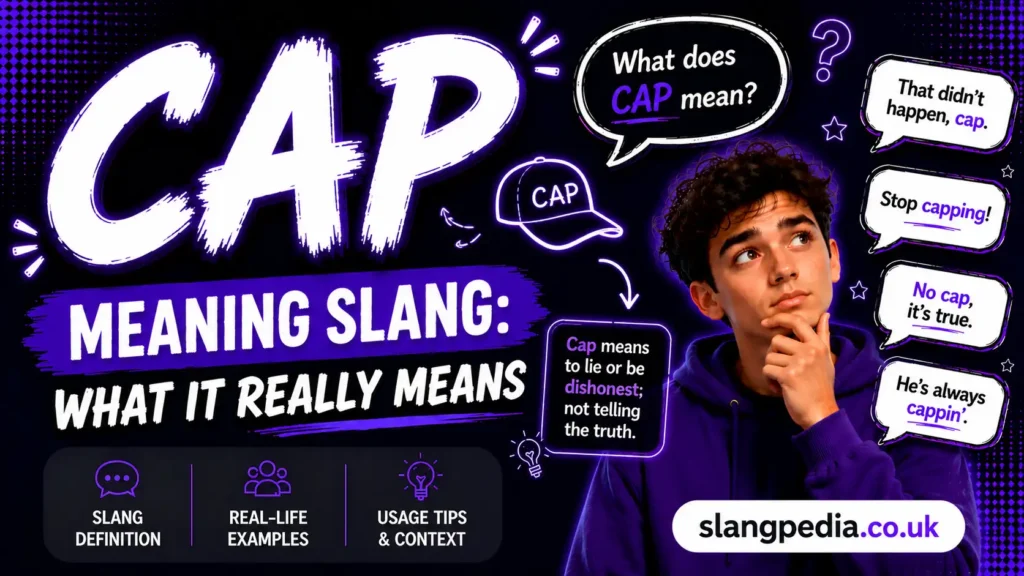
“Cap” means a lie or fake claim — you’ll see it most on TikTok and in iMessage threads when someone calls out another person for saying something untrue.
TL;DR
- Cap = a lie, exaggeration, or fake claim; “no cap” = total honesty
- Tone is accusatory or validating, depending on whether you’re calling cap or denying it
- Rooted in Black American slang and hip-hop culture, spread through TikTok around 2017–2019
- Used heavily by Gen Z and millennials across the US and UK
- Don’t use “cap” ironically with older adults — it reads as confusing or rude without shared context
What Does Cap Mean in Slang?
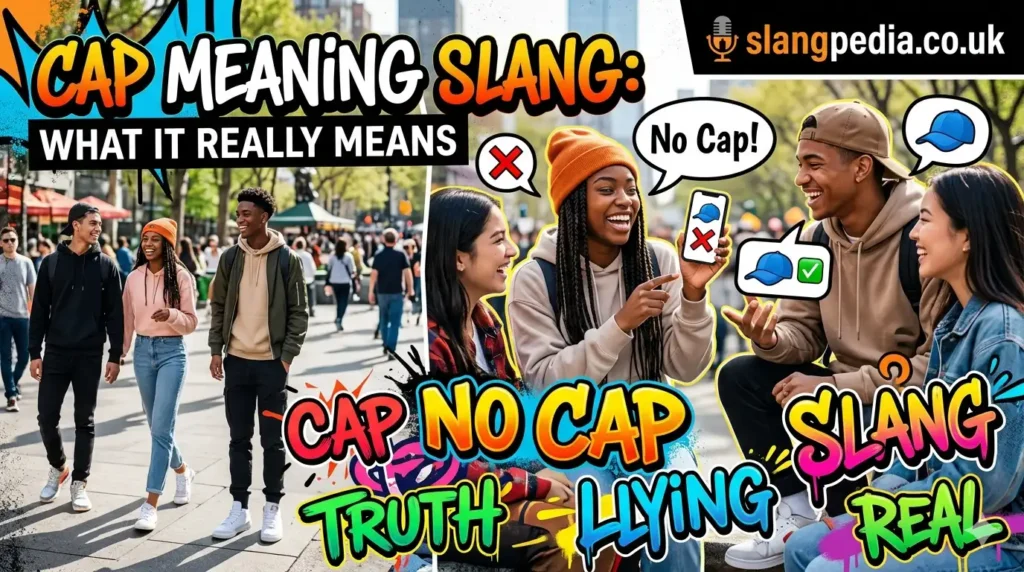
Your group chat blows up. Someone posts: “I deadass got 100 on that exam without studying.” Three people reply instantly — “Cap.” One person sends the crying-laughing emoji. Nobody believes it.
That’s cap in action.
Cap means a lie, a false claim, or an exaggeration. When someone says “cap,” they’re telling you directly: I don’t believe that. It’s blunt. It’s fast. It fits perfectly in comment sections and DMs where long explanations would kill the vibe.
The flip side is “no cap” — meaning I’m being completely serious, no lies attached. Both phrases work together as a built-in credibility system for online conversation.
Cap = a lie or false claim; “no cap” = the absolute truth
The tone matters. Dropping “cap” on someone isn’t neutral — it’s a challenge. It signals doubt or disbelief, and sometimes a little shade. No cap works the opposite way, functioning like “I swear” or “for real” to add weight to a statement.
Where Did the Slang “Cap” Come From?
Cap comes from AAVE — African American Vernacular English — where “capping” meant lying or boasting falsely. The phrase “old cap” was used in Black communities for decades before the internet existed.
Hip-hop carried it forward. Artists used “capping” and “no cap” in lyrics through the 2010s. Young Thug and Future helped push the phrase into wider rap vocabulary around 2016–2017.
TikTok did the rest. By 2018–2019, “cap” and “no cap” appeared in comment sections constantly. Gen Z absorbed it fast. It jumped from US Black culture into mainstream internet slang across races and countries.
By 2020, it was everywhere — UK TikTok, Discord servers, UK roadman slang circles, and iMessage threads from LA to London.
Why Is “Cap” Spelled Different Ways?
You’ll sometimes see “kap” or “🧢” (the blue cap emoji). These aren’t misspellings — they’re intentional stylistic variants that carry the same meaning.
The blue baseball cap emoji became a visual shorthand. Dropping 🧢 in the comments says “cap” without a single letter. It’s especially popular on TikTok where emoji responses move faster than typing.
Timeline
- 2016: “No cap” gains traction in hip-hop lyrics and Black Twitter
- 2018: TikTok spreads “cap” and “no cap” to mainstream Gen Z audiences
- 2026: Both phrases are standard internet vocabulary across the US and UK
What Does Cap Mean in Text?
In texts and DMs, “cap” works as a one-word verdict. It hits harder than saying “I don’t believe you” because it’s shorter, more loaded, and instantly recognizable.
In private chats, it feels more personal — almost confrontational. In group chats, it lands lighter, more like a joke or playful call-out.
The 🧢 emoji almost always goes with it. Sometimes it replaces the word entirely.
Real text exchange:
Tyler: Bro I ran 10 miles this morning no big deal
Marcus: 🧢🧢🧢
Tyler: No cap I’m serious ask Jess
Marcus: We’ll ask her lmao
In this exchange, Marcus uses the cap emoji to challenge Tyler’s claim. Tyler fires back with “no cap” to double down on the truth. Classic cap-no cap dynamic.
Also worth knowing: fs — “for sure” — often appears in the same messages as “no cap” as another truth-affirming phrase.
Common Cap Phrases and Where They Show Up
| Phrase | Meaning | Common Platform |
|---|---|---|
| “That’s cap” | Calling something out as a lie | TikTok comments, Discord |
| “No cap” | Swearing something is true | iMessage, Instagram DMs |
| “🧢” (cap emoji) | Visual shorthand for “cap/lie” | TikTok, Twitter/X replies |
What Does Cap Mean on TikTok?
On TikTok, “cap” shows up most in comment sections reacting to wild claims. Someone posts a crazy story or an unlikely flex — comments fill with “cap” and 🧢 emojis fast.
It also appears in video captions — creators use “no cap” to signal they’re being real about something vulnerable or surprising.
US TikTok uses it constantly. UK TikTok picked it up with the same energy, though British users sometimes pair it with their own dialect additions like “that’s bare cap.”
The TikTok meaning hasn’t shifted from the texting meaning. Both mean the same thing — lie vs. truth. TikTok just gave it a much bigger, faster-moving audience.
Cap in Real Conversations: 5 Examples
Example 1 — Calling out a brag
Cody: I literally never study and still pull A’s
Ashley: Cap. We’ve seen you study.
Ashley uses “cap” to gently expose a known lie. Playful but pointed.
Example 2 — Sincere honesty
Jess: You okay? You seemed off today
Tyler: No cap, I’ve been struggling lately
Tyler uses “no cap” to signal genuine vulnerability. It removes any doubt that he’s being real.
Example 3 — Group chat chaos
Marcus: I can finish this whole pizza by myself
Cody: 🧢🧢
Ashley: LMAOOO cap detected
The cap emoji does the work. The group doesn’t even need the word — 🧢 says it all.
Example 4 — Sarcastic agreement
Jess: This is the best movie ever made, no cap
Marcus: Bro it’s a 5.2 on IMDb. Major cap.
Marcus flips the “no cap” energy back with “major cap” — a sarcastic correction using their own phrasing.
Example 5 — Ironic self-awareness
Tyler: I’m totally fine with losing, no cap
Cody: You’ve been complaining for 20 minutes
Tyler: …cap.
Tyler admits his own lie mid-conversation. Self-aware, funny, and real.
Cap vs. Similar Slang
| Word | Core Meaning | Tone | Best Used When |
|---|---|---|---|
| Cap | A lie or false claim | Accusatory or validating | Calling out BS or swearing honesty |
| Bluff | Pretending or faking | Neutral / strategic | Someone’s faking confidence |
| Fronting | Pretending to be something you’re not | Judgmental | Someone’s performing for an audience |
| Clout chasing | Lying or exaggerating for attention | Dismissive | Someone’s faking for social clout |
The biggest confusion is between cap and bluff. Bluffing implies a strategic performance — you might bluff in poker. Cap is simpler: it means something someone said is just false. Cap doesn’t require intent or strategy. It’s a straight-up accusation of lying.
The Emotional Vibe Behind “Cap”
Cap exists because people needed a fast, low-drama way to say I don’t believe you. In person, calling someone a liar risks a whole confrontation. Online, “cap” does the same job in three letters, with just enough ambiguity to stay in the joke zone.
That speed matters. Social media moves fast. Comment sections don’t have time for “Well, I find that claim somewhat dubious.” Cap cuts through instantly.
When someone drops “cap,” they’re not just doubting you — they’re asserting social intelligence. They’re saying: I see through this. It signals you’re sharp, not naive.
“No cap” carries equal weight from the other side. It’s a verbal signature that what follows is real. In a culture flooded with irony and performance, “no cap” cuts through as genuine.
The phrase traveled so fast because it filled a gap that other slang didn’t. Terms like herring mislead — cap accuses directly. That directness is exactly why it stuck.
Is “Cap” Offensive?
No, “cap” is not a slur or inherently offensive word. It’s widely used across racial groups and age ranges online without causing harm.
Context shifts how it lands. Calling “cap” on a friend’s exaggeration is funny. Calling “cap” on something someone shares as genuinely personal or emotional can read as dismissive or rude.
In the US and UK, it’s safe to use in casual digital conversation. However, it can come across as disrespectful in professional or academic settings. Stick to “false,” “inaccurate,” or “misleading” in formal writing.
Who should be careful: People unfamiliar with the AAVE origins of the word should use it with awareness, not as a way to seem current without understanding where it comes from.
📌 Quick note for parents and teachers: “Cap” means a lie, and “no cap” means someone is being honest. It’s not a harmful word and doesn’t relate to violence or explicit content. It’s common in TikTok comments and text messages among teens and young adults.
Cap Slang — FAQ
Q: What does cap mean on TikTok? A: On TikTok, “cap” means a lie or fake claim — usually dropped in comments to call out something unbelievable. “No cap” means the opposite: total honesty. Both appear in captions and comments across US and UK TikTok constantly.
Q: Is cap a bad word? A: No, “cap” is not a bad word. It’s casual slang that means “lie.” It can be rude depending on how it’s used — calling cap on something sensitive reads as dismissive — but the word itself isn’t offensive or explicit.
Q: What’s the difference between cap and fronting? A: Cap calls out a specific false statement. Fronting describes a broader pattern of pretending to be something you’re not. Someone can cap once; fronting is a whole performance. Cap is a single call-out; fronting is a character assessment.
Q: Do Americans and British people use cap the same way? A: Mostly yes. Both use “cap” and “no cap” with the same meaning. UK users sometimes blend it with British slang (e.g., “that’s bare cap”), but the core meaning doesn’t change. US TikTok originated the widespread usage, but UK Gen Z adopted it quickly and naturally.
The Bottom Line
Cap is more than slang for “lie.” It’s a social tool — a fast, shared signal that cuts through exaggeration and performance. “No cap” does the opposite, adding weight to honesty in a world full of irony. Both phrases work because they’re quick, loaded, and universally understood online. Next time you see 🧢 in a comment section, you’ll know exactly what’s happening. Have you seen cap used in a way that surprised you? Drop it in the comments.
Verified by native English speakers across the US and UK. Last reviewed: 2026.

Maggie Wiersma is a USA-based writer with 2 years of experience covering slang meanings, internet culture, and modern language trends. With a background in communication studies, she creates simple and engaging content that helps readers understand today’s most popular slang terms.