“HG” means “holy grail” — the absolute best version of something you’ve ever tried — and you’ll see it most on TikTok and Instagram when someone recommends a product, routine, or item they would never swap out.
TL;DR
- HG = “holy grail” — something so trusted and effective that nothing else competes
- Tone is enthusiastic and deeply personal — it signals long-term loyalty, not first-impression hype
- Originated in beauty forums and YouTube communities around 2010–2013
- Used heavily by Gen Z on TikTok, Reddit, Instagram, and iMessage
- Can also mean “home girl” in AAVE-rooted contexts — always read the full post before assuming
What Does HG Mean in Slang?

You’re scrolling TikTok and hit a skincare creator holding up a $12 drugstore moisturizer. She says: “This is my HG. Nothing has ever replaced it.” The comments pile on — “same, my HG for three years” — “HG products only” — “what’s everyone’s HG serum?”
That’s HG doing exactly what it’s built for.
HG = the absolute personal best — the thing you’ve tried to replace but never could
In plain terms, calling something your HG means it’s the top of the category for you personally. It’s not casual praise. It’s not “this is decent.” It signals: “I’ve tested alternatives, and I keep coming back to this.”
The tone carries weight because HG implies experience. You don’t call a new product your HG after one use. The word earns trust specifically because it suggests time and comparison.
HG is most common in beauty, skincare, and wellness content — but it stretches into gaming, food, fashion, and fitness easily. If something is the undisputed number one in a person’s life, it qualifies.
Slang like “GOAT” covers similar ground — both signal the highest tier of approval — but HG feels more intimate and product-specific, while GOAT tends toward broader cultural recognition.
Where Did the Slang “HG” Come From?
HG grew directly out of beauty culture — specifically the forums and YouTube comment sections that thrived before TikTok existed.
Online communities like Reddit’s r/SkincareAddiction and MakeupAlley were using “holy grail” as a full phrase by the early 2010s. Users would tag their most-loved products as “HG” to save space in long review threads. The abbreviation caught on fast because these communities typed it constantly.
The phrase “holy grail” itself comes from Arthurian legend — the sacred cup sought by medieval knights. Over time, it became a general metaphor for any ultimate, near-impossible-to-find thing. Beauty communities borrowed that energy and applied it to a mascara that doesn’t flake.
Why Is “HG” Spelled Different Ways?
You’ll see it as HG, hg, and occasionally H.G. — all mean the same thing. Lowercase hg is the most casual, appearing in comments and texts. Uppercase HG shows up more in captions and written reviews. No version is more “correct” — platform and personal style determine which people use.
Timeline:
- 2010–2013: Beauty forums on Reddit and MakeupAlley use “HG” as shorthand for “holy grail” product recommendations
- 2015–2019: YouTube influencers adopt the term; “HG products” videos gain millions of views; the abbreviation enters mainstream beauty vocabulary
- 2020–2026: TikTok accelerates the spread beyond beauty into gaming, fashion, food, and fitness; HG becomes standard Gen Z slang across platforms
What Does HG Mean in Text?
In a text or DM, HG almost always means “holy grail” — your ultimate favorite in some category. Context makes it obvious. If someone texts “what’s your HG foundation?” they want your number-one recommendation.
In private chats, HG feels casual and specific. In group chats, it often sparks a thread of everyone sharing their own picks.
Emojis that commonly pair with HG: 🏆 👑 💯 ✨ — all signal top-tier status.
Example text exchange:
Jess: ok what’s your hg lip product rn
Ashley: literally this $8 chapstick i’ve had for a year lmao
Jess: wait the same one?? mine keeps changing
Ashley: when you find your hg you just know
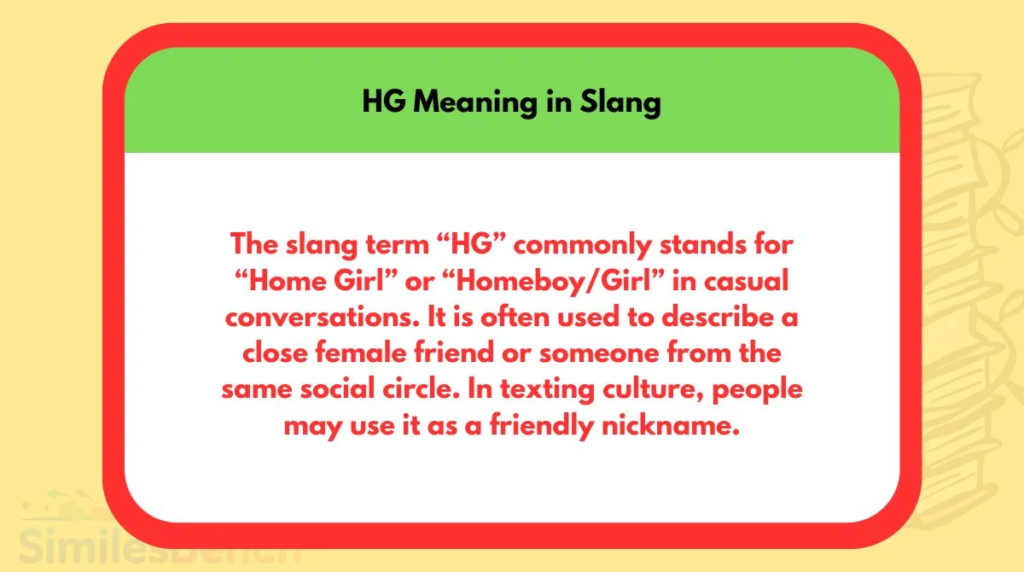
Occasionally HG shifts to “home girl” in texts — a term for a close female friend, rooted in AAVE and hip-hop culture. If someone texts “she’s been my HG since 6th grade,” they’re using it that way. Context makes the difference clear.
Slang like “DP” can carry multiple meanings the same way — always check what’s being discussed before settling on one definition.
| Phrase | Meaning | Common Context |
|---|---|---|
| “My HG moisturizer” | Best moisturizer you’ve ever used | Skincare TikTok, beauty reviews |
| “That’s my HG fr” | Genuine top-tier endorsement | iMessage, group chats, DMs |
| “She’s my HG” | Close female best friend (homegirl) | AAVE, hip-hop influenced contexts |
What Does HG Mean on TikTok?
On TikTok, HG almost always means “holy grail” — and it shows up everywhere: captions, voiceovers, comment sections, and on-screen text.
It’s most dominant in beauty, skincare, and wellness content. Creators drop it into captions like “HG serum review” or “rating my HG products.” Viewers reply with their own HG picks in the comments, which creates high engagement and repeat traffic.
The TikTok meaning aligns closely with the texting meaning — both signal a deeply trusted favorite. The difference is scale. On TikTok, calling something HG is a recommendation signal that can move real purchasing decisions.
US TikTok uses HG slightly more than UK TikTok, where the term has spread but sits alongside British alternatives. Both audiences understand it clearly in beauty and skincare contexts.
HG in Real Conversations: 5 Examples
Example 1 — Skincare recommendation
Marcus: yo what cleanser are you using rn
Tyler: the cerave one, it’s my hg honestly
Marcus: i’ve heard that a hundred times, maybe i gotta try it
HG here signals a well-tested endorsement — not hype, but real daily-driver approval.
Example 2 — Group chat chaos
Ashley: ok everyone drop your hg snack rn
Cody: flamin hot cheetos no debate
Jess: that’s not an hg that’s an addiction cody
HG used playfully in a casual group context — the word flexes beyond beauty easily.
Example 3 — Sarcastic use
Tyler: bro you wear the same shoes every single day
Marcus: they’re my hg okay, i’m not switching
Tyler: you’ve had those for four years 💀
Ironic tone — HG as a mock-serious defense of something worn out but beloved.
Example 4 — Sincere personal moment
Jess: my therapist recommended journaling and i was skeptical
Ashley: wait did it actually help?
Jess: it’s my hg now. genuinely changed everything for me
HG used sincerely outside of products — expressing deep personal value.
Example 5 — Gaming context
Cody: what’s your hg weapon in this game
Tyler: the scout rifle every time, nothing else hits the same
Cody: valid, that one carried me through the whole campaign
HG slips naturally into gaming — the word works anywhere a “best of” conversation happens.
HG vs. Similar Slang
| Word | Core Meaning | Tone | Best Used When |
|---|---|---|---|
| HG | Absolute personal best — tested and trusted | Enthusiastic, loyal, personal | Recommending something after long-term use |
| GOAT | Greatest of all time — cultural or performance-based | Celebratory, widely applicable | Praising a person, artist, or legend |
| S-tier | Top of a ranked scale | Analytical, gaming-influenced | Rating things in lists or comparisons |
| Slaps | Something is really good right now | Casual, energy-based | Reacting to music, food, or vibes in the moment |
The biggest confusion is between HG and GOAT. Both signal the best — but GOAT is about greatness recognized by others, while HG is about personal, private loyalty. You’d call Beyoncé the GOAT. You’d call your $15 serum your HG. One is cultural consensus; the other is personal conviction.
The Emotional Vibe Behind “HG”
HG fills a very specific gap in online language: the space between “this is good” and “this changed my life.”
Most recommendation language is throwaway. People say “obsessed” about things they’ll forget in a week. “Love” gets overused until it means nothing. HG resists that inflation. Calling something your HG implies you’ve earned the right to say so — through time, comparison, and experience.
That’s why the word spread. In a culture drowning in sponsored content and five-star reviews, HG signals authenticity. It says: I’m not being paid to say this. I’ve just genuinely not found better.
It also says something about the person using it. HG users tend to be the researchers — the ones who read every ingredient list, test every option, and want others to skip the trial-and-error phase. Sharing your HG is an act of practical generosity.
For the thing being called HG, the status is meaningful. It’s earned, not assigned.
Slang like “GOAT” carries cultural weight, but HG carries personal weight — and in a world of curated feeds and performative taste, personal feels more real.
Is “HG” Offensive?
No — HG is not offensive in any context.
It’s not a slur. It carries no harmful connotations toward any group. It’s safe to use in both the US and UK without causing offense.
The only version that warrants care is the “home girl” meaning, which is rooted in AAVE and hip-hop culture. If you’re not from that cultural background, using HG to mean “home girl” could come across as appropriative — especially in writing. In casual speech and among close friends, context usually clears it up. Stick to “holy grail” if you’re ever unsure which meaning fits.
In professional or academic writing, skip HG entirely. Write “the definitive recommendation,” “the top-performing option,” or “the most trusted choice” instead.
📌 Quick note for parents and teachers: HG most commonly stands for “holy grail” — meaning someone’s absolute favorite product or go-to recommendation. It appears most often in beauty, skincare, and lifestyle content. It is not harmful, offensive, or age-inappropriate. You may also see it meaning “home girl,” which is an affectionate term for a close female friend.
HG Slang — FAQ
Q: What does HG mean on TikTok? A: On TikTok, HG almost always stands for “holy grail” — someone’s absolute favorite and most trusted product, routine, or item. It’s most common in beauty, skincare, and wellness content, but shows up across gaming, food, and lifestyle videos too.
Q: Is HG a bad word? A: No. HG is completely inoffensive in all common uses. It signals enthusiasm and personal trust, not negativity or harm. It’s safe across all audiences and both US and UK contexts.
Q: What’s the difference between HG and GOAT? A: HG is personal — it’s your trusted best based on your own experience. GOAT is cultural — it’s the greatest recognized by a wider audience. You’d call your favorite moisturizer your HG. You’d call Serena Williams the GOAT. Both mean “the best,” but the source of that claim is very different.
Q: Do Americans and British people use HG the same way? A: Mostly yes. Both communities use HG to mean “holy grail” in beauty and lifestyle contexts. American TikTok adopted it slightly earlier and uses it more frequently. British users understand it clearly but may reach for it less often in casual speech compared to US counterparts.
Q: Can HG mean something other than “holy grail”? A: Yes — in AAVE and hip-hop influenced contexts, HG can mean “home girl,” a close female friend. In very niche gaming communities it occasionally refers to a coveted item. But in 2026, the dominant meaning across TikTok, Instagram, and texting is “holy grail.” When in doubt, that’s the safe assumption.
The Bottom Line
HG isn’t just slang for “really good.” It’s the language of earned loyalty — the way people online signal that something has genuinely passed the test of time and alternatives.
When you see HG in a comment section or caption, someone isn’t just recommending something. They’re vouching for it. That’s a different kind of approval, and that’s why the word has staying power.
Next time you see “my HG pick,” you’ll know exactly what’s being claimed — and how seriously to take it.
Have you seen HG used in a way that surprised you? Drop it in the comments.
Reviewed for cultural accuracy and native usage. Last updated: 2026.

Maggie Wiersma is a USA-based writer with 2 years of experience covering slang meanings, internet culture, and modern language trends. With a background in communication studies, she creates simple and engaging content that helps readers understand today’s most popular slang terms.