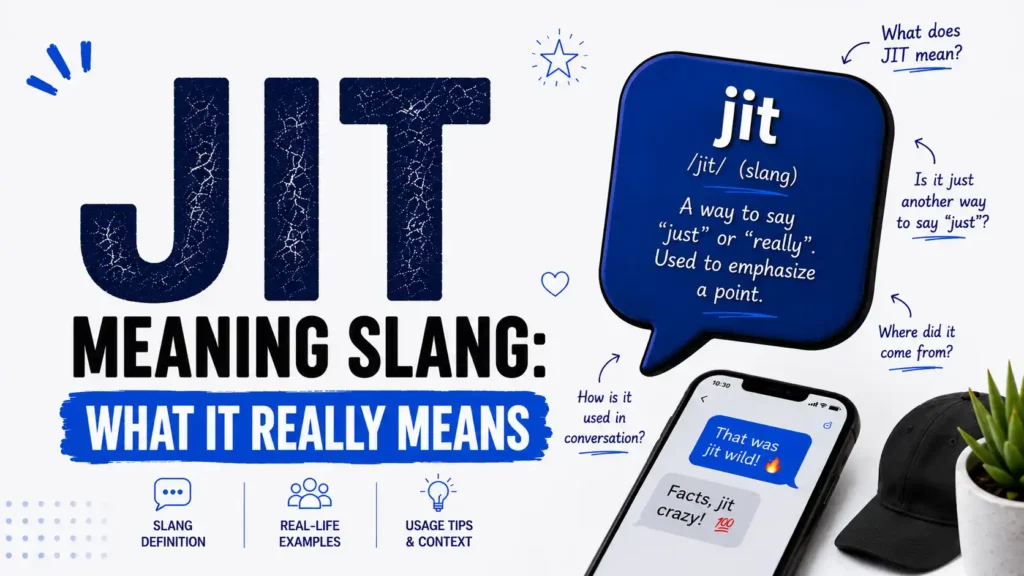
“Jit” means a young, inexperienced, or small person — usually a kid or teenager — and you’ll see it most in Florida-origin slang on TikTok and iMessage when someone is calling out someone younger or less experienced than them.
TL;DR
- Jit = a young kid, a little person, or someone acting immature
- Tone is usually affectionate or dismissive — context tells you which
- Originated in Florida street slang, especially around Jacksonville and Miami
- Used mostly by Gen Z and younger millennials in the American South and online
- Avoid using it to talk down to someone — it can read as condescending fast
What Does Jit Mean in Slang?
Picture this: your older cousin drops you off at a party, looks around, and texts his friend “bro this place is full of jits, I’m leaving.” That’s jit in its natural habitat — used to clock that everyone around is younger, greener, or just not on the same level.
At its core, jit means a young kid or a little person — someone who’s new to something or clearly inexperienced. It’s not always an insult. An older sibling calling their little brother “that jit” is basically the same energy as “that kid.”
Jit = a young, inexperienced, or small person — often a child or teenager.
The tone flips depending on who’s saying it. Said with warmth, it’s almost like calling someone “little man.” Said with shade, it’s a way of dismissing someone as too young to matter in the conversation. Similar to how shawty can mean something sweet or something dismissive depending on delivery, jit works the same way.
The word is tightly tied to Florida — especially its street culture — and it carries real regional flavor. Using it outside the South can sometimes feel forced.
Where Did the Slang “Jit” Come From?
Jit is a Florida original. It grew out of the street slang ecosystem in cities like Jacksonville, Tampa, and Miami — rooted in the Southern Black community and local hip-hop culture that flourished there from the 1990s onward.
The word likely derives from “jitterbug,” an older piece of slang used to describe young, reckless street kids. Over time, “jitterbug” shortened to “jit” and its meaning narrowed to simply mean “a young person” or “a little kid.”
Why Is “Jit” Spelled Different Ways?
You might see it written as jit, jitt, or occasionally jyt. The standard spelling is jit — two letters, no doubling. The variant “jitt” shows up in texts and lyrics where writers emphasize the short, clipped sound. “Jyt” is rare and mostly a stylistic choice — it doesn’t represent a different pronunciation.
Timeline:
- 1990s: Jit circulates in Florida street slang, particularly in Jacksonville’s hip-hop scene, to describe young reckless kids
- 2018–2020: Florida rappers and SoundCloud artists start dropping it in lyrics, pushing it beyond state lines
- 2021–2026: TikTok carries it nationwide — it becomes recognizable internet slang across the U.S.
What Does Jit Mean in Text?

In texts and DMs, jit is casual and quick. It usually pops up when someone is talking about a younger person — either affectionately or dismissively.
In private texts between close friends, jit often sounds warm, almost like saying “lil bro.” In group chats, it can shift and become a subtle diss — implying someone is too young or too inexperienced to be taken seriously.
Emojis that typically travel with it: 😭 (when it’s funny), 💀 (when it’s a roast), or 🤦 (when someone’s acting immature).
Example text exchange:
Tyler: bro did you see what Marcus posted Jess: lmaooo he’s such a jit sometimes Tyler: fr he needs to grow up 💀 Jess: give him a year
That exchange shows jit used as a light roast — not cruel, but definitely not a compliment. It’s a close cousin to lil bro, which carries the same “you’re younger and less experienced” energy in online spaces.
Common Jit Phrases by Region:
| Phrase | Meaning | Where You’ll Hear It |
|---|---|---|
| “That jit wilding” | That kid is acting crazy | Florida, online |
| “Little jit” | Extra emphasis on someone’s youth/immaturity | Southern U.S. |
| “Don’t let the jits see” | Don’t let the younger crowd find out | Florida streets, Discord |
What Does Jit Mean on TikTok?

On TikTok, jit shows up mostly in captions and comment sections — rarely in voiceovers. It’s almost always talking about a younger person doing something surprising, embarrassing, or impressive.
You’ll find it under videos of kids doing stunts, getting caught doing something dumb, or somehow keeping up with older creators. The comment might read “this jit built different” — which is actually a compliment.
TikTok kept the Florida meaning intact. The U.S. TikTok community uses it far more than UK TikTok, where the term hasn’t fully landed. On American TikTok, it carries that regional Southern flavor and still feels somewhat niche — not every user knows it.

Jit in Real Conversations: 5 Examples
Example 1 — Younger sibling roast
Tyler: my lil brother just tried to give ME advice Marcus: 😭 the jit really said that??
The word signals disbelief that someone younger would step out of their lane.
Example 2 — Genuine compliment
Cody: yo that kid scored 40 points last night Ashley: that jit is nasty on the court no cap
Here, jit is used with respect — the speaker is impressed a younger player is that skilled.
Example 3 — Group chat dismissal
Marcus: should we invite Caleb? Tyler: nah he’s a jit, he’ll get us kicked out
Jit signals that Caleb is too immature for the situation — a clear dismissal.
Example 4 — Ironic self-reference
Jess: I was such a jit in 2019 omg Ashley: girl we ALL were 💀
Using it about yourself signals growth and self-awareness — almost nostalgic humor.
Example 5 — TikTok comment energy
Cody: [on a video of a 12-year-old cooking a five-course meal] “this jit eating better than me 😭”
A classic TikTok use — the jit is actually impressive, and the commenter is mock-offended.
Jit vs. Similar Slang
| Word | Core Meaning | Tone | Best Used When |
|---|---|---|---|
| Jit | Young or inexperienced kid | Affectionate or dismissive | Talking about someone younger, usually male |
| Youngin | Young person, often a kid | Neutral to warm | Referring to someone younger with respect or concern |
| Lil bro | Someone acting beneath your level | Condescending or playful | Dismissing someone who overstepped or is acting childish |
| Shorty | Young person or romantic interest | Context-dependent | Varies wildly — can be affectionate or flirtatious |
The closest mix-up is between jit and lil bro. Both dismiss someone as younger or less mature. The difference is that lil bro is almost always a power move — you’re actively putting someone below you. Jit can simply be descriptive, with no malice attached. People confuse them because both can land as condescending, but jit has more neutrality built in.
The Emotional Vibe Behind “Jit”
Jit fills a very specific emotional slot. It’s not quite “kid,” which sounds too formal. It’s not quite “youngin,” which sounds too Southern-grandparent. Jit sits in the middle — casual, regional, and loaded with unspoken hierarchy.
When someone calls another person a jit, they’re asserting experience. They’re positioning themselves as someone older, wiser, or further along. That matters online, where age and clout are constantly being negotiated.
The word spread because it sounds exactly like what it means. Short, clipped, slightly dismissive. It doesn’t drag out like “youngster” or soften like “kiddo.” It lands flat and fast.
What does it say about the person using it? Usually that they feel a level above the person being described. Not necessarily hostile — but aware of the gap.
What does it say about the person being called a jit? They’re new. They’re still figuring it out. And someone older noticed. The slang has that same complicated energy as sus — it can be playful or pointed depending entirely on who’s in the room.
Is “Jit” Offensive?
Jit is not a slur and it’s not offensive to any specific group. In most uses, it’s a mild descriptor — the equivalent of calling someone a kid.
Context changes everything, though. Calling a close friend’s little brother “that jit” might get a laugh. Saying it to dismiss someone in a serious argument reads as condescending. In a professional or academic setting, it’s out of place entirely.
Americans who grew up around Florida slang will recognize it. Most British people won’t — so using it in the UK risks confusion more than offense.
If you’re writing formally, skip it. The standard alternatives are: young person, child, teenager, or minor.
📌 Quick note for parents and teachers: “Jit” is a piece of Florida-origin slang meaning a young or inexperienced kid. It’s not a harmful word — it’s closer to “little dude” than anything offensive. You might see it in texts, TikTok comments, or rap lyrics. It doesn’t carry any explicit content.
Jit Slang — FAQ
Q: What does jit mean on TikTok? A: On TikTok, jit means a young or inexperienced kid — usually someone younger than the speaker. It shows up in comments on videos of younger creators doing something impressive or foolish. The TikTok meaning stays close to the original Florida street slang definition.
Q: Is jit a bad word? A: No, jit is not a bad word. It’s a casual slang term for a young person. It can sound condescending depending on the context, but it’s not a slur or an explicit term. Most uses are either affectionate or lightly dismissive.
Q: What’s the difference between jit and lil bro? A: Jit can simply mean “a young person” without any real shade attached. Lil bro is almost always a power move — you’re actively positioning yourself as superior. Jit can be neutral or warm; lil bro rarely is.
Q: Do Americans and British people use jit the same way? A: No. Jit is firmly American slang with roots in Florida. British slang culture doesn’t use this term — you won’t find it in UK roadman vocabulary or on UK TikTok in any meaningful way. British speakers might understand it from context, but it’s not part of their native slang toolkit.
The Bottom Line
Jit is a piece of genuine regional American slang that traveled north from Florida on the back of hip-hop and TikTok. It means a young, inexperienced kid — and how it lands depends entirely on tone. Used warmly, it’s almost affectionate. Used dismissively, it’s a quiet power move. It’s not offensive, but it’s not universal either. Now that you know what it means, you’ll catch it every time someone drops it in a comment section or group chat.
Have you seen “jit” used in a way that surprised you? Drop it in the comments.
Article reviewed for cultural accuracy. Slang meanings shift — definitions reflect current usage as of 2026.

Maggie Wiersma is a USA-based writer with 2 years of experience covering slang meanings, internet culture, and modern language trends. With a background in communication studies, she creates simple and engaging content that helps readers understand today’s most popular slang terms.