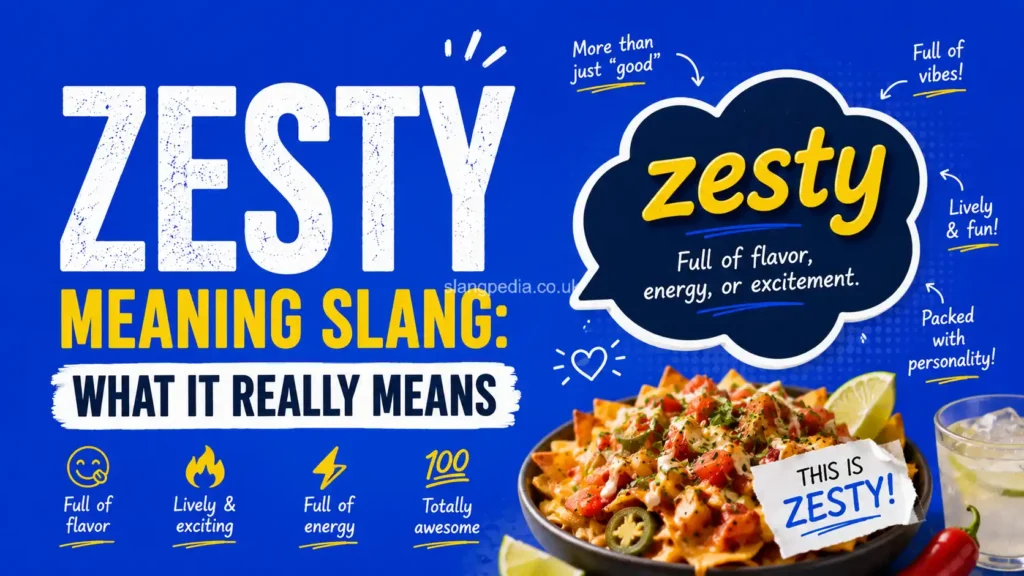
“Zesty” means someone is acting flamboyant, extra, or sexually suggestive — you’ll see it most on TikTok and Twitter/X when someone wants to call out over-the-top or queer-coded behavior without using a slur.
TL;DR
- “Zesty” = flamboyant, extra, or queer-coded behavior — said with a smirk, not always cruelty
- Tone is usually teasing or ironic; it can be affectionate depending on who’s saying it
- Originated in Black American slang online, spread fast through TikTok in 2021–2022
- Mostly used by Gen Z across the US and UK — especially on social media
- Warning: Context matters hard — “zesty” from a friend lands differently than from a stranger
What Does Zesty Mean in Slang?
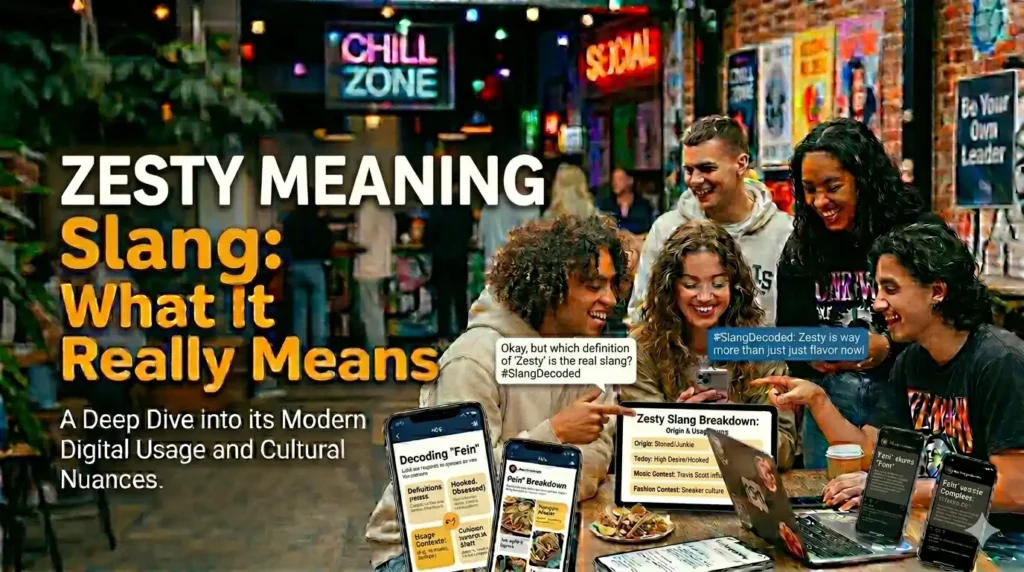
Picture this: your group chat drops a photo of a guy posing in a fitted floral shirt, one hand on his hip, chin tilted up. Someone immediately responds, “bro is ZESTY 💅.” Everyone loses it.
That’s the word working exactly as intended.
In internet slang, “zesty” describes a person — almost always a man — whose behavior, style, or energy reads as flamboyant, dramatic, or queer-coded. It’s a step beyond regular “extra.” It carries a specific flavor of theatrical flair.
zesty = acting flamboyant, over-the-top, or sexually suggestive in a way that reads as queer-coded
The tone is usually playful but loaded. When someone calls you zesty, they’re not just saying you’re enthusiastic. They’re flagging something specific about how you’re presenting yourself. It sits in the same lane as slay — words born from queer culture that Gen Z repurposed for everyday online humor.
The word lands differently in every conversation. Between friends, it’s often just good-natured roasting. In a hostile context, it edges toward a microaggression. That gap is what makes it interesting — and worth understanding.
Where Did the Slang “Zesty” Come From?
“Zesty” isn’t new as a word. Dictionaries have used it to mean lively or sharp-flavored for decades. But its current slang meaning? That’s a different story.
The internet slang version grew out of Black American online communities, particularly on Twitter and early TikTok, around 2020–2021. In those spaces, “zesty” became a coded way to describe someone giving off queer energy — especially a man acting flamboyant or femininely expressive.
By 2022, TikTok had blasted it into mainstream Gen Z vocabulary across the US. UK users picked it up through TikTok’s For You Page, adopting the same meaning with their own spin.
By 2023–2024, it appeared in YouTube comment sections, Discord servers, and iMessage threads globally. At this point, it had traveled far from its origin community.
Why Is “Zesty” Spelled Different Ways?
You’ll occasionally see “zestie” as a variant. This is mostly affectionate — it softens the edge and turns it more into a playful nickname. Some users also write “zesty af” as a compound intensifier. None of these are wrong; they’re just different registers of the same word.
Timeline:
- 2020: Black Twitter uses “zesty” to describe flamboyant male behavior in a coded, teasing way
- 2021–2022: TikTok explodes the word into mainstream Gen Z use in the US
- 2023–present: UK TikTok adopts it; the word appears across Discord, YouTube, and iMessage globally
What Does Zesty Mean in Text?
In texts and DMs, “zesty” usually appears as a reaction. Someone shares a video, a photo, or a story — and “zesty” is the one-word verdict.
In private chats between friends, it’s almost always playful. In group chats, it can get sharper — more performative, more likely to get laughed at. The audience changes the sting level.
Common emojis alongside it: 💅🌈✨😭 — all pointing toward dramatic flair or ironic admiration.
Here’s a real-feeling exchange:
Tyler: bro just watched Jake’s Instagram story
Marcus: what happened
Tyler: he’s doing yoga in a crop top with incense going 😭
Marcus: ZESTY 💅💅
The word works like a verdict. No sentence needed. It also pairs naturally with lms energy — someone asking their followers to rate them, only to get “zesty” back as the whole review.
Common “Zesty” Text Phrases
| Phrase | Meaning | Where It’s Used |
|---|---|---|
| “That’s so zesty” | Calling out dramatic/flamboyant behavior | iMessage, Twitter/X |
| “He’s giving zesty” | Saying someone’s energy reads as queer-coded | TikTok comments, group chats |
| “Zesty behavior” | Describing over-the-top or theatrical actions | Discord, Snapchat |
What Does Zesty Mean on TikTok?
On TikTok, “zesty” lives in the comments. When a male creator poses a certain way, dances dramatically, or wears something expressive — “ZESTY” floods the section within minutes.
It also appears in video captions and voiceovers, usually as a punchline. Creators will deliberately do something theatrical, then caption it “zesty era 💅.”
The TikTok meaning matches the texting meaning almost exactly. The difference is volume. On TikTok, the word becomes a mass reaction — sometimes affectionate, sometimes mocking, often both at once.
It trends harder on US TikTok, where it originated, but UK TikTok has fully adopted it with the same energy.
Zesty in Real Conversations: 5 Examples
Example 1 — Group chat roast
Tyler: just saw Cody’s story, he’s doing a whole photoshoot with rose petals
Jess: BRO IS ZESTY FR 😭
“Zesty” here is pure group-chat energy — the dramatic staging earns the label instantly.
Example 2 — Sincere compliment, sort of
Ashley: ok but his whole vibe at the party was so fun
Marcus: he’s just built zesty, it’s a gift honestly
Here “zesty” flips into something almost admiring — acknowledging flair as a personality asset.
Example 3 — TikTok comment
[Video: guy does an elaborate hand gesture while talking about his skincare routine]
Cody: this man is peak zesty and i respect it 💅
The “I respect it” softens any edge — this is fandom-coded approval.
Example 4 — Sarcastic self-awareness
Tyler: ok I bought lavender candles and a silk pillowcase
Tyler: don’t say it
Jess: ZESTY
The anticipation makes it funnier. The target already knows what’s coming.
Example 5 — Casual, no drama
Marcus: what’s Jake been up to
Ashley: idk he’s been real zesty lately, posting a lot of mirror pics
Marcus: classic
Low-key use — “zesty” as a casual descriptor with zero heat, just observation.
Zesty vs. Similar Slang
| Word | Core Meaning | Tone | Best Used When |
|---|---|---|---|
| Zesty | Flamboyant, queer-coded behavior | Teasing, ironic, sometimes affectionate | Describing dramatic energy in a male specifically |
| Extra | Over-the-top in general | Light teasing, neutral | Anyone being too dramatic about anything |
| Slay | Performing confidently and fabulously | Celebratory, affirming | Complimenting someone’s boldness or appearance |
| Camp | Deliberately theatrical, ironic flair | Knowing, cultural | Describing intentional over-the-top aesthetic |
The word that trips people up most is “extra.” Both describe over-the-top behavior. But “extra” is gender-neutral and just means too much. “Zesty” specifically codes the behavior as queer-adjacent or femininely expressive — and almost always applies to men. That distinction matters. Calling someone “extra” is mild. Calling someone “zesty” carries a specific implication about how they’re presenting.
The Emotional Vibe Behind “Zesty”
Here’s what makes “zesty” interesting: it filled a gap that used to be occupied by slurs.
Online spaces — especially Gen Z ones — needed a way to describe queer-coded male behavior that wasn’t cruel. “Zesty” gave them that. It’s playful enough to be deniable but specific enough that everyone knows exactly what it means.
That ambiguity is the whole point. The speaker gets to tease without fully committing to what they’re saying. The target gets labeled without being openly attacked.
What does it say about the speaker? Usually that they noticed something — and couldn’t resist pointing it out. Sometimes that’s warmth. Sometimes it’s low-key homophobia wearing a friendly mask.
What does it say about the person being described? That their self-expression is visible enough to register. In some circles, getting called zesty is almost a flex. Think of how no cap became a way to claim sincerity — “zesty” similarly became a way to claim a certain kind of unapologetic expressiveness.
The word spread fast because it’s useful, funny-sounding, and perfectly ambiguous. That ambiguity is a feature, not a bug.
Is “Zesty” Offensive?
“Zesty” is not a slur, but it can absolutely function as one depending on who says it and how.
It’s not offensive by default. Between friends who use it affectionately, it’s just teasing. But used against someone with real contempt, it becomes a coded way to mock queer expression — without using a word that would get you called out immediately.
Context is everything. In the US and UK, most Gen Z users understand this dual nature. Using it casually in a friendly group chat is generally fine. Using it to target a stranger online reads as homophobic.
- Who should be careful: Anyone outside the community it came from, especially older users who might not read the tone correctly
- Formal alternative: “flamboyant,” “theatrical,” or “expressive”
📌 Quick note for parents and teachers: “Zesty” is a Gen Z slang term used to describe someone — usually a male — who acts in a flamboyant or dramatically expressive way. It’s not a formal slur, but it carries implied commentary about gender expression and can be used mockingly. It’s common on TikTok and in group chats among teenagers and young adults.
Zesty Slang — FAQ
Q: What does zesty mean on TikTok?
A: On TikTok, “zesty” appears in comments and captions to describe a male creator whose behavior, style, or energy reads as flamboyant or queer-coded. It’s often used as a one-word reaction — sometimes affectionate, sometimes mocking. The meaning on TikTok matches everyday texting use almost exactly.
Q: Is zesty a bad word?
A: It’s not a slur, but context determines whether it’s offensive. Between friends, it’s usually harmless teasing. Directed at a stranger with contempt, it functions as coded homophobia. It sits in a gray zone — playful on the surface, potentially pointed underneath.
Q: What’s the difference between zesty and extra?
A: “Extra” just means someone is being over-the-top or dramatic — it applies to anyone, any gender, any situation. “Zesty” specifically implies queer-coded or femininely expressive behavior and almost always describes men. “Extra” is general; “zesty” is pointed.
Q: Do Americans and British people use zesty the same way?
A: Mostly yes — the meaning traveled intact from US TikTok to UK TikTok. Both audiences use it to describe flamboyant male behavior. The slight difference is delivery: US usage tends to be louder and more exaggerated, while UK usage is often drier and more deadpan. The word itself means the same thing on both sides of the Atlantic.
The Bottom Line
“Zesty” is one of those words that tells you more about the culture around it than it does about the person being described. It’s a product of Gen Z’s need to talk about queerness without always saying so directly.
It can be affectionate. It can be cruel. It can be both in the same sentence. Understanding which one you’re dealing with requires reading the room — the speaker, the target, the platform, the tone.
Next time you see it in a TikTok comment or group chat, you’ll know exactly what’s happening.
Have you seen “zesty” used in a way that surprised you? Drop it in the comments.
Reviewed by native US and UK English speakers. Last updated: 2026.

Maggie Wiersma is a USA-based writer with 2 years of experience covering slang meanings, internet culture, and modern language trends. With a background in communication studies, she creates simple and engaging content that helps readers understand today’s most popular slang terms.