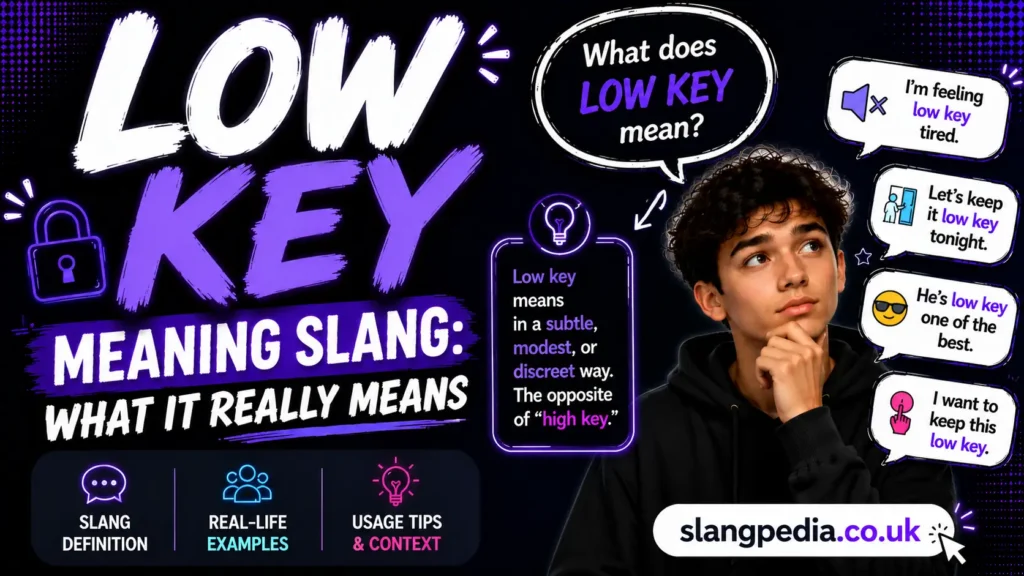
“Low key” means doing or feeling something secretly, mildly, or without making a big deal of it — you’ll see it most on TikTok captions and group chats when someone admits a quiet truth without fully committing to it.
TL;DR
- “Low key” softens a statement so it sounds casual instead of intense.
- The tone is quiet, modest, almost confessional — never loud or dramatic.
- It started in everyday speech, then spread fast through hip-hop and social media.
- Teens and young adults use it most, especially on TikTok and iMessage.
- Warning: overusing it in every sentence makes it sound try-hard fast.
What Does Low Key Mean in Slang?
Your friend texts you mid-movie: “ngl low key obsessed with this soundtrack.” You didn’t ask. They just needed you to know, quietly.
That’s the whole function of low key. It lets someone admit something true without sounding like they’re making a scene.
The core meaning is simple: doing or feeling something to a small or hidden degree. But the nuance is what makes it stick. Saying “I like him” sounds like a confession. Saying “low key I like him” sounds like a thought that slipped out.
Low key = admitting something quietly, like you’re not trying to make it a big deal
The tone signals self-protection. If the statement gets mocked, the speaker can shrug it off — they only said it “low key,” after all.
This softening trick is exactly why BM works the same way in UK slang — both words let someone say something real while keeping a little emotional distance.
Where Did the Slang Low Key Come From?
The exact origin is unclear, but it spread mainly through hip-hop and early 2010s internet culture. The phrase “low-key” existed in standard English for decades, meaning subdued or modest. Rap lyrics and AAVE speech patterns repurposed it as a tone-softener, not just an adjective.
By the mid-2010s, Black Twitter and Vine had turned “low key” into a verbal habit — a way to admit something while keeping your cool intact.
Why Is Low Key Spelled Different Ways?
You’ll see “low key,” “lowkey,” and “low-key” used interchangeably online. The one-word “lowkey” is the internet-native spelling, common in captions and texts.
The hyphenated “low-key” is the original, dictionary-correct adjective form. “Low key” with a space is the loosest, most casual version, often used in quick typing.
Timeline:
- 2013–2014: “Low key” spreads through hip-hop lyrics and AAVE-rooted online speech.
- 2015–2017: Vine, Twitter, and early meme culture push “lowkey” into mainstream teen slang.
- 2020–2026: TikTok and texting normalize it as an everyday filler word for soft confessions.
What Does Low Key Mean in Text?
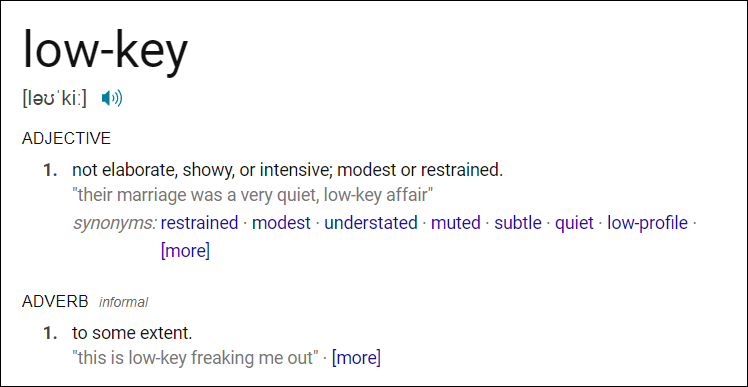
In texts and DMs, “low key” works as a confession softener. It shows up before admitting a feeling, opinion, or guilty pleasure.
In a private chat, it can feel intimate — like sharing a secret. In a group chat, it often turns into a joke or a shared “same” moment.
Common emoji pairings include 👀, 😭, and 💀, depending on whether the tone is shy, dramatic, or self-deprecating.
| Phrase | Meaning |
|---|---|
| Low key fire | Secretly really good or attractive |
| Low key shady | Quietly rude or suspicious behavior |
| Low key the move | Actually a smart or correct choice |
Text exchange:
Tyler: low key thinking about pizza rn Jess: it’s 9am 💀 Tyler: exactly. low key the best time Jess: ok valid
This kind of quiet honesty connects to crack — another word that depends entirely on tone to land right.
What Does Low Key Mean on TikTok?
On TikTok, “low key” shows up constantly in captions, comments, and voiceovers. It softens bold opinions so they read as relatable instead of preachy.
It appears most on confessional content — outfit checks, relationship takes, food reviews, and “unpopular opinion” videos.
The TikTok meaning matches the texting meaning closely. The main difference is volume: TikTok comments often stack multiple “low keys” for comedic emphasis.
It’s popular on both US and UK TikTok, though US creators use it slightly more in spoken voiceovers.
Low Key in Real Conversations: 5 Examples
Example 1 — Roommate confession
Marcus: low key I ate your leftovers
That’s not even an apology, that’s a confession with confidence.
Example 2 — Sarcastic group chat
Ashley: low key you’re the drama 💀
This flips the phrase into a playful accusation, not a real secret.
Example 3 — Genuine compliment
Cody: low key you did amazing today
Here it softens sincerity so the compliment doesn’t feel too intense.
Example 4 — Ironic understatement
Jess: low key I might fail this exam
She’s clearly stressed, but downplaying it on purpose.
Example 5 — Casual group chat hype
Tyler: low key this song goes hard
It signals genuine enthusiasm without sounding too eager.
Low Key vs. Similar Slang
| Word | Core Meaning | Tone | Best Used When |
|---|---|---|---|
| Low key | Mild, secret, or downplayed feeling | Quiet, modest | Admitting something casually |
| High key | Obvious, intense, fully committed feeling | Loud, dramatic | Emphasizing something strongly |
| Kind of | Mild uncertainty or partial truth | Neutral, hedging | Softening a claim politely |
| Deadass | Serious, no exaggeration | Blunt, sincere | Confirming something is true |
The closest lookalike is “high key,” and people mix them up constantly. “Low key” downplays a feeling, while “high key” announces it loudly — they’re opposites, not synonyms.
The Emotional Vibe Behind Low Key
People need a way to say true things without sounding too exposed. “Low key” is emotional armor disguised as casual speech.
It spread fast because it solves a real problem: how do you admit something real in a culture obsessed with appearing chill? The phrase lets you have it both ways.
When someone says “low key,” they’re signaling self-awareness and a fear of seeming too intense. About the person being described, it usually means the feeling is real but slightly embarrassing.
This is the same emotional function behind tea — slang that lets people share something personal while keeping a protective layer of irony intact.
Is Low Key Offensive?
No, “low key” is not offensive. It is not a slur and doesn’t target any specific group.
Context rarely changes that — it’s almost always neutral, casual speech. It’s safe to use in both the USA and UK without causing offense.
The only people who should be cautious are those writing formal English, like essays or business emails. The formal alternative is “somewhat,” “secretly,” or “to a small extent.”
📌 Quick note for parents and teachers: “Low key” simply means doing something quietly or mildly. It’s not harmful or inappropriate language. You’ll see it in casual texting, TikTok captions, and everyday teen conversation.
Low Key Slang — FAQ
Q: What does low key mean on TikTok? A: It softens an opinion or confession so it feels casual instead of dramatic. You’ll see it most in captions, voiceovers, and comment sections on relatable content.
Q: Is low key a bad word? A: No. It’s completely neutral slang with no offensive history or target. It’s safe for casual use in any setting, formal writing aside.
Q: What’s the difference between low key and high key? A: “Low key” downplays a feeling, while “high key” announces it boldly. They’re opposites used in similar sentence structures, which is why people confuse them.
Q: Do Americans and British people use low key the same way? A: Mostly yes, though it’s slightly more common in American texting and voiceovers. British TikTok and group chats have adopted it just as widely in recent years.
Q: Why do people spell it three different ways? A: “Lowkey” is the casual internet spelling, “low-key” is the original dictionary form, and “low key” is the loosest typing version. All three mean the same thing in slang use.
The Bottom Line
“Low key” gives people a low-stakes way to say real things. It softens confessions, opinions, and compliments so they feel casual instead of heavy.
Once you notice it, you’ll see it everywhere — texts, captions, comment sections. It’s less about hiding the truth and more about easing into it.
Have you seen low key used in a way that surprised you? Drop it in the comments.
This article is reviewed for accuracy and updated regularly to reflect how language actually moves through TikTok, texting, and everyday conversation in the US and UK.

Maggie Wiersma is a USA-based writer with 2 years of experience covering slang meanings, internet culture, and modern language trends. With a background in communication studies, she creates simple and engaging content that helps readers understand today’s most popular slang terms.