
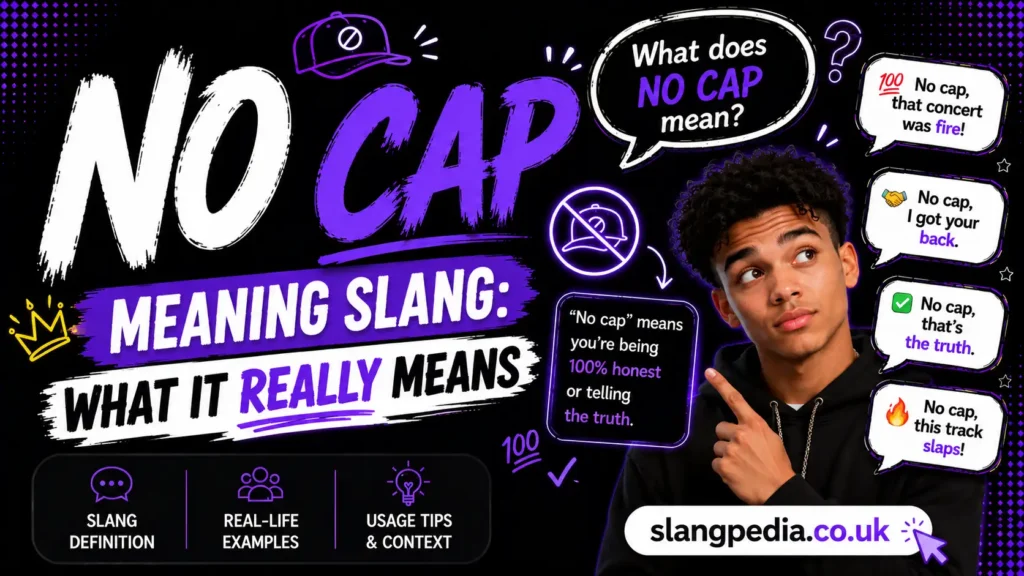
“No cap” means you’re telling the truth — you’ll see it most in TikTok comments and Discord chats when someone wants to emphasize they’re not lying.
TL;DR
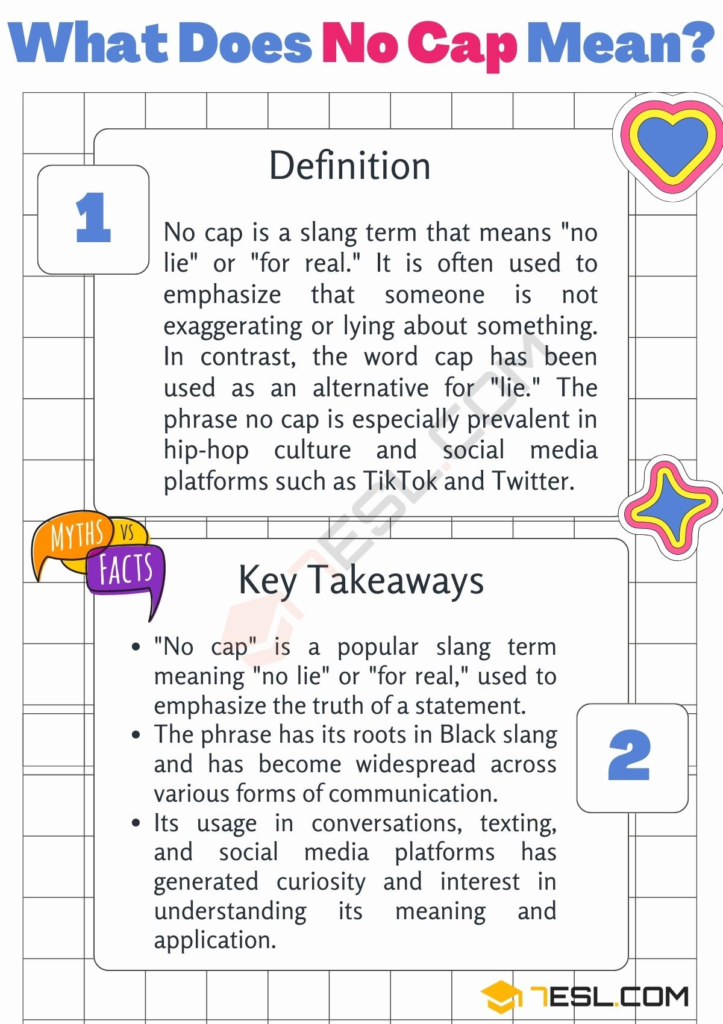
- Definition: “No cap” = “I’m not lying” or “that’s the real truth.”
- Tone: Casual, emphatic, sometimes ironic or sarcastic depending on context.
- Origin: African American Vernacular English (AAVE), popularized through rap and hip-hop in the 2010s.
- Who uses it: Gen Z and Gen Alpha across TikTok, Instagram, and gaming spaces.
- Warning: It’s not offensive, but using it to mock AAVE or Black culture reads as appropriation.
What Does “No Cap” Mean in Slang?
You’re scrolling through TikTok when a friend sends you a clip of someone doing something wild. The caption reads: “yo this actually happened no cap.” You know instantly it means they’re vouching for the authenticity — no exaggeration, no joke, this is real.
“No cap” is slang for “I’m telling the truth.” The word “cap” means to lie or exaggerate. So “no cap” flips it — it’s an emphatic way to say you’re being genuine. The tone matters though. Sometimes it’s sincere. Sometimes it’s ironic (“I totally didn’t eat your fries, no cap” — everyone knows you did).
No cap = I’m not lying; that’s the honest truth.
The phrase works best when you want to add weight to a claim. It signals confidence in what you just said. You’ll hear it used interchangeably with “fr fr” (for real for real) or “swear to god,” but “no cap” feels slightly more casual and Gen Z specific.
Where Did the Slang “No Cap” Come From?
“Cap” originated in African American Vernacular English (AAVE), where it meant lying or exaggerating for years before it went mainstream online. The phrase “no cap” didn’t explode until the mid-2010s, particularly through hip-hop lyrics and SoundCloud rappers.
By 2017–2018, “no cap” was everywhere in Black Twitter, rap culture, and TikTok. It spread fastest among Gen Z because it filled a linguistic gap — existing phrases like “for real?” felt older, and “no cap” sounded more authentic and direct. Non-Black Gen Z picked it up quickly, which is when it became an internet-wide phenomenon by 2020–2021.
Today, “no cap” is mainstream. You’ll see it in brand social media accounts, music streaming playlists, and YouTube comments. The meaning hasn’t shifted, but the context has broadened from a cultural marker to just everyday internet slang.
Why Is “No Cap” Spelled Different Ways?
You might see “no kap,” “no cap,” or rarely “no chap” online. “No kap” is purely stylistic — some users replace the “c” with a “k” for emphasis or aesthetic reasons (it’s common in text-speak and lingo variations). “No cap” remains the standard spelling and the only one that’s actually used and understood universally.
Timeline:
2010–2015: “Cap” and “no cap” circulate in AAVE and hip-hop communities.
2017–2018: “No cap” spreads through SoundCloud rap, Black Twitter, and early TikTok.
2020–2026: Mainstream adoption across all platforms; used by all demographics globally.
What Does No Cap Mean in Text?
In DMs and group chats, “no cap” usually appears at the end of a message to reinforce what you just said. It’s less common at the start, but you’ll see both:
- “I finished the project already no cap”
- “No cap that movie was terrible”
The meaning stays the same in text — you’re emphasizing truth. But in group chats, people often use it more sarcastically. A friend might text “I definitely didn’t skip class today no cap 😭” and everyone knows they did. The laughing emoji flips the tone.
No cap in text = adding certainty to whatever you just claimed.
You’ll rarely see it with formal emojis. Instead, it pairs with laughing faces 😭, smiley faces 😊, or skull emojis 💀 (which means you’re dying laughing). Some people add exclamation marks for extra emphasis: “no cap!”
| Platform | Usage | Example |
|---|---|---|
| iMessage (private) | Sincere emphasis of truth | “I actually like cilantro no cap” |
| Group Chat | Mix of sincere and sarcastic | “I woke up at 6am no cap 💀” |
| Discord (friends server) | Usually sarcastic or joking | “I’m touching grass today no cap” |
What Does “No Cap” Mean on TikTok?
On TikTok, “no cap” lives in captions and comments. You’ll see it when someone posts something shocking or unbelievable — like a wild story video or a transformation. Creators use it in voiceovers too: “I made $10K in a week, no cap.”
The TikTok meaning is identical to texting: you’re vouching for truth. But TikTok is where the phrase gets the most ironic usage. Users will post obviously fake or exaggerated content with “no cap” in the caption, and the humor is the contradiction.
“No cap” appears equally on US and UK TikTok. British users adopted it just as fast as Americans, though some UK creators mix it with British slang (like “no cap, bruv”). It’s universal enough now that geography doesn’t really matter.
No Cap in Real Conversations: 5 Examples
Example 1 — Sincere promise
Marcus: Bro I swear I’m coming to the game tonight.
Jess: You said that last week.
Marcus: No cap this time, I already got my ticket.
Marcus is genuinely emphasizing his promise here. He sounds sincere and wants Jess to believe him.
Example 2 — Ironic disbelief
Tyler: I made my bed this morning no cap.
Ashley: Tyler you haven’t made your bed since 2019.
Tyler is joking. He knows the claim is ridiculous, and “no cap” adds to the humor because everyone knows it’s false.
Example 3 — Casual group agreement
Group chat:
Cody: that new game is insane
Morgan: no cap it’s the best release all year
Kai: fr fr I’ve been playing for 12 hours straight
Morgan and Kai are both emphasizing they genuinely think the game is good. It’s casual agreement among friends.
Example 4 — Sarcastic contradiction
Alex: I definitely paid you back already.
Sam: Alex you owe me $40 still.
Alex: No cap I’m telling you I paid it.
Alex is being sarcastic or dishonest. Sam clearly doesn’t believe them. “No cap” here is humorous because the credibility is obviously broken.
Example 5 — Social media authenticity
Comment on TikTok post:
User: this filter actually made my skin look better no cap
The poster is expressing genuine surprise about something. They’re vouching for the unexpected truth.
No Cap vs. Similar Slang
| Word | Core Meaning | Tone | Best Used When |
|---|---|---|---|
| No cap | I’m not lying | Casual, emphatic | Emphasizing truth in any situation |
| Fr fr (for real for real) | I’m being serious | Slightly more sincere | Showing genuine emotion or commitment |
| On god | I swear to god | Serious, dramatic | Making a strong oath or promise |
| Facts | That’s true | Agreeable, affirming | Agreeing with someone’s statement |
The biggest confusion happens between “no cap” and “fr fr.” Both mean you’re telling the truth, but “fr fr” feels more sincere and serious. If someone says “I love you fr fr,” they’re being genuinely emotional. If they say “I love you no cap,” it’s slightly more casual, sometimes even joking. People often use them together (“fr fr no cap”) to stack emphasis.
The Emotional Vibe Behind “No Cap”
“No cap” exists because lying online is so normalized that people need a way to break through the noise. Everyone exaggerates on social media. Everyone makes things sound cooler or sadder than they are. The internet created a credibility crisis, and “no cap” is the solution.
This phrase spread fast because Gen Z needed to signal authenticity in a space built on performance. It’s a verbal contract between the speaker and listener: “I’m dropping the bit for a second and being real with you.”
When someone uses “no cap,” they’re essentially saying: this claim matters enough that I’m putting my reputation behind it. It’s a soft oath. It also signals a kind of cultural awareness — the user knows how lying works online and is choosing not to.
For the listener, hearing “no cap” creates a moment of trust. The speaker is saying “believe this one.” It’s why the phrase works perfectly for vulnerable moments — “I’m scared no cap” or “I actually miss you no cap” — where authenticity matters.
Is “No Cap” Offensive?
No, “no cap” is not offensive on its own. It’s not a slur. It won’t get you in trouble at work or school.
However, there’s a caveat: the phrase originates from AAVE (African American Vernacular English), and appropriating it ironically or using it to mock Black speech patterns is offensive. Using the phrase respectfully — just as everyday slang — is fine. Doing accents or exaggerating “Black speech” around it is not.
In the USA and UK, “no cap” is safe to use casually. It’s in mainstream dictionaries now. But if you’re using it to seem cool or edgy around Black peers, that reads as inauthentic and disrespectful.
For professional or academic writing, use “I’m telling the truth” or “genuinely” instead. “No cap” has no place in a formal essay or business email.
📌 Quick note for parents and teachers:
“No cap” means a teenager is claiming something is truthful. It’s not harmful slang. You’ll see it everywhere online — TikTok, Discord, group chats, YouTube comments. It’s not a warning sign. It’s just how Gen Z emphasizes honesty.
No Cap Slang — FAQ
Q: What does “no cap” mean on TikTok?
A: It means the creator is telling the truth or vouching for authenticity. It appears in captions and comments, often with exaggerated or shocking claims. On TikTok, it’s frequently used ironically.
Q: Is “no cap” a bad word?
A: No. It’s not offensive, a slur, or inappropriate for most contexts. It’s mainstream slang now, found in dictionaries and brand social media.
Q: What’s the difference between “no cap” and “fr fr”?
A: Both mean you’re telling the truth, but “fr fr” feels more sincere and serious. “No cap” is more casual. People often use them together for emphasis.
Q: Do Americans and British people use “no cap” the same way?
A: Yes, completely. Both countries adopted the phrase identically. Gen Z in the UK uses it just as much as Gen Z in the USA.
Q: Can you use “no cap” sarcastically?
A: Absolutely. Half of “no cap” usage online is ironic — saying it when you’re clearly lying is the joke.
The Bottom Line
“No cap” is Gen Z’s way of cutting through online noise and saying “believe me on this one.” It signals authenticity in a space built on performance and exaggeration. The phrase isn’t going anywhere. It’s already in dictionaries.
Understanding “no cap” means understanding how young people signal trust online. It’s not slang you need to avoid — it’s slang you need to recognize. Next time you see it, you’ll know exactly what the claim is worth.
Have you seen “no cap” used in a way that surprised you? Drop it in the comments.
Maggie Wiersma is a USA-based writer with 2 years of experience covering slang meanings, internet culture, and modern language trends. With a background in communication studies, she creates simple and engaging content that helps readers understand today’s most popular slang terms.
Pingback: Feining Meaning Slang: What It Really Means in 2026 - Slang Pedia
Pingback: Mo Meaning Slang: What It Really Means in 2026 - Slang Pedia