

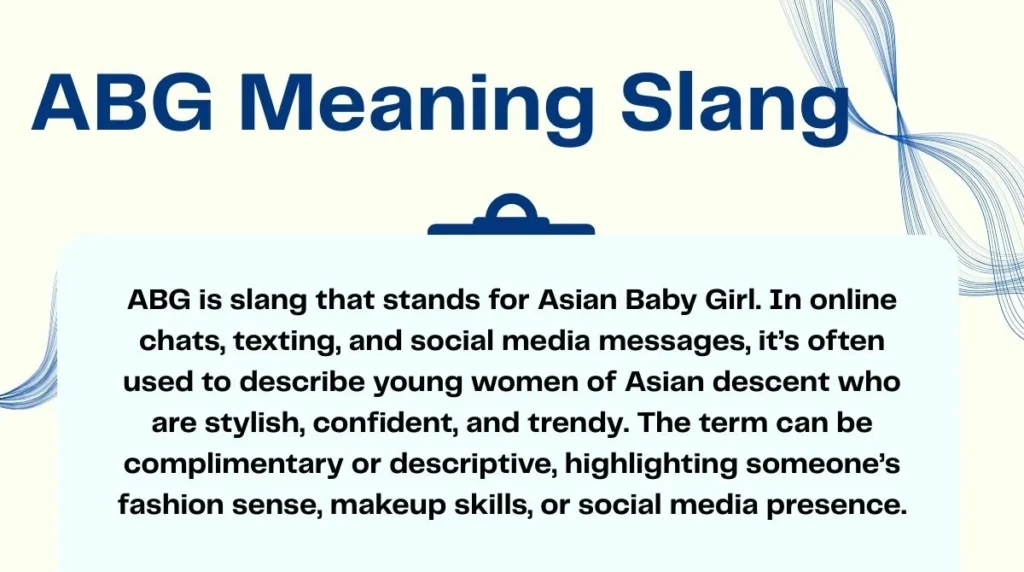
“ABG” means Asian Baby Girl — a specific aesthetic identity tied to a party-heavy, glam lifestyle — you’ll see it most on TikTok and Instagram when someone is describing a girl (or themselves) who fits the hyper-feminine, going-out-every-weekend type.
TL;DR
- ABG stands for Asian Baby Girl — a subculture identity, not just a compliment
- Tone is playful and self-aware; women often use it to reclaim the label with pride
- Originated in the Asian-American party scene in the early 2010s, mainly in California
- Mostly used by Asian-American Gen Z women on TikTok, Instagram, and in group chats
- Warning: Using it to describe someone outside the culture can read as reductive or mocking
What Does ABG Mean in Slang?

Your friend just posted a mirror selfie — lash extensions, acrylic nails, a mini skirt, and a hoop earring set. The comments fill up fast. Someone drops “omg ABG behavior 😭” and everyone loses it.
That’s ABG in action.
ABG = Asian Baby Girl, a term used to describe a specific aesthetic and lifestyle within Asian-American culture.
It goes beyond looks. An ABG is associated with going out frequently, wearing heavy glam makeup, being active on social media, and moving in party or nightlife circles. It’s a whole identity — not just a vibe check.
The nuance matters. When Asian women use it about themselves, it’s often ironic or proud. It signals in-group familiarity. Think of it like baddie — an aesthetic label that’s been reclaimed as a flex.
Used about someone by an outsider, though? The tone can tip into stereotype territory fast.
Where Did the Slang “ABG” Come From?
ABG originated in Asian-American college party scenes, particularly in Southern California, in the early 2010s. It grew out of communities at schools like UCLA, UCI, and USC, where a distinct look and social lifestyle had developed among young Asian-American women.
The term spread first through Facebook event pages, then through Instagram as the aesthetic crystallized around 2015–2016. It wasn’t mainstream until TikTok exploded — by 2020, ABG content was everywhere.
Why Is “ABG” Spelled Different Ways?
You’ll occasionally see “A.B.G.” with periods or “Asian bb girl” in captions, but these are just stylistic variations. The core acronym ABG is the dominant form and the one recognized across platforms.
Some users shorten it further to just baby girl when the Asian context is already understood. That version strips out the cultural specificity, which is worth noting.
Timeline:
- 2010–2013: Term surfaces in Southern California Asian-American college social circles
- 2015–2017: Spreads on Instagram through aesthetic accounts and party pages
- 2019–2026: Hits mainstream TikTok; spawns parody content, “ABG starter pack” videos, and self-identification trends
What Does ABG Mean in Text?
In texts and DMs, ABG functions like a character description shorthand. It can be affectionate, teasing, or self-referential depending on context.
In private chats between Asian-American friends, it often comes with zero negative edge. It’s how you describe your friend who always looks done-up before noon. In group chats, it tends to be used with a laughing or nail emoji.
Emojis that commonly travel with ABG: 💅 💋 🥂 🖤 😭
Example text exchange:
Mia: wait are you really getting lashes done before a Tuesday dinner Ashley: ABG behavior never sleeps bestie 💅 Mia: OMG i can’t with you
In texts, slay often shows up near ABG — it’s a natural pairing when someone’s praising the look.
| Phrase | Meaning | Context |
|---|---|---|
| “Full ABG fit” | Head-to-toe glam aesthetic outfit | Instagram caption or DM compliment |
| “ABG behavior” | Acting like the stereotype — partying, dressing up, etc. | Playful group chat ribbing |
| “ABG era” | Personally leaning into the aesthetic phase | Self-description in captions or bio |
What Does ABG Mean on TikTok?
TikTok is where ABG became a full-blown content genre.
You’ll find it in captions like “rating my ABG fits 🖤,” in comments under glam transformation videos, and in parody POVs mocking or celebrating the aesthetic. The “ABG starter pack” format was a massive trend.
On TikTok, the term is used more broadly than in real life. Non-Asian creators occasionally use it, which has sparked debate in comments about whether the label travels outside its original community.
It’s overwhelmingly a US TikTok phenomenon. UK TikTok uses it far less — the term doesn’t have the same cultural roots there.
ABG in Real Conversations: 5 Examples
Example 1 — Instagram comment
Tyler: yo who is she Marcus: that’s Jess, she’s ABG to the core lmao Tyler: makes sense she looks immaculate rn
ABG here signals a specific type of put-together, going-out aesthetic — said with admiration, not shade.
Example 2 — Self-identifying caption
Ashley: “no I will not be taking the ABG out of me 💅🖤”
Reclaiming the label — the tone is confident and self-aware.
Example 3 — Group chat roast
Cody: why does she have lashes on to go to Target Jess: because she’s an ABG, Cody, keep up 😭
Used to explain someone’s behavior as entirely on-brand — zero judgment from Jess.
Example 4 — Sarcastic Discord post
Marcus: posting my skincare routine at 11pm like a responsible adult Ashley: one ABG phase away from a 47-step routine tbh
Ironic use — predicting someone’s drift toward the aesthetic as inevitable.
Example 5 — Sincere DM
Tyler: I love how you own the ABG thing, it’s actually iconic Mia: honestly it used to bother me now I’m just like yeah, that’s me
The most emotionally real use — ABG as an identity someone has made peace with.
ABG vs. Similar Slang
| Word | Core Meaning | Tone | Best Used When |
|---|---|---|---|
| ABG | Asian Baby Girl — specific glam party aesthetic identity | Playful, cultural, identity-based | Describing someone in the Asian-American glam scene |
| Baddie | Attractive, confident, stylish woman | Broadly positive, hype | Complimenting anyone’s look regardless of background |
| That girl | Wellness-focused, productive, put-together aesthetic | Aspirational, soft | Describing self-improvement lifestyle content |
| It girl | The most stylish, enviable person in a room | Elevated, fashion-forward | Someone setting trends, not following them |
The word people most often confuse with ABG is baddie. Both describe an aesthetically elevated woman, but ABG is culturally specific to Asian-American identity while baddie is a general compliment. Using baddie when you mean ABG loses the cultural layer entirely.
The Emotional Vibe Behind “ABG”
ABG exists because labels fill gaps that adjectives can’t.
Calling someone “well-dressed” doesn’t capture a whole lifestyle. ABG does. It’s shorthand for a specific combination — the aesthetic, the social life, the unapologetic femininity.
For many Asian-American women, it’s also a reclamation. The “model minority” stereotype leaves no room for going out, being glamorous, or taking up space in nightlife. ABG directly resists that.
That’s why the self-identification angle matters. Saying “I’m in my ABG era” isn’t self-deprecation. It’s ownership.
The term also spread fast because it’s specific. Vague words go viral briefly. Precise subculture labels stick — they make people feel seen. Aesthetic labels like this one work because they bundle appearance, behavior, and identity into one compact word.
It says something about the speaker too. Using ABG correctly signals you’re genuinely inside or adjacent to the culture — not just observing from outside.
Is “ABG” Offensive?
ABG is not a slur, but context changes everything.
Within Asian-American communities, it’s widely used without offense — often proudly. The problem starts when people outside the community use it reductively, flattening a real identity into a costume or punchline.
It’s not offensive to use in casual conversation if you’re describing the genuine aesthetic or someone who self-identifies that way. It becomes problematic when it’s used to mock, generalize, or “other” Asian women.
In the USA, the term is fairly well-understood in Gen Z circles. In the UK, it’s less culturally embedded and may need context.
For professional or academic writing, the formal alternative is simply describing the aesthetic directly — “young Asian-American women in party/glam culture” — rather than using the acronym.
📌 Quick note for parents and teachers: ABG stands for “Asian Baby Girl” and refers to a specific aesthetic subculture among young Asian-American women. It is not a harmful or sexual term. It appears mainly on TikTok, Instagram, and in social media captions. It’s rarely used in a bullying context — most uses are neutral, affectionate, or self-referential.
ABG Slang — FAQ
Q: What does ABG mean on TikTok? A: On TikTok, ABG means Asian Baby Girl — a term used in captions, comments, and parody videos to describe a specific glam, party-forward aesthetic. It appears in “starter pack” content, transformation videos, and self-identification posts. The TikTok meaning matches the texting meaning but is used more broadly and playfully.
Q: Is ABG a bad word? A: ABG is not a bad word or a slur. Within Asian-American communities, it’s often used with pride. The term can become offensive if used mockingly by outsiders to stereotype Asian women, but in most everyday contexts it’s neutral to positive.
Q: What’s the difference between ABG and baddie? A: Baddie is a general compliment for any stylish, confident woman regardless of background. ABG is specifically rooted in Asian-American identity and culture. Both describe aesthetic confidence, but ABG carries cultural specificity that baddie does not.
Q: Do Americans and British people use ABG the same way? A: No. ABG is primarily an American term rooted in Asian-American communities, especially on the West Coast. In the UK, it has very little cultural traction because the same subculture doesn’t exist in the same form. British audiences may not recognize the term without context.
The Bottom Line
ABG is more than an acronym. It’s a cultural identity marker that emerged from Asian-American party and glam communities and went fully mainstream through TikTok.
It signals a specific aesthetic — heavy makeup, dressed-up lifestyle, social confidence. But it also signals something deeper: a pushback against the idea that Asian women have to be one type of person.
When you see ABG in a comment or caption, you now know it’s rarely an insult. It’s usually a flex, a laugh, or a badge.
Have you seen ABG used in a way that surprised you? Drop it in the comments.
Last reviewed June 2026. Written with input from native US English speakers familiar with Asian-American digital culture.
Maggie Wiersma is a USA-based writer with 2 years of experience covering slang meanings, internet culture, and modern language trends. With a background in communication studies, she creates simple and engaging content that helps readers understand today’s most popular slang terms.

