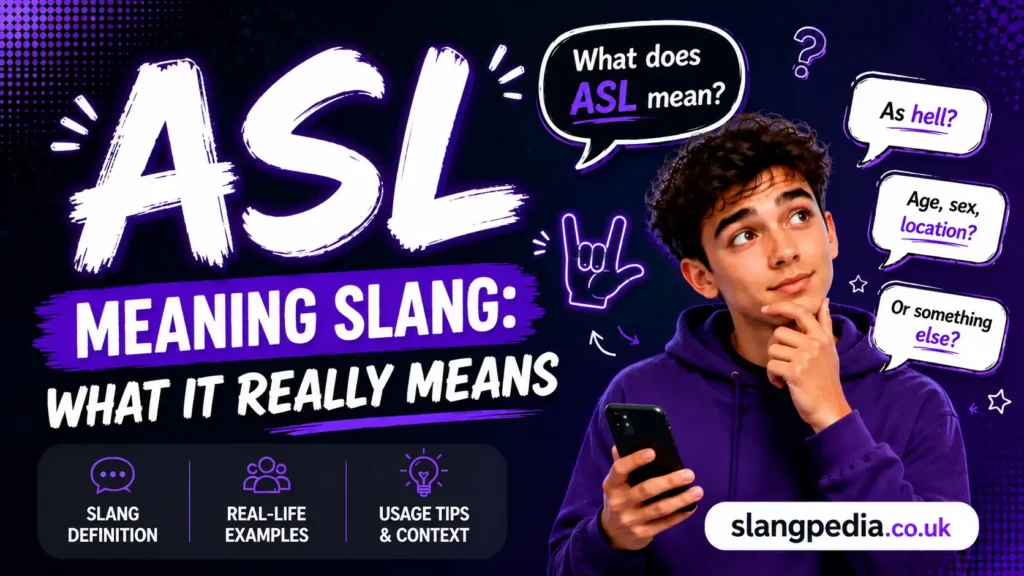
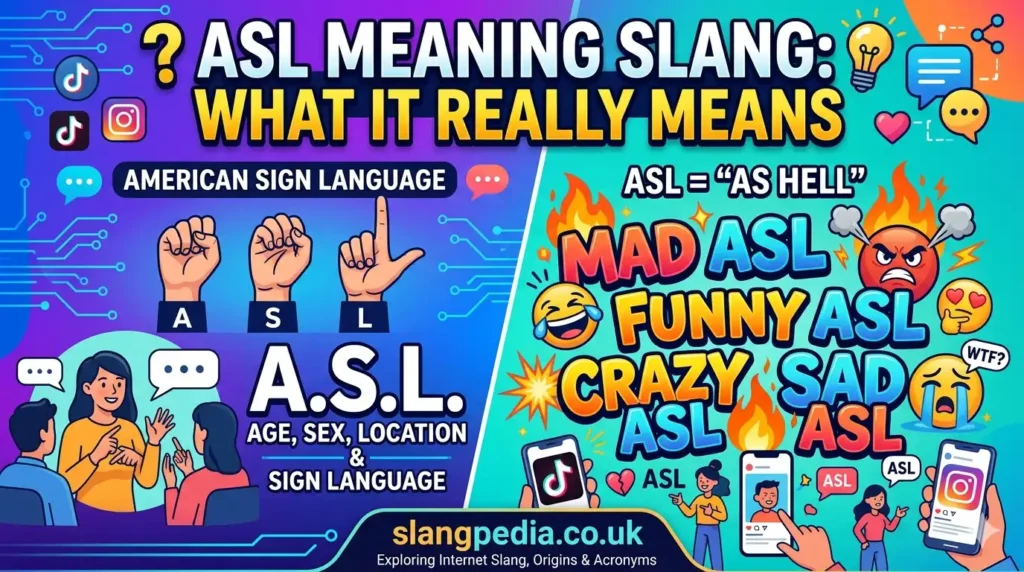
“ASL” means “as hell” — used to intensify any adjective — and you’ll see it most on TikTok and iMessage when someone wants to emphasize how extreme something is, without typing it out in full.
TL;DR
- ASL stands for “as hell” in modern internet slang — it intensifies whatever word comes before it
- Tone: casual, expressive, often hyperbolic — not aggressive
- Origin: emerged from Black Twitter and AAVE around 2018–2019, exploded on TikTok by 2021
- Who uses it: Gen Z, primarily 16–25-year-olds across the US and UK
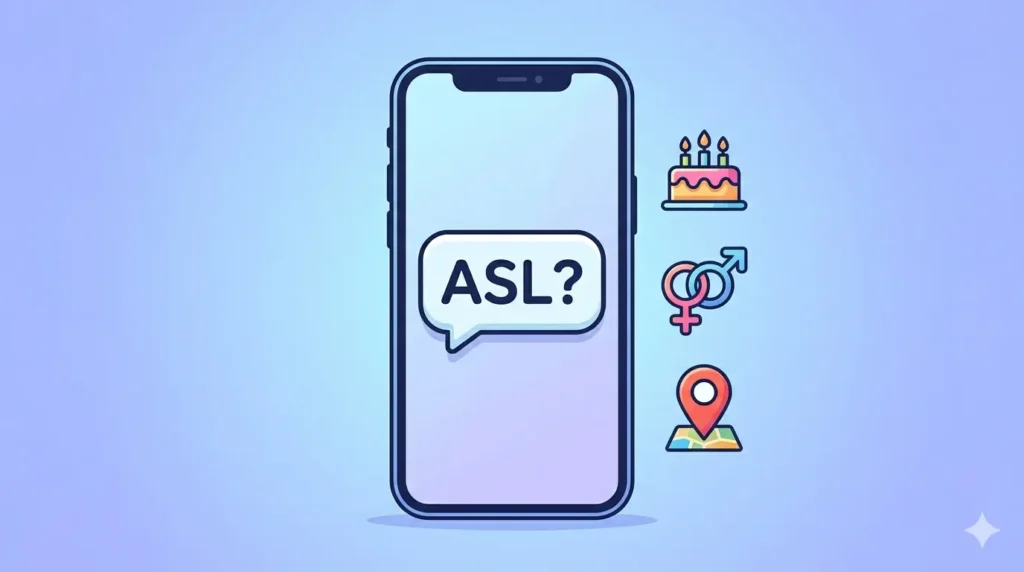
- ⚠️ Usage warning: ASL also still means “age, sex, location” in older chat contexts — don’t confuse them
What Does ASL Mean in Slang?
Your friend sends you a meme at 2am. You respond: “This is funny asl.” No one questions it. Everyone gets it.
That’s ASL working exactly as intended — a pure intensifier bolted onto an adjective to push it past regular emphasis.
The core meaning is simple: ASL = “as hell.” You slap it after an adjective to say something is extremely that thing.
ASL = “as hell” — intensifies any adjective to signal something is extremely that way
But the tone matters. Using “asl” signals you’re fluent in current internet language. It’s not just emphasis — it’s a register marker. It tells the other person you’re texting in casual, plugged-in mode.
The phrase lives comfortably alongside other intensifiers like no cap — both come from the same digital-native, AAVE-influenced speech patterns that dominate Gen Z communication online.
It almost always appears lowercase (“asl” not “ASL”) in text, which separates it visually from the older meaning.
Where Did the Slang “ASL” Come From?
The intensifier “asl” grew out of Black Twitter and AAVE (African American Vernacular English), where “as hell” was already a common spoken intensifier long before the internet.
By 2018–2019, Twitter users were shortening “as hell” to “asl” in tweets and replies. The abbreviation kept the punch without the extra keystrokes.
TikTok’s explosion after 2020 turbocharged the spread. Gen Z creators dropped “tired asl,” “bored asl,” and “funny asl” constantly in captions and comments. By 2022 it was mainstream on both sides of the Atlantic.
Why Is “ASL” Spelled Different Ways?
You’ll sometimes see it written “asf” (“as f***”) — a parallel intensifier with the same grammar but a stronger, more explicit punch. Some users alternate between the two depending on platform rules or audience.
On more restricted platforms (school Discord servers, family group chats), “asl” is preferred because it flies under the radar. On Twitter/X and private DMs, “asf” is just as common.
| Year | Milestone |
|---|---|
| 2018 | “As hell” abbreviations start appearing on Black Twitter as casual intensifiers |
| 2020–2021 | TikTok spreads “asl” into mainstream Gen Z vocabulary via comments and captions |
| 2023–2026 | Fully normalized in iMessage, Discord, and UK social media — used interchangeably with “asf” |
What Does ASL Mean in Text?
In one-on-one texts, “asl” is pure emphasis. It makes a statement feel immediate and emotionally true — not dramatic, just real.
In group chats, it often lands with a comedic edge. Someone says something relatable, and the reply “same asl 💀” collapses the whole group into agreement.
Common emojis paired with it: 💀 😭 😮💨 💅 🙏
Real text exchange:
Tyler: bro I just slept 11 hours and I’m still tired asl
Marcus: same that’s wild asl
Tyler: something is wrong with us fr
Marcus: or we just need a week off 😭
NGL is another term that shows up in the same texting contexts — both function as low-effort, high-authenticity reaction shorthand.
Common ASL Phrases by Context
| Phrase | Meaning | Where You’ll See It |
|---|---|---|
| “tired asl” | Extremely tired | iMessage, Discord, Twitter/X |
| “funny asl 💀” | Incredibly funny | TikTok comments, group chats |
| “late asl” | Very late / tardiness | Instagram DMs, iMessage |
What Does ASL Mean on TikTok?
On TikTok, “asl” lives in comments and captions more than voiceovers — it’s a visual shorthand.
A creator posts a chaotic cooking fail. Top comment: “this is brave asl 😭.” That’s the full sentence. That’s the whole reaction.
It shows up most on relatable content, reaction videos, and “day in my life” style posts. The TikTok meaning matches the texting meaning exactly — no shift in definition, just a shift in volume. It’s used constantly on TikTok.
US TikTok and UK TikTok both use it equally. British creators adopted it at the same pace as American ones — partly because AAVE-origin slang travels fast through shared algorithm feeds.
ASL in Real Conversations: 5 Examples
Example 1 — Late-night group chat
Jess: why are we still awake it’s 3am
Cody: tired asl but can’t sleep
“Asl” here signals real exhaustion with zero drama — it’s just emphasis, not a complaint.
Example 2 — Ironic compliment
Ashley: you actually finished that whole pizza yourself
Tyler: brave asl honestly 💅
Used ironically here — Tyler’s calling himself impressive in a self-aware, mock-proud way.
Example 3 — Sincere reaction
Marcus: she said yes btw
Jess: happy asl for you genuinely
“Asl” doesn’t weaken sincerity — it just makes it feel more natural and less formal.
Example 4 — Sarcastic commentary
Cody: teacher assigned homework due Monday at 8am
Ashley: bold asl move from someone with tenure
Sarcasm lands harder with “asl” — the understatement makes the frustration funnier.
Example 5 — Discord gaming chat
Tyler: how did you miss that shot
Marcus: laggy asl in here bro I can’t
Classic Discord usage — quick, lowercase, no punctuation. Pure Gen Z gaming voice.
ASL vs. Similar Slang
| Word | Core Meaning | Tone | Best Used When |
|---|---|---|---|
| ASL | “as hell” — pure intensifier | Casual, expressive, neutral | Emphasizing any adjective in text or captions |
| ASF | “as f***” — same function, more explicit | Edgier, less filtered | Private chats, Twitter, among close friends |
| AF | “as f***” — older version of asf | Slightly more mainstream, less current | Still widely used but feels a little 2017 |
| HELLA | “very” / “extremely” | Regional (US West Coast), warm | Casual speech and text, especially California |
The main confusion is between asl and af. They mean the same thing grammatically. But “af” peaked around 2015–2018 and now reads slightly dated. “Asl” is the current version — it’s what someone who’s genuinely online right now reaches for.
The Emotional Vibe Behind “ASL”
“ASL” exists because English doesn’t have a good low-effort intensifier.
“Very” sounds stiff. “Really” sounds basic. “Extremely” sounds like a job posting. But “tired asl”? That hits like a text from a real person.
The word spread fast because it sounds exactly like how Gen Z actually speaks out loud. It’s transcribed speech, not written language. That authenticity is the whole point.
When someone uses “asl,” they’re signaling they’re in the same linguistic group as you. It’s a membership card. It says: I’m not writing a formal message — I’m just talking.
It also fills a gap that older intensifiers left. Rain check the formal stuff for another time — in casual digital spaces, you need something faster.
The word also has an implicit softness. “As hell” sounds more intense spoken aloud. Abbreviated to “asl,” it loses the harsh edge and becomes almost affectionate in tone.
Is “ASL” Offensive?
No, “asl” (as hell) is not offensive in any meaningful way.
It’s not a slur. It doesn’t target any group. The word “hell” in this context is so diluted it carries almost no religious weight — especially among younger users.
Context shifts its appropriateness slightly. In a casual DM: completely fine. In a class presentation or work Slack: obviously out of place. But that’s a register issue, not an offense issue.
Both American and British users can use it without risk of causing harm. The formal English alternative is simply: “extremely” or “very.”
📌 Quick note for parents and teachers: “ASL” in this context means “as hell” and is used as an intensifier — the equivalent of saying something is “very” or “extremely” something. It’s not harmful or aggressive slang. It appears most often in text messages, TikTok comments, and Discord chats.
ASL Slang — FAQ
Q: What does asl mean on TikTok?
A: On TikTok, “asl” means “as hell” — it’s used in comments and captions to intensify adjectives. For example, “funny asl 😭” means “extremely funny.” It appears across both US and UK TikTok constantly.
Q: Is asl a bad word?
A: No, “asl” is not a bad word. It shortens “as hell,” which is a mild expression. It’s completely harmless in casual contexts, though it’s informal and not suitable for professional or academic writing.
Q: What’s the difference between asl and af?
A: Both mean the same thing grammatically — they intensify adjectives. “AF” (as f***) was the dominant form around 2015–2018. “Asl” (as hell) is the current version, preferred because it’s less explicit and more current. They’re used interchangeably by many people, but “asl” trends younger and more current.
Q: Do Americans and British people use asl the same way?
A: Yes — almost identically. The term crossed from US Gen Z to UK Gen Z rapidly through TikTok and Instagram. Both groups use it in the same grammatical position and with the same casual, emphatic tone. There’s no meaningful regional difference in how it’s used.
The Bottom Line
“ASL” does one job — it makes you sound like a real person texting another real person. It’s not trying to be poetic. It’s not loaded with cultural baggage. It’s just the cleanest way to say something is extremely whatever it is, without sounding formal or trying too hard.
It comes from AAVE, spread through Black Twitter, and got turbocharged by TikTok. Now it’s everywhere.
Next time you see “tired asl” or “funny asl” in a caption, you’ll know exactly what’s happening — and exactly what energy the person is putting out.
Have you seen “asl” used in a way that surprised you? Drop it in the comments.
Reviewed for cultural accuracy and native usage. Last updated: 2026.

Maggie Wiersma is a USA-based writer with 2 years of experience covering slang meanings, internet culture, and modern language trends. With a background in communication studies, she creates simple and engaging content that helps readers understand today’s most popular slang terms.