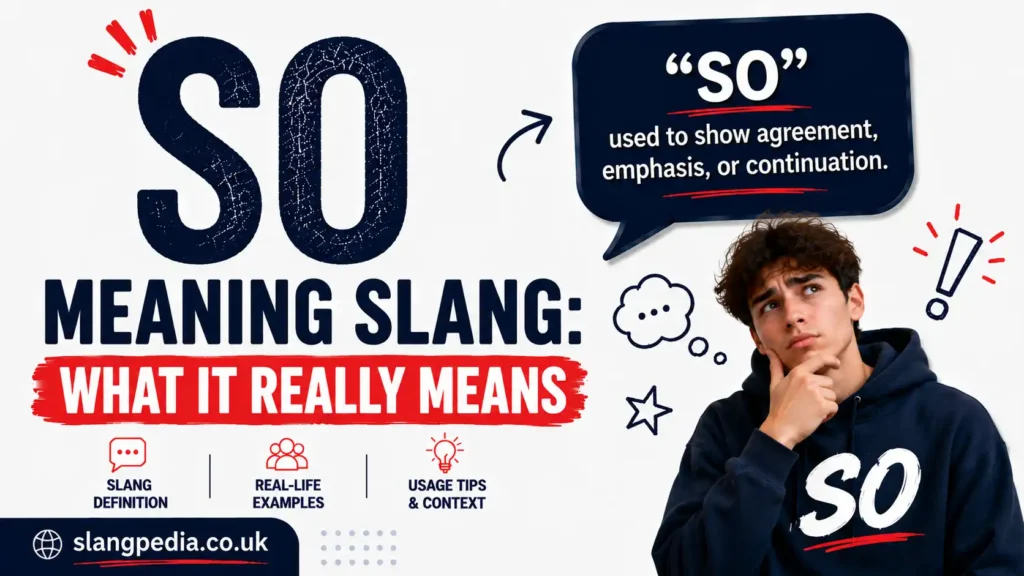
“SO” means “significant other” — short for a girlfriend, boyfriend, or partner — and you’ll see it most on TikTok, Instagram, and group chats when someone is talking about their relationship without naming the person directly.
TL;DR
- SO is short for “significant other,” meaning a romantic partner.
- The tone is casual and slightly private, used to talk about a partner without full details.
- It started as an old dating-profile abbreviation before TikTok relationship content picked it up.
- Mostly used by people aged 16–35 on TikTok, Instagram captions, and texting.
- Warning: context matters — “SO” almost never means “significant other” in coding or finance threads.
What Does SO Mean in Slang?
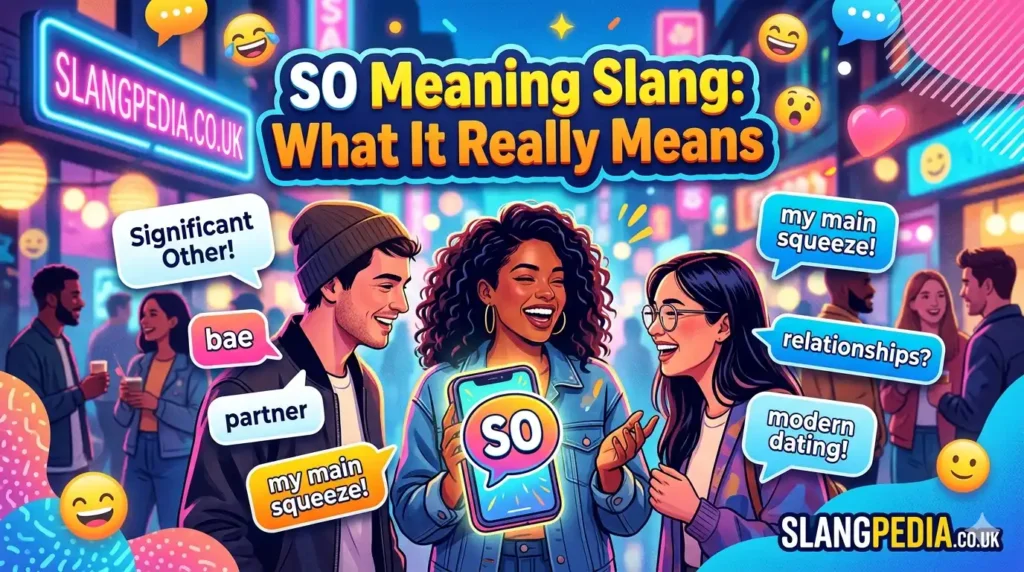
Picture a TikTok caption under a couples’ vlog: “POV: my SO surprised me with breakfast in bed 🥹.” No name. No labels. Just SO. That’s the whole point of the word.
In slang, SO stands for significant other — a boyfriend, girlfriend, partner, or spouse. It’s a stand-in word, used when someone wants to mention their relationship without getting specific about gender, title, or relationship status.
SO = a shorthand way to say “my partner” without naming them.
The nuance matters here. People use SO instead of “boyfriend” or “girlfriend” for a few reasons: it sounds more grown-up, it avoids assuming gender, and it keeps things slightly vague on purpose. It’s the difference between oversharing and just hinting.
This keeps the tone light but a little guarded. You’re letting people in, but only partway. That’s why SO shows up so often in captions paired with cute or low-key dramatic moments — it signals “this is about my relationship” without opening the door to questions like “wait, who’s that?”
If you’ve seen people drop ATP in a caption about venting over their relationship, SO often shows up in the same breath — both are shorthand built for quick, casual storytelling online.
Where Did the Slang “SO” Come From?
The exact origin is unclear, but “significant other” as a phrase dates back to therapy and self-help language from the 1950s. The abbreviation SO picked up steam later, mainly through early 2000s online dating profiles and forums.
By the 2010s, SO was a staple on Tumblr and Reddit relationship threads. It spread mainly through dating apps and advice subreddits, where people needed a neutral, gender-flexible way to refer to partners.
TikTok gave it a second life around 2021–2022. Relationship creators, couple-prank videos, and “day in my life” vlogs leaned on SO as a quick caption tag. It fit perfectly into short-form captions with limited character space.
Why Is “SO” Spelled Different Ways?
You’ll mostly see it capitalized as SO, but lowercase “so” also pops up in lowercase-style captions common on TikTok and Twitter/X. Some people write it as “S.O.” with periods, which is more common in older forum posts and formal writing.
There’s no real meaning difference between the variants — it’s purely a style choice tied to platform or generation.
Timeline:
- 1950s–1990s: “Significant other” starts as therapy and relationship-counseling language.
- 2000s–2010s: Abbreviated to “SO” on dating profiles, forums, and Reddit relationship threads.
- 2020s: TikTok and Instagram turn SO into a everyday caption tag for couples content.
What Does SO Mean in Text?
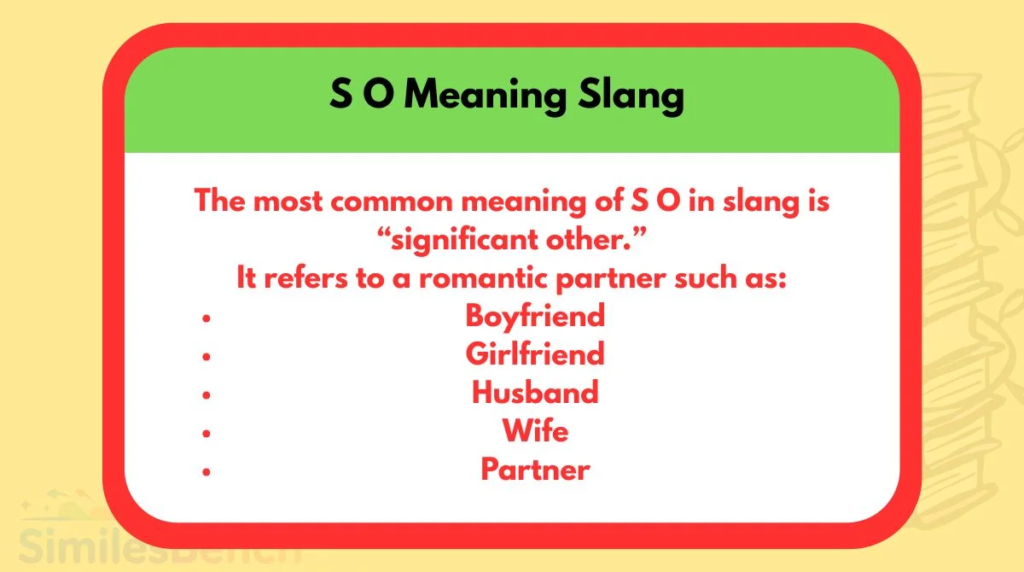
In texts and DMs, SO usually means exactly what it means online: a romantic partner. The meaning barely shifts between private texts and group chats — it stays consistent.
What changes is the tone. In a private text, SO can sound affectionate or matter-of-fact. In a group chat, it often comes with teasing energy, especially if friends are clowning someone for being “whipped” or extra committed.
Common emojis paired with SO: 🥹, 💍, 😩, 🙄 (when annoyed), and 💕.
Text example:
Jess: my SO just canceled plans again 😩 Ashley: again?? what’s going on with him Jess: idk he’s been so DEADASS distant lately Ashley: girl that’s a conversation, not a vibe
| Phrase | Meaning | Local Flavor |
|---|---|---|
| “my SO” | my partner | Used across US and UK group chats |
| “SO drama” | relationship problems | Common in venting threads |
| “future SO” | hoped-for future partner | Popular in manifesting/TikTok captions |
What Does SO Mean on TikTok?
On TikTok, SO shows up mainly in captions and comment sections — rarely in voiceovers, since it’s a written shorthand. You’ll see it under couples’ vlogs, “get ready with me” videos, and relationship advice content.
It usually appears in lines like “when your SO does the cutest thing” or “rating my SO’s cooking.” The meaning doesn’t shift from texting — it’s the same significant-other definition, just public-facing.
SO is used fairly equally on US and UK TikTok, though UK creators sometimes mix it with “partner” or “other half” in the same caption for variety.
SO in Real Conversations: 5 Examples
Example 1 — Couples prank video
Tyler: bro my SO almost killed me over this prank 💀
This signals lighthearted relationship content, the kind built for laughs, not real conflict.
Example 2 — Venting to a friend
Jess: my SO keeps canceling plans last minute
This use is sincere — a genuine complaint shared in confidence with a close friend.
Example 3 — Sarcastic group chat
Marcus: my SO said pineapple belongs on pizza 🚩
This is sarcasm — the word “SO” stays neutral while the joke carries the tone.
Example 4 — Wholesome caption
Ashley: grateful for my SO today, no real reason 🥹
This is a sincere, soft-launch type caption meant to flex a happy relationship subtly.
Example 5 — Group chat roast
Cody: bro check on your SO, she’s posting cryptic stuff
This is casual concern mixed with group-chat teasing energy.
SO vs. Similar Slang
| Word | Core Meaning | Tone | Best Used When |
|---|---|---|---|
| SO | Significant other / partner | Neutral, slightly private | Talking about a partner without naming them |
| Bae | Romantic partner, term of endearment | Affectionate, playful | Expressing love or closeness directly |
| Boo | Romantic partner, slightly older slang | Cute, casual | Light teasing or affectionate captions |
| Wifey/Hubby | Long-term, marriage-coded partner | Committed, joking or serious | Implying long-term seriousness |
The biggest mix-up is SO vs. bae. SO stays neutral and almost clinical, while bae carries warmth and affection built into the word itself. People confuse them because both refer to a partner, but SO is the version you’d use to be vague, and bae is the version you’d use to be sweet.
The Emotional Vibe Behind “SO”
SO exists because people want to talk about their relationships without fully exposing them. It fills the gap between “I’m in a relationship” and “here’s everything about my partner.”
It spread fast online because privacy got harder to keep. Posting about love is normal now, but full names invite screenshots, judgment, and unwanted attention. SO lets people share the feeling without the exposure.
When someone uses SO, it signals they’re protective of the relationship, even while posting about it publicly. It can also signal a slightly more mature or guarded communication style compared to gushing with a partner’s name everywhere.
For the person being described, it can feel like a small, safe spotlight — included, but not fully named. It’s similar in spirit to how people drop GYAT for reactions they don’t want to fully spell out — vague on purpose, but everyone gets it.
Is “SO” Offensive?
No, “SO” is not offensive. It’s not a slur, and it doesn’t target any group.
Context rarely changes that — SO is one of the few slang terms that stays neutral almost everywhere it’s used. It’s safe to use in the USA and UK without causing offense.
The only group that should be cautious is anyone writing in a technical or professional context, since “SO” can also mean “Stack Overflow,” “sold out,” or “significant order” depending on the field. The formal alternative in professional or academic writing is simply “partner” or “significant other,” written in full.
📌 Quick note for parents and teachers: “SO” simply means “significant other” or romantic partner. It carries no harmful or inappropriate meaning. You’ll mostly see it in relationship-related captions, texts, and social media posts among teens and young adults.
SO Slang — FAQ
Q: What does SO mean on TikTok? A: On TikTok, SO means “significant other,” referring to someone’s boyfriend, girlfriend, or partner. It usually shows up in captions for couples’ content, vlogs, or relationship-focused videos.
Q: Is SO a bad word? A: No. SO is not offensive, rude, or inappropriate in any context. It’s a neutral abbreviation for “significant other.”
Q: What’s the difference between SO and bae? A: SO is neutral and slightly vague, often used to keep details private. Bae is affectionate and warm, used to express closeness or love directly.
Q: Do Americans and British people use SO the same way? A: Yes, mostly. Both use SO to mean “partner,” though British speakers sometimes swap in “other half” for the same meaning in casual speech.
Q: Does SO always mean “significant other”? A: Not always — outside of relationship contexts, SO can mean “Stack Overflow,” “sold out,” or just the word “so” used for emphasis. Context determines the meaning.
The Bottom Line
SO works because it lets people share their love life without spelling out every detail. It’s a small word doing a big job — hinting at a relationship while keeping some privacy intact.
Next time you see it in a caption or text, you’ll know exactly what’s being said, and what’s being left out on purpose.
Have you seen SO used in a way that surprised you? Drop it in the comments.
This article is reviewed and updated regularly to reflect current slang usage across US and UK platforms.

Maggie Wiersma is a USA-based writer with 2 years of experience covering slang meanings, internet culture, and modern language trends. With a background in communication studies, she creates simple and engaging content that helps readers understand today’s most popular slang terms.